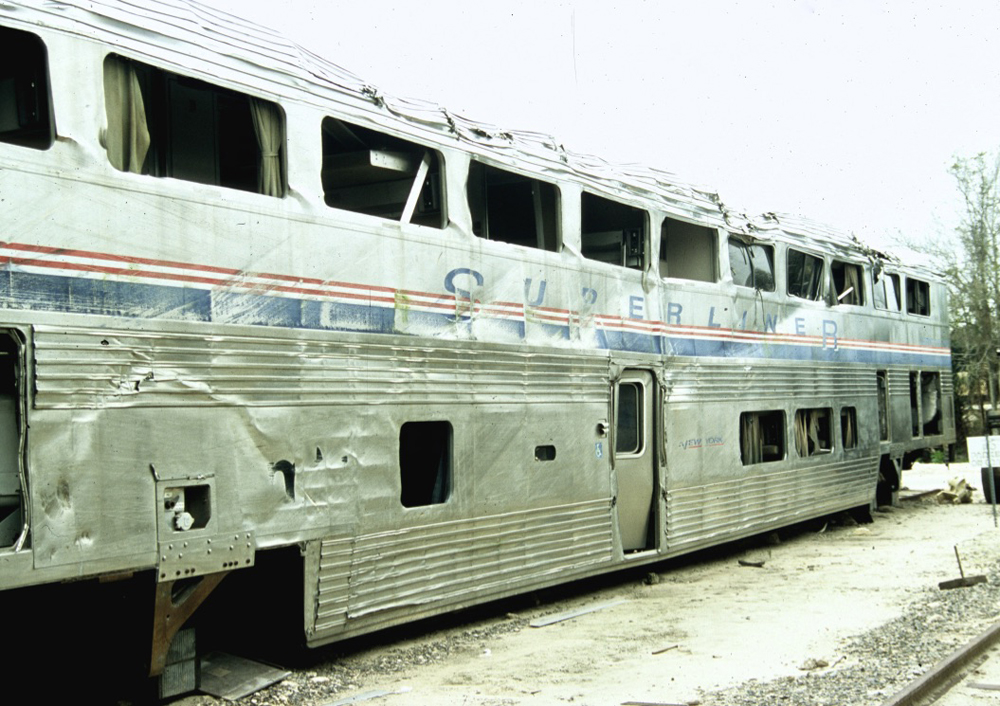
CHICAGO — When bad CSX track caused the northbound Auto Train to derail 14 of 16 Superliners at Crescent City, Fla., on April 18, 2002, Amtrak strategists scrambled but were able to counteract the resulting equipment shortage.
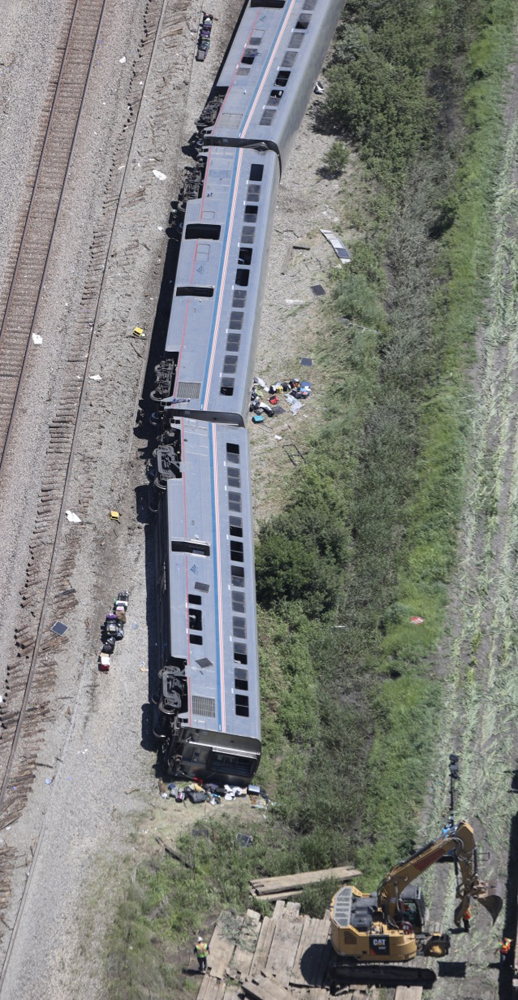
Dealing with a similar shock to the system today — such as the one caused by last week’s Southwest Chief accident at Mendon, Mo. — is much more difficult.
In the wake of the Auto Train accident, planners immediately switched the Cardinal from a Chicago-Washington, Superliner-equipped train back to a Chicago-New York, single-level operation with Viewliner sleepers and Amfleet II coaches and cafes. They were also able to quickly assemble ready-to-roll Superliners held as “protect” equipment at terminals across the country, and at the company’s Beech Grove (Ind.) Heavy Maintenance Facility.
In the current situation, maintenance and personnel cutbacks management initiated in 2020 continue to negatively impact long-distance train capacity. This is despite an infusion of $728.6 million specifically allocated to the national network in early 2021 [see “FRA obligates Rescue Plan funds to Amtrak, states,” Trains News Wire, April 27, 2021].
Amtrak was able to scrounge enough cars and locomotives to send a Southwest Chief west last Thursday [see “Southwest Chief resumes service after Missouri derailment,” News Wire, June 30, 2022]. However, the westbound train departing Chicago on July 2 and eastbound Chief on July 4 did not run “due to crew and equipment availability issues for that route,” Amtrak spokeswoman Beth Toll tells News Wire.
The train scheduled to leave Chicago on Thursday, July 7, would normally use equipment making an overnight turn after arriving on July 6 — the trainset that would have departed Los Angeles on July 4. The July 7 departure is scheduled to run and is fully booked — as of July 4, its three coaches were sold out between Newton, Kan., and Lamar, Colo. The additional time created by not running the trains on the 2nd and 4th will allow the company to get more rolling stock ready.
Shrinking supply of serviceable cars
That overnight trains have been sold out for months, while operating with reduced consists, reflects management’s decision to limit the amount of serviceable equipment available while reducing the workforce necessary to maintain and run it.
In September 2020, Amtrak Executive VP and Chief Human Resource Officer Qiana Spain announced plans to furlough 1,950 union and 100 management employees [see “Amtrak tells employees it will furlough 1,950 …,” News Wire, Sept. 1, 2020]. This was after 284 union and 227 management workers accepted buyouts earlier that year [see “More than 500 accept Amtrak buyouts,” News Wire, July 27, 2020]. Those buyouts averaged $33,000 for a direct cost of $16.83 million, but taking into account revenue lost from inadequately equipped and staffed trains, the cost is much higher.
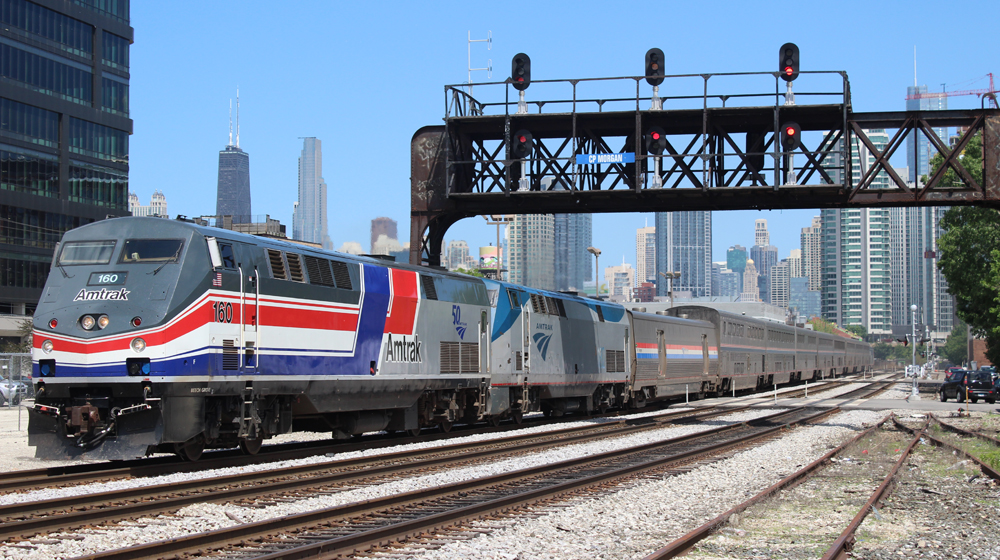
Demand for space on Amtrak’s long-distance network in 2022 has reprised the segment’s strong showing in summer 2021, when Amtrak operated 66 fewer Superliners than comparable months in 2019 and 2020 [see “Coming back,” Trains Magazine, November 2021]. Yet staffing and maintenance shortfalls have reduced this year’s capacity even further.
Earlier this year, News Wire asked why Sightseer Lounges were not being redeployed on the Texas Eagle, and why the City of New Orleans schedule was not adjusted to avoid having its off days fall on Saturday and Sunday, which are traditionally high-demand days for that train. Amtrak responded on May 10, 2022, with this statement:
“We are deploying all available long-distance equipment this summer. With a portion of the Superliner fleet in need of maintenance due to a production fall-off during the pandemic, transition sleepers and Sightseer Lounges are most impacted. Resource constraints across several operating functions have limited the restoration of the remaining reduced service routes, which we hope to restore later this year.”
A former Amtrak employee tells News Wire that Amtrak management “probably let cars sit because it costs about $13,000 to put a car back in service.” Superliners undergo preventive maintenance every 92 days, and face additional service at longer intervals. “If management decides to let a four-year brake inspection date slide [while a car is stored],” the former employee adds, “that would have to be redone before a car is put back in service.” The company’s focus on these maintenance costs, without taking into account lost revenue, has resulted in substantial asset mismanagement.
How many Superliners?
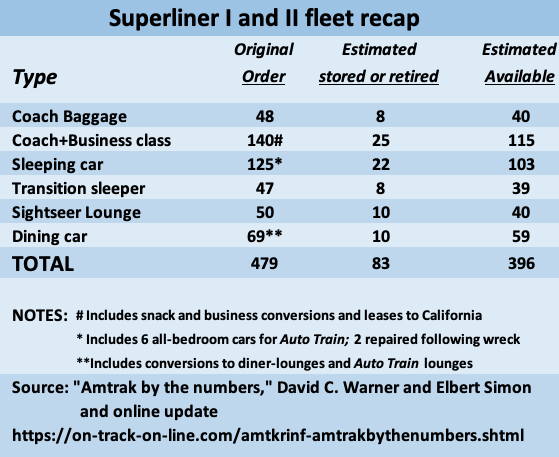
Amtrak has enough of the bilevel cars available to make up for the eight cars that will be sidelined in the foreseeable future as a result of last week’s wreck. But there has been attrition among the Superliner I and II fleets, for which orders were completed in 1981 and 1996, respectively, because of unrepaired cars. The table below estimates the available equipjment, based on online updates to “Amtrak by the Numbers,” by David C. Warner and Elbert Simon, and other News Wire sources.
 Only three Superliners of the 16 that went on the ground in the 2002 Auto Train accident never returned to service after tipping, sliding, and jackknifing. Heavily damaged Superliner II sleeper No. 32100, New York, was relocated to the Sanford, Fla., maintenance facility and cannibalized for parts, but No. 32084, Kansas, was repaired and soldiered on until February 2021, when it was stored.
Equipment is permanently taken out of service for many reasons other than wreck damage, such as fatigued frames. But once sidelined, and with insufficient shop forces to restore to operation cars ranging from almost 30 to more than 40 years of age, the danger is that a cost-focused management will strip a car for parts to keep the remainder of the fleet active. As a result, restoration becomes even more expensive.
Four Superliner coaches that received relatively minimal structural damage in a March 2016 derailment of the Chief at Cimarron, Kan., have not been repaired and were put up for sale in 2019. Since then, two transition sleepers, four standard Superliner sleeping cars, two diners, two Sightseer lounges, and three coaches have been listed as “stored.” The list doesn’t necessarily include all cars damaged in the Sept. 25, 2021, Empire Builder derailment at Joplin, Mont.
Amtrak still has plenty of unspent Bipartisan Infrastructure Law funds it can invest in equipment restoration that is sorely needed. And the company also received an $8 million Federal Railroad Administration grant to expand an apprenticeship pilot program “aimed to create a talent pipeline for new and existing employees,” according to a press release [see “Amtrak receives FRA funding for apprenticeship program,” News Wire, June 9, 2022].
The question now is whether Amtrak management’s missteps have caused irreversible damage to the ability to meet the rural-to-urban travel demand that only its national-network trains are positioned to provide.
Share this article