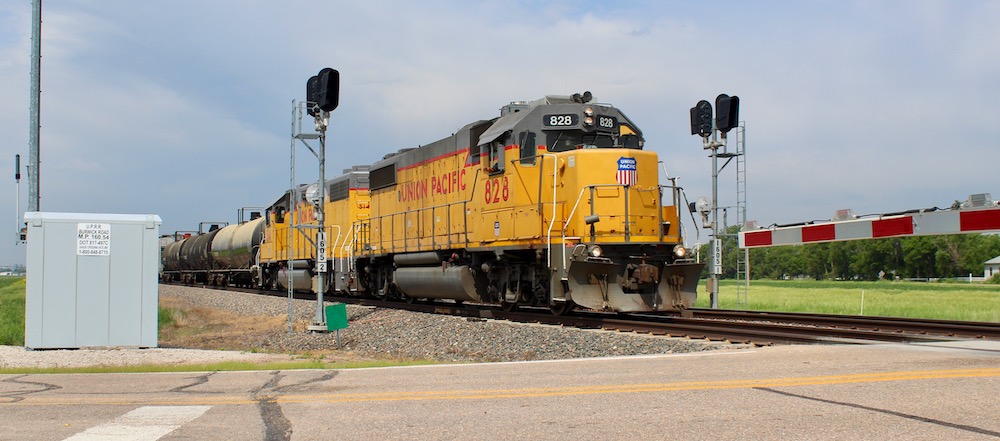
MANALAPAN, Fla. – Union Pacific, which has come under fire for its increased use of embargoes, has not fully shut down service to any customers as it grapples with congestion related to ongoing train crew shortages.
“It really is a tool of last resort for us. As a common carrier, we don’t have other mechanisms to fully suppress volumes coming on to our network,” Jennifer Hamann, UP’s chief financial officer, told an investor conference on Wednesday.
Federal regulators have ordered UP executives to appear at two days of hearings next month regarding the railroad’s increased use of embargoes, which have skyrocketed from 27 in 2017 to more than 1,000 so far this year.
Railroads commonly use embargoes to limit traffic in the aftermath of a derailment, washouts, or severe weather. But UP has become increasingly reliant on embargoes to limit congestion and twice this year has asked customers to reduce the number of cars on the railroad or face embargoes.
As a railroad slows down, and shippers see transit times go up, they typically use more freight cars to ensure their supply chains are not interrupted. But that only exacerbates congestion.

“We are very much working with our customers and many of our customers have employed what I call self help, where they have taken deliberate measures to help pull back on some volumes that are on our network [to] help ease some of the operating inventory,” Hamann says. “But in cases where that hasn’t been able to fully happen, we have put in place embargoes. I think it’s important to note though that an embargo can be done with 100% permits, so you allow permits for the customer to continue to ship against that embargo.”
None of UP’s congestion-related embargoes have completely shut off service to customers, Hamann says. Instead, shippers have been able to request permits that allow them to schedule a certain number of shipments.
“Again, it’s a tool of last resort. It’s not what we want to do. But in terms of trying to regain fluidity on the network and to be able to provide service to all of our customers, in some select locations and areas we have done that,” Hamann says.
Through October, UP accounted for 79% of embargoes issued by the Class I railroads this year, and 98% of them have been due to congestion, according to STB data.
“The number of embargoes has skyrocketed in recent years,” STB Chairman Martin J. Oberman told the RailTrends conference in New York earlier this month. Through Sept. 30 of this year, the Class I railroads have issued a combined total of 1,115 embargoes, he says.
“The vast percentage of these embargoes, over 80%, are the result of what the railroads call congestion — a railroad euphemism for ‘we don’t have enough crews to move our trains and keep our network fluid,’” Oberman says.
UP is working with customers to meter traffic in areas where the railroad is short of crews, particularly on its northern tier from Nebraska to the Pacific Northwest.
The Dec. 13-14 STB hearings will be an opportunity for UP to educate the board about its efforts to limit congestion, Hamann says.
Hamann acknowledged that some of the railroad’s customers who are likely to appear at the STB hearings are upset about the embargoes. “So I’m sure there will be some venting that occurs,” she says.
Congestion has worsened on UP in recent weeks, with average train speed falling and the number of trains held for lack of power rising to a three-month high. And in the weeks before Thanksgiving, the number of unplanned recrews were running at their highest levels in five months.
Due to lower volumes, the Thanksgiving holiday week allowed UP to make “good progress” clearing backlogs, Hamann says. The metrics UP will report to the STB this week show improvements in velocity and the number of cars on the network, she says.
Rick Paterson, an analyst at Loop Capital Markets who closely follows railroad performance metrics, says UP stands to gain the most from the Thanksgiving volume reprieve.
“In our view, UP has strayed into the gray area where embargoes are being used as a volume metering tool in the interests of network health (BNSF employed a similar metering strategy in June), rather than the traditional use as an emergency mechanism to stop the flow of freight into areas impacted by natural disasters,” he wrote in a Nov. 27 note to clients. “That violates the spirit of the railroad’s common carrier obligation, which has irked the STB. However, in theory at least, the situation should eventually self-correct once UP’s network gets back on its feet and there’s no longer desperate times that require desperate measures.”
Hamann spoke at the Credit Suisse 10th Annual Industrials Conference.
Share this article