





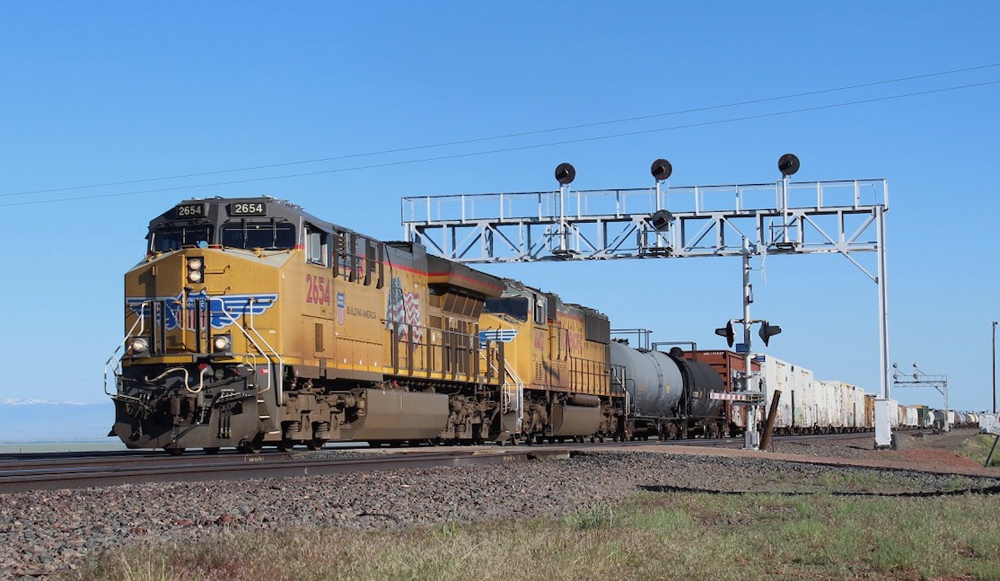
OMAHA, Neb. — Union Pacific once again will meter traffic to limit congestion if certain customers don’t voluntarily reduce the number of private freight cars operating on the railroad.
UP informed shippers last week, Trains News Wire has learned.
“Union Pacific regularly reviews our network to monitor for elevated inventory,” UP spokeswoman Robynn Tysver says. “We are currently experiencing higher than normal rail car inventory, which has resulted in congestion on our network. We reached out to some of our customers and asked them to voluntarily take steps to reduce car inventory on our network.
“It is our hope, that by working proactively together, we can reduce the congestion, speed up operations and deliver a more reliable service product. If we do not see a voluntary decline in their inventory levels, we will notify impacted customers of a temporary embargo,” she says.
UP made a similar move in April, when it also was facing congestion due to the impact of crew shortages. As a railroad slows down, and shippers see transit times go up, they typically use more freight cars to ensure their supply chains are not interrupted. But that only exacerbates congestion.
Surface Transportation Board Chairman Martin J. Oberman today was critical of railroads’ increasing use of embargoes over the past five years, a period when they dramatically cut the number of train and engine employees.
“The number of embargoes has skyrocketed in recent years,” Oberman told the RailTrends conference in New York. “It used to be that railroads implemented embargoes due to unforeseen natural disasters — bridge washouts, forest fires, polar vortexes. But no more. For some Class I [carriers], embargoes now are being used as a routine part of their operating plans.”
In 2017, the seven Class I railroads issued a combined total of 140 embargoes, a figure that jumped to 631 in 2019, Oberman says. Through Sept. 30 of this year, the total stands at 1,115, he says.
“The vast percentage of these embargoes, over 80%, are the result of what the railroads call congestion — a railroad euphemism for ‘we don’t have enough crews to move our trains and keep our network fluid,’ ” Oberman says.
Oberman singled out UP for its use of embargoes, which leads the industry with 886 this year, or 79% of the total. BNSF is second, with 104 embargoes.
In 2017 UP issued just five embargoes, Oberman notes.
“These embargoes are not just metrics reported to the STB,” he says. “Each embargo means the railroad has almost always, with virtually no notice, told the customer it will not serve that customer for a period of days, often a week or more. We’re talking about major U.S. industries: Grain, fertilizer, chemicals, livestock, soda ash, and others. Industries which cannot function without regular and most importantly reliable rail service.”
UP is nearing its goal of hiring 1,400 train and engine employees this year, with two-thirds of the new hires in active service and one-third in training, executives said at an investor conference last week.
But the railroad remains short of crews across its northern tier and is offering hiring bonuses of $10,000 to $25,000 to new conductors at some locations, including Cheyenne and Green River, Wyo.; Salt Lake City and Helper, Utah; Portland, Ore.; and Seattle.
“We still have those pockets where we are constrained,” Eric Gehringer, UP’s executive vice president of operations, said last week.





Wall street has become all powerful in it’s push to make everything as profitable as possible with as little outlay as possible. They appear to be trying to create a new way to do what they did with much US business when corporations moved all manufacturing off shore to eliminate all US based workers and expenses. In this case they want to improve profits by boasting transportation prices but limit what they will haul. Hey as long as management gets a fat bonus who cares.
Sad it has come to this.
Mr Healey and Mr Landey, You want our government to take control of the railroad? I am afraid that our government is to busy trying to convict our past president, and now that the house has a majority they will probably try to impeach sleepy Joe. (BTW I am not a fan of either) I’m afraid that the next two years will be tied up with political name calling and more division. Sorry no time to run a railroad with politics at stake.
Do you really think that government operation will really improve things??? Look at Amtrak or look at the nationalization of railroads during WW1. They didn’t repeat that mistake during WW2. Maybe the answer lies in limiting the power of the hedge funds that are major stakeholders in the major railroad companies.
No doubt, federal takeover of UP is obviously necessary.
Surprise surprise. The other big western road will follow suit in short order…….. they’re back to making all but their intermodal trains notch 0 over 40 which in essence relegates all trains other than intermodal no faster than 40 or slower. It’s all supposed technology and computer modeling that does nothing more than screw up how a railroad should run. Oh and wi tronix the famous Barney boxes that pretty much spy on every move being made in the engine up to and including flushing the toilet(sarcasm about the toilet) is in the process of convincing the railroads that by 2035 they won’t need anyone in the cab because AI will run the whole shebang……….I say go for it, all technology has done in my career is throw an anchor out on real railroading , so if they want the place to come to a complete and total demise in 15 years time by all means go for it. Their genius computer people have done nothing to move freight faster, only impair the fast and efficient movement of that freight because they ask the wrong people and ask the wrong questions to those wrong people that have no institutional knowledge of how a railroad needs to run to be efficient and speedy. Freight railroading could be so much more useful to the transportation system as a whole and dare I say it way more profitable if they’d actually concentrate on the basics and move the damn freight instead of finding ways to park it or kill,it off altogether. In my career all I’ve seen is the more dependent of computer technology they get the less efficient it’s gotten. Computers have their place in railroading most definitely, but their use has to be in tune with keeping the place fluid and all I’ve seen is theyve made mountains out of molehills with every new latest and greatest system upgrade or improvement. To me it’s where they focus on……. And it’s not moving the freight. $$$$$$$$$$$$$$$$$$$$$$$$$$
Politics and Greed are preventing the USA from realizing the full efficiency of the rail network that instead has been shrinking since the 1950s. https://youtu.be/eT9H44ytagw
This action must make Schneider and Swift sleep better!!!
So they are saying “We are making record profits on the business we have. Take your freight to someone else and leave us alone!”
Mr Landey your idea is communism at its best!
And what at worst? Fascism? But honestly, I do think that Union Pacific needs an overhaul of it’s management and current operations. The current management is so greedy.
This corporation needs to be seized by the government as a public nuisance, its management dismissed — and the railroad put up for auction to another set of owners.