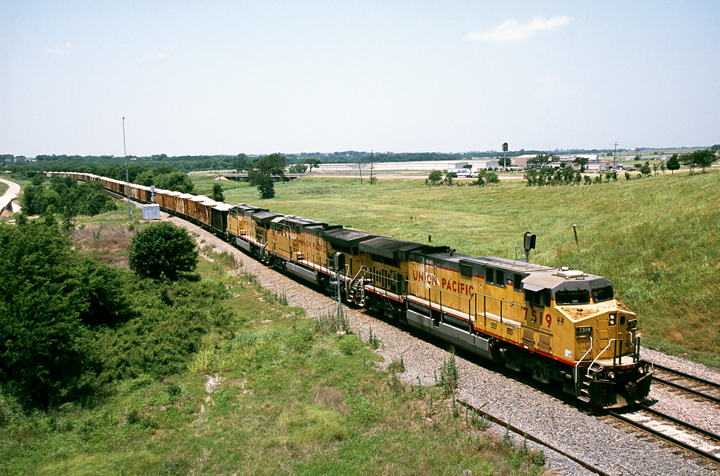
CHICAGO –—Climate change provides an opportunity for railroads, even as more frequent extreme weather events take a toll on railroad operations and infrastructure and require investments in new locomotive technology, executives told a shipper conference last week.
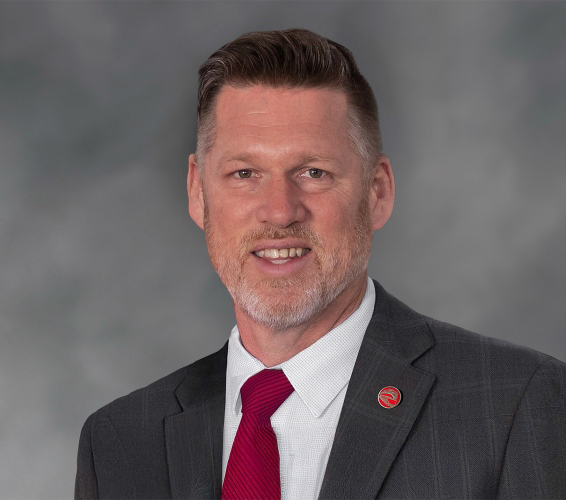
The increased emphasis on sustainability is a tremendous opportunity for rail carriers, BNSF CEO Katie Farmer told the North American Rail Shippers conference. “We’re really starting to see customers incorporate that into their buying decisions … it is no longer a trend but rather a business imperative,” she says.
Major rail shippers are pledging to become carbon neutral over the next two or three decades, so rail officials believe there’s a potential for a shift of some of traffic from truck to rail due to railroads’ far lower carbon footprint. Railroads carry 40% of the ton-miles in the U.S. but produce only 2% of the transportation sector’s greenhouse gas emissions.
“This is the biggest opportunity for the rail industry in the next 20 years,” says Michael Miller, president of Genesee & Wyoming’s operations in North America.
But railroads won’t be able to take advantage of their fuel efficiency edge over trucking unless the industry can improve customer service in five key ways, Miller says.
“We have to be collaborative. We have to be transparent. We have to provide visibility. We have to be resilient. We have to be adaptable,” he says. “If we can’t do those things for our customers, they’re not going to entrust their business to us long term and we’re not going to be able to grow.”
The Class I railroads have all set science-based targets for significant reductions in their greenhouse gas emissions by the end of the decade. “Those would be really tough [to reach] if your carloads grow by 40 or 50%,” Miller says. “But hopefully that’s where we are.”
Surface Transportation Board Chairman Martin J. Oberman says railroads will play an important role in reducing the transportation sector’s greenhouse gas emissions.
Oberman scolded railroads for losing market share to trucks over the past two decades and encouraged the industry to focus on growth. “I hope that the railroads and shippers will work together creatively to figure out how best to move more freight on the railroads and less freight on highways,” he says.
Building a more resilient railroad
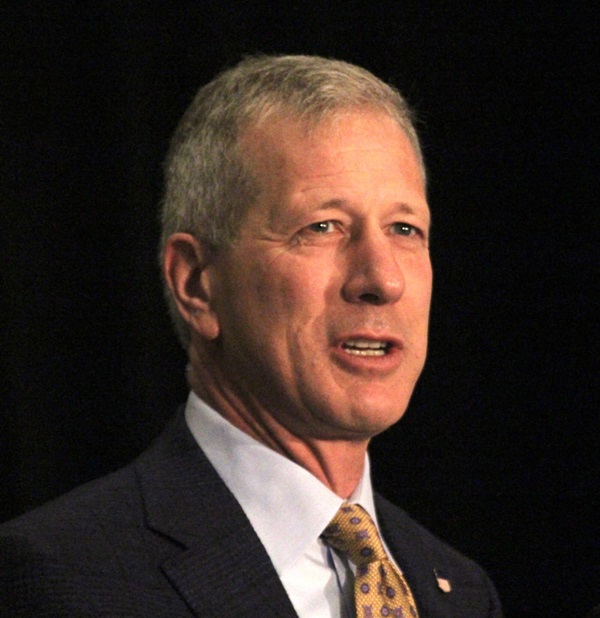
Scientists say climate change makes extreme weather events more frequent, from droughts and wildfires to flash flooding and deep cold snaps.
UP’s Dry Canyon Bridge, on its I-5 Corridor in Northern California, was severely damaged by the Lava Fire in late June and was out of commission for just over a month while crews rebuilt the 1,440-foot span. Fritz visited the site last month after the bridge had been reopened and crews were in what he called “mop-up mode.”
“It’s amazing how that team speaks about the railroad. It’s their child,” Fritz says. “It hurts them personally when they lose it.”
Fritz says he saw the same thing in the Feather River Canyon, where the Dixie Fire put UP’s route out of service despite railroaders’ best efforts to protect the line.
Over the past five years UP has taken several steps to harden the railroad and make it better able to withstand extreme weather, Fritz says. Among them: Raising flood-prone sections of roadbed by three or four feet, enlarging culverts and keeping them clear of debris, conducting hydrologic studies to determine what sections of the railroad may be more at risk in coming years, and improving localized weather forecasting so severe events can be identified sooner.
One area of focus, Fritz says, is trying to better understand flash flooding risk in the desert Southwest, where a heavy thunderstorm miles from UP’s tracks could send a deluge toward the railroad.
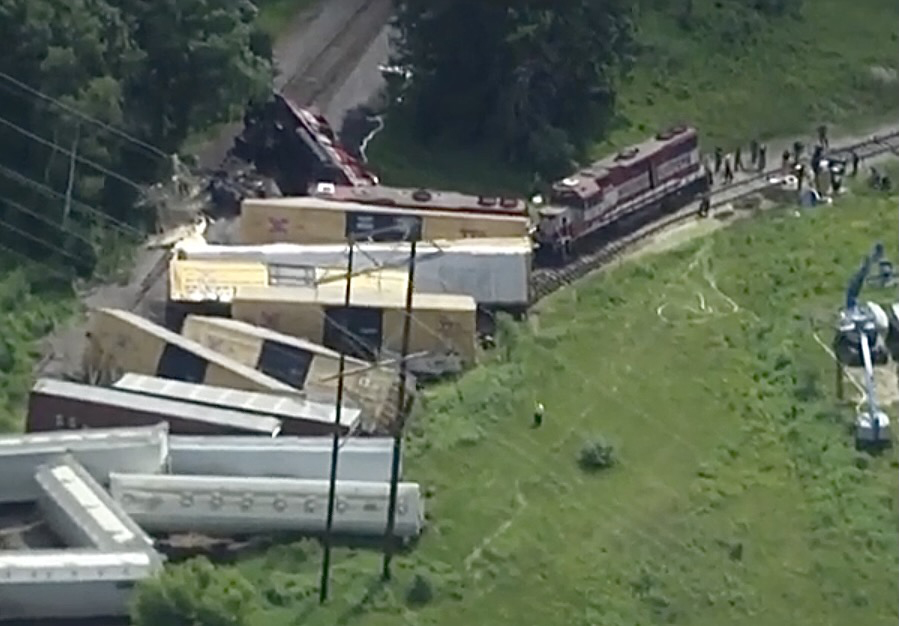
“Sometimes we miss it. We did miss one of those on our Caliente Sub about a month and a half ago,” Fritz says. “We had a couple of locomotives put on their side due to a flash flood that came down a wash that, in the memories of the railroad, had never been filled with water. But rain happened in the mountains about 20 miles away, and we were unaware of it. And that’s a learning process for us.”
That incident, near Lund, Utah, saw three injured crewmen stranded on an overturned locomotive for hours before rescuers could reach them [see “Flooding triggers derailment …,” Trains News Wire, July 17, 2021].
Lower-emission locomotives

Battery-electric locomotives will play a major role in reducing BNSF’s greenhouse gas emissions 30% by the end of the decade, Farmer says.
BNSF tested a prototype Wabtec battery-electric locomotive in California earlier this year. The FLXdrive locomotive improved fuel efficiency of the traditional diesel-electric locomotives it was paired with by 11% [see “Wabtec, BNSF conclude initial tests …,” News Wire, April 30, 2021]. Wabtec is now developing a FLXdrive with significantly more battery power.
“We’re going to continue to work on the battery technology, to be able to have greater capacity. But I think there’s opportunities both in the yard as well as revenue line-haul service,” Farmer says.
BNSF is not considering main line electrification, Farmer said in an interview. Although the technology is proven, it also has been proven to be prohibitively expensive, she explains, and partial electrification would introduce operational complexities.
UP also sees battery-electric locomotives as key to reducing its greenhouse gas emissions 26% by 2030, Fritz says.
The railroad has ordered a battery-electric switcher for use in a California yard as part of a pilot program. “What we really look forward to is setting up a couple of yards where we electrify entirely, and experiment,” Fritz says.
UP is likely to shift to battery-electric locomotives in yards and local service first, Fritz says, then in line- haul service when feasible.
Union Pacific also will boost the biodiesel fuel blend in its EMD locomotives to 20% from the current 5%, Fritz notes.
Share this article