PITTSBURGH — Wabtec says the next step in its development of a battery-electric locomotive will be a locomotive with a battery capacity of more than 6 megawatt hours, which could reduce the fuel consumption and carbon emissions of a locomotive consist by up to 30%. Such a second-generation locomotive would be offered commercially and could enter service “in the next few years,” the company says, as part of an effort to develop zero-emission locomotives using batteries, hydrogen fuel cells, and hydrogen internal combustion engines. Wabtec says it has “a clear path” to power new locomotives and re-power existing engines — with those forms of power.
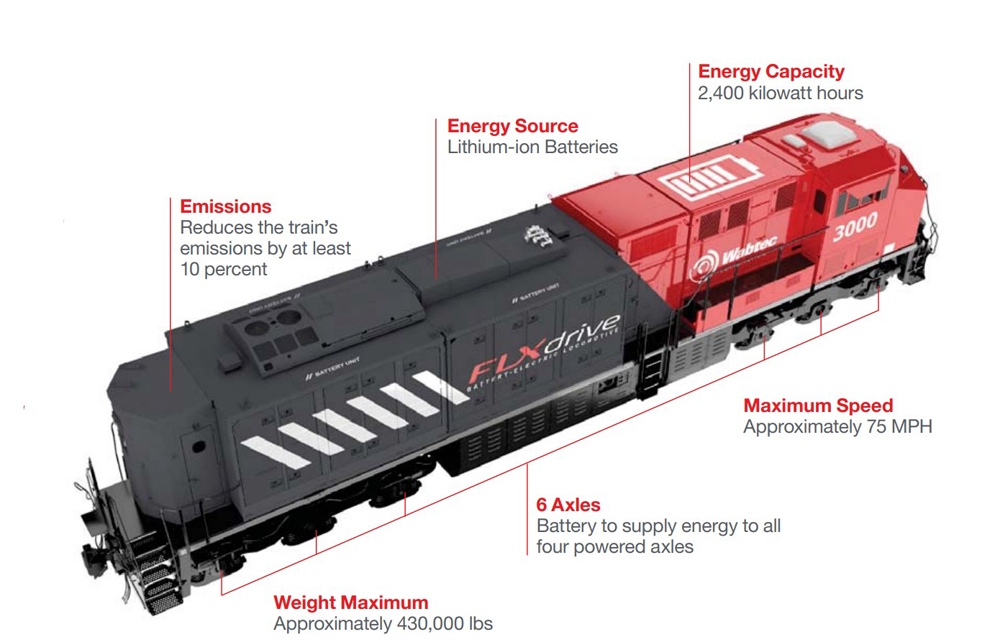
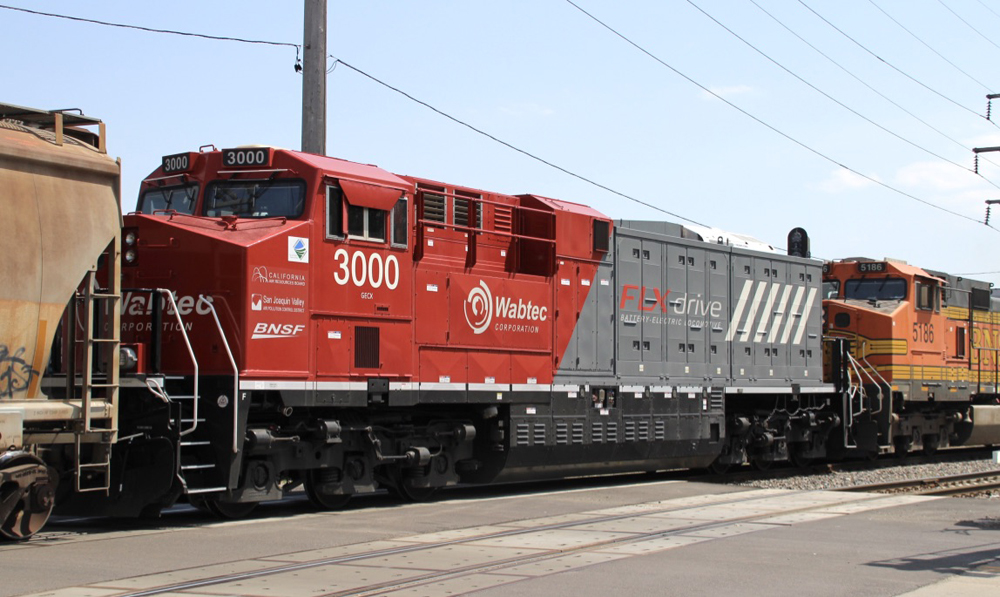
Wabtec announced those plans while summarizing the recent test of the company’s first FLXdrive battery-electric on BNSF in California, where it helped reduce fuel consumption and greenhouse gas emissions by 11% over more than 13,000 miles of testing [see “Wabtec, BNSF conclude initial tests …,” Trains News Wire, April 30, 2021]. That locomotive, with 18,000 lithium-ion battery cells, had 2.4 megawatts of power and charged at rail yards and through regenerative braking. It was funded through a $22.6 million grant from the California Air Resources Board to Wabtec, BNSF, and the San Joaquin Valley Air Pollution Control District.
“The FLXdrive battery-electric locomotive is a defining moment for freight rail and will accelerate the industry toward low- to zero-emission locomotives,” Eric Gebhardt, Wabtec chief technology officer, said in a press release. “It builds upon the rail industry’s position as the most efficient and sustainable mode of transportation. Building on our long history of pioneering train energy management technologies, this demonstration … fully validated our assumptions for the potential for this next generation technology to further drive efficiencies and greenhouse gas reductions.” The next version of the FLXdrive technology, he said, will put the rail industry “on the cusp of a once-in-a-generation improvement in energy savings and emission reductions.”