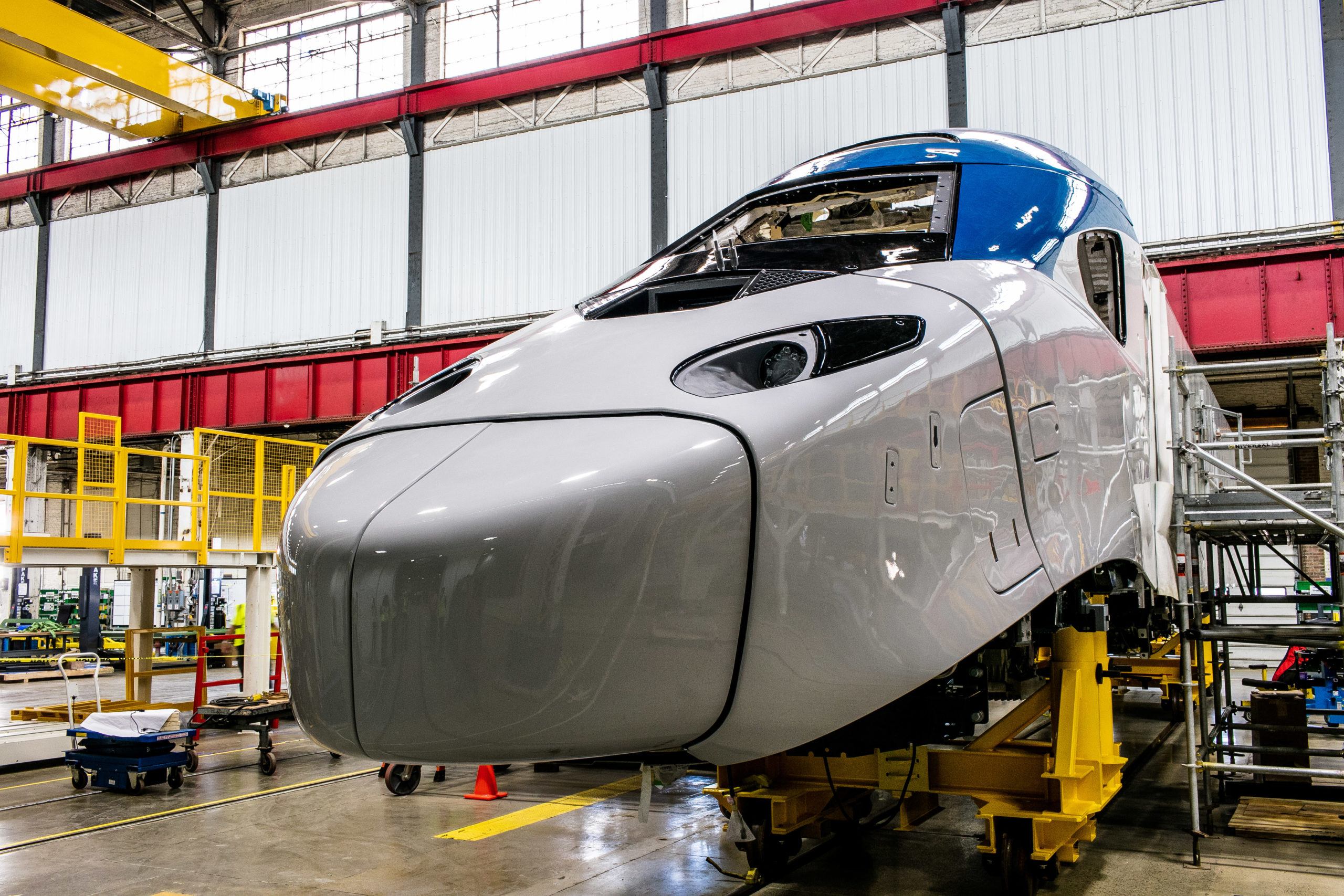
By now, Amtrak’s second-generation Acela trainsets were supposed to be in their second year of operation.
Instead, they have no definite date to enter service, and are taking a growing toll on the passenger operator’s bottom line. A company web page simply says the trains are scheduled to debut “in 2024.”
A Wall Street Journal report in November placed the cost of the delays in launching next-generation service at $140 million and counting. That figure includes the increasing expense of maintaining the aging first-generation Acela fleet, as well as lost revenue from reduced Acela capacity on two fronts. The new trainsets will have about 25% more seating than the trains they replace, and fewer Acela trips are currently being offered, with four of the original 20 trainsets sidelined. They are being cannibalized for parts to keep the others running.
The Journal report was based in part on an unredacted version of a report by the Amtrak Office of Inspector General that was highly critical of manufacturer Alstom’s process for building the new trainsets. The public version of that report had dollar figures moved “due to [their] sensitive nature,” but offered plenty of other insight into the problems that have led to the mounting delays.
Among them:
— At the time of the report, defects had kept Amtrak from accepting any of the 12 trainsets (out of an order of 28) already produced, as well as 22 of the 28 café cars. The trainsets had not yet met federal safety requirements, and each trainset produced had defects Alstom must fix or modify before the start of revenue service.
— More than half the trainset units were built without a finalized design. Unanticipated design changes stemming from model validation will need to be retrofitted onto the already-produced equipment.
— Alstom did not establish a schedule to address defects, which the Inspector General said “creates a secondary risk to the overall program schedule” because it leaves Amtrak without enough information to know the impact on the start of revenue service.
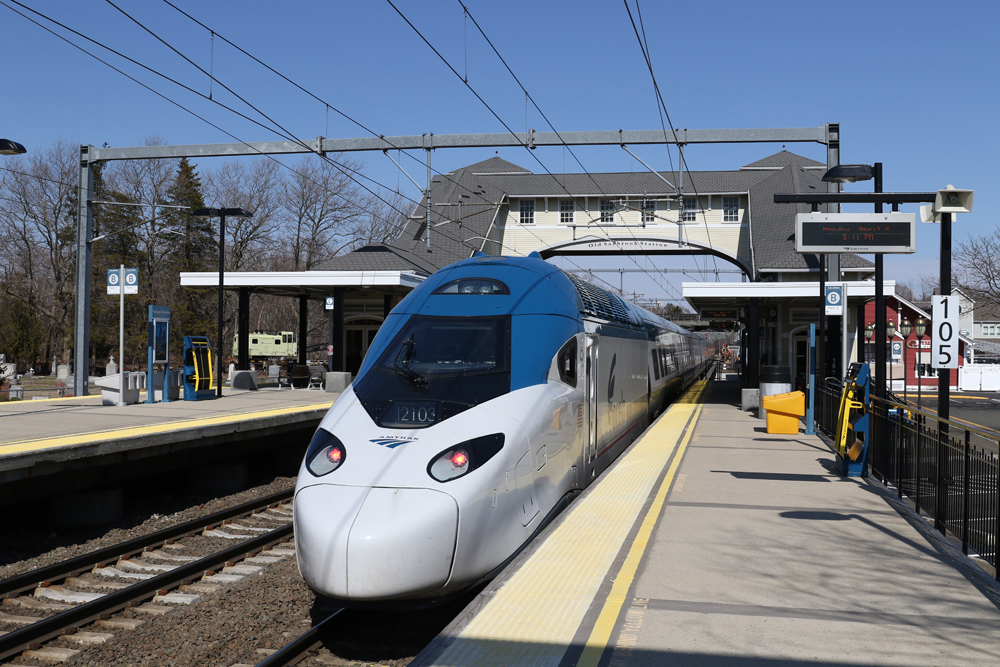
The report also said there would be delays from an inability to produce a validated computer model of the equipment’s performance, required by the Federal Railroad Administration as part of its testing plan.
Computer and physical testing have been or detected problems since the first trainsets were delivered in 2021 and they displayed difficulty coping with the aging, curving infrastructure of the Northeast Corridor. The conditions are far different than the more modern high-speed routes used by the European equipment on which they are based.
Initially, that led to a problem with the trains’ pantographs losing contact with the catenary wire, preventing them from reaching top speed [see “News report says debut of new Acelas will be delayed …,” Trains News Wire, June 3, 2021], pushing the expected service back by a year.
A further delay became public in 2022 when Amtrak tucked a deployment delay to 2023 into a release of images of the new trains’ interiors. Alstom explained this was to accommodate modifications based on testing — specifically, that “mass was added to the extremity ends of each car and additional anti-roll bars were added to the café cars to lower the center of gravity over specific wheels and to distribute load on wheels [to optimize] the trainset’s behavior on the curves of the NEC.” [See “Alstom explains latest delay …,” News Wire, April 8, 2022]. That, in turn, required updating of the model used in computer testing.
And earlier this year, the Washington Post — which was first to report the pantograph issue — reported testing and computer modeling found problems with the wheelsets. Alstom said in a statement to the newspaper that it was confident its “extensive investigations … will demonstrate compatibility of the latest generation of high-speed technology with existing [Amtrak] infrastructure.” Sources told Trains News Wire that computer modeling of performance at speeds over 150 mph had been confirmed on a Pueblo, Colo., test track, but not on portions of the corridor itself.
The ongoing issues come at a time when Amtrak has pointed to recovery of Northeast Corridor ridership in general and on the Acela in particular as a highlight of its 2023 fiscal performance. In its year-end fiscal report, the company said Northeast Corridor ridership was up 31.3% over fiscal 2022. Acela ridership was up 38%; that included fourth-quarter ridership that exceeded pre-pandemic figures by 8% [see “Amtrak cites major ridership increase …,” News Wire, Nov. 30, 2023].
Previous News Wire coverage:
“New Acelas face further delays,” May 30, 2023.
“Amtrak Inspector General: Production problems plague new Acela,” Oct. 3, 2023.
“News report says new Acela delays have cost Amtrak $140 million,” Nov. 9, 2023.
Note: The News Wire countdown of the Top 10 stories of 2023 will take a break Monday for Christmas Day. It will resume Tuesday, Dec. 26, with the two stories that tied for No. 6.
Share this article