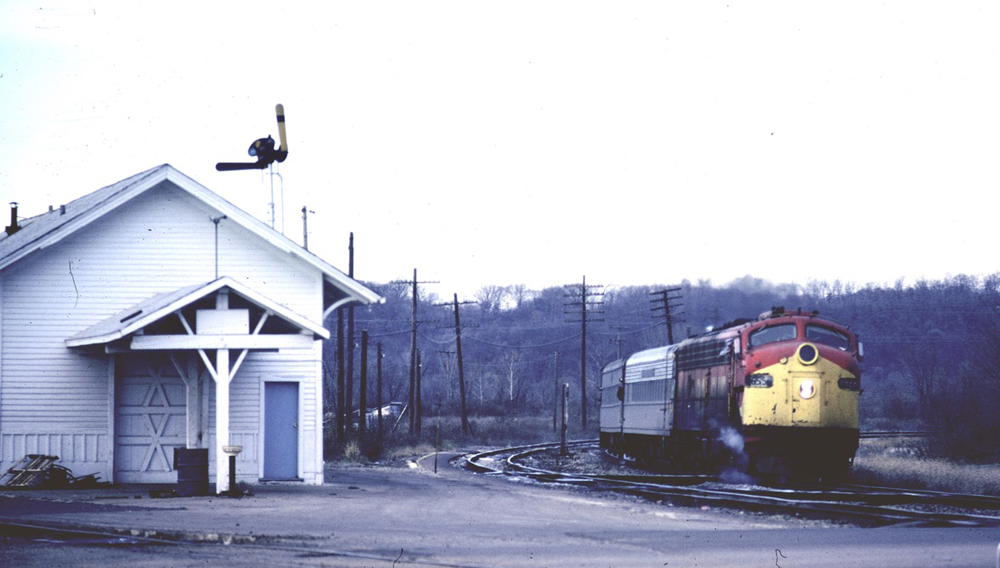
PEORIA, Ill. — Officials from Peoria and nearby communities have announced results of a feasibility study for a Chicago-Peoria passenger rail corridor over former Chicago, Rock Island & Pacific tracks that last saw passenger trains in 1978.
The clear intent of last week’s announcement is to compete for $1.8 billion in the Federal Railroad Administration’s recently-announced Corridor Identification and Development Program [see “FRA unveils Corridor ID …,” Trains News Wire, May 17, 2022]. Corridors selected by the end of 2022 will be eligible to apply for $36 billion of Bipartisan Infrastructure Law funding.
Schedules, improvements proposed
The report, prepared by consultant Patrick Engineering, itemizes $2.5 billion worth of infrastructure investments on rails west of Joliet, Ill., now operated by CSX Transportation, regional Iowa Interstate, and short line Tazewell & Peoria. Those investments are detailed on page 18 of the report.
(Story continues below illustration)
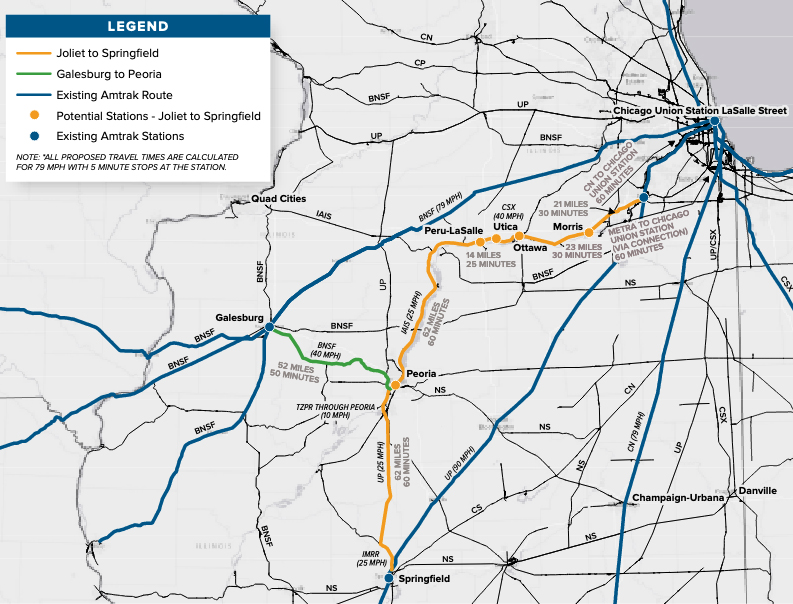
Improvements purportedly would allow five daily round trips at speeds reaching 79 mph on track now ranging from Class 1 (15 mph maximum) to Class 3 (59 mph). The proposed enhancements include mainline rehabilitation and construction; three 3-mile sidings on what is now a single-track railroad; positive train control; and upgrades to 110 public and 104 private grade crossings. Host railroads were not consulted for this “high level of conceptual study.”
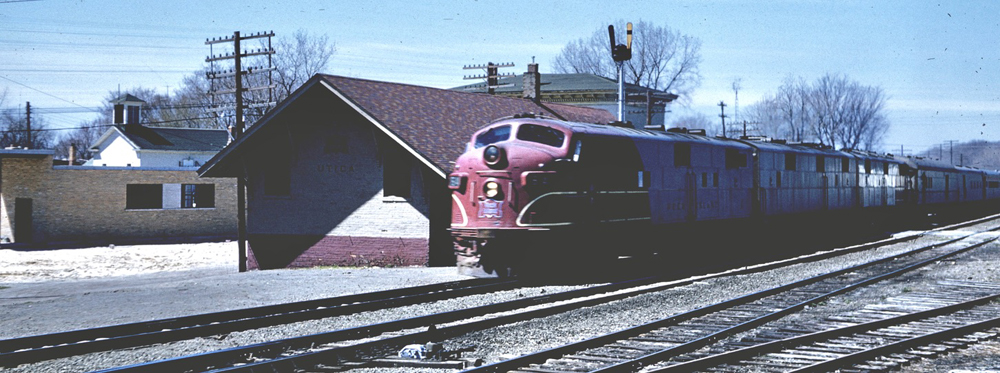
On page 12, the document lists proposed schedules with five intermediate stops and a proposed running time of 2 hours, 27 minutes for the 161-mile Chicago-Peoria route. In 1950, Rock Island’s fastest Peoria Rockets took 2 hours, 35 minutes. Those schedules were lengthened to 3 hours, 10 minutes by the mid-1960s, 3:25 by 1970, and more than four hours over bad track before a single round trip was discontinued on Dec. 31, 1978.
The study’s timetable and string graph require four sets of equipment to execute, though the cost-estimate table lists 10 trainsets for $234 million without further explanation.
Initiative anticipated federal funding
When it became evident that rail infrastructure funding might be available, a steering committee of the region’s civic leaders and federal and state politicians was established in August 2021 that commissioned the Illinois Department of Transportation to fund the study. It is not clear how much money each party contributed or how involved IDOT was in evaluating the report.
One of the committee’s requirements was that Amtrak would be the operator and the corridor must serve Chicago Union Station, but the route between Joliet and Chicago was not specified. As a result, costs of any improvements Canadian National (Amtrak’s current Chicago-St. Louis route) or Metra (the former Rock Island) might require to handle 10 additional passenger trains were not included.
The report does suggest on page 10, though, how new tracks might facilitate entry to Union Station. A CSX-CN connection at Joliet would require a looping connection through or around the Will County Correctional Center. If the Metra route is chosen, Norfolk Southern’s ex-Chicago Junction track across the Dan Ryan Expressway at 39th Street would be utilized by adding a west-to-north track connection to the Amtrak main line. The diagrams are listed as a “concept for discussion, not construction.”
Many steps still remain
More than a year after the demise of Rock Island service, Illinois and Amtrak launched the Chicago-East Peoria Prairie Marksman on Aug. 9, 1980. This utilized a Chenoa, Ill., connection with the Toledo, Peoria & Western from Amtrak’s Chicago-St. Louis route.
The daily round trip, inbound in the morning and outbound in the late afternoon on a 3½ hour schedule, lasted only until Oct. 4, 1981, when it succumbed to low ridership and Reagan-era Amtrak budget cuts.
The report notes that since 2003 there have been a series of proposals and feasibility studies to serve Peoria and stations along the former Rock Island route. The latest version provides research attempting to demonstrate ridership potential, based on population in the area and favorable responses to a survey. That information is one of the elements required by the FRA’s competitive Corridor Identification and Development Program. But if the applicants are successful, environmental and more detailed operating analyses must follow before construction money is allocated.
Even then, obstacles remain. Federal grants from a 2010 federal stimulus package have been in place more than a decade for a proposed Chicago-Quad Cities Amtrak corridor, yet the Illinois Department of Transportation and Iowa Interstate have yet to reach agreement on construction and operating terms. There is also no evidence that engineering plans have progressed for a connection between the BNSF Chicago-Galesburg main line and the regional operator at Wyanet, Ill.
Ray LaHood, U.S. Transportation Secretary under President Barack Obama who championed passenger rail investment and was previously a congressman representing the region, spoke at a news conference Thursday. The Peoria Journal Star reported that La Hood said “the stars have aligned properly” for the new service. If their corridor is selected by the FRA, proponents of the Chicago-Peoria route will have a long road ahead before any trains begin running.
Share this article