





WASHINGTON — Questions raised by Surface Transportation Board Chairman Martin Oberman and other board members Wednesday, during the second day of a hearing over Amtrak service on the Gulf Coast, pointed to the key issues on which the case will likely be decided.
Following Wednesday’s conclusion of the public-comment portion of the case, which featured testimony by chief executives from Amtrak, CSX, and Norfolk Southern, the hearing will resume March 9 with the parties to the dispute presenting their cases to the STB.
The second day of the hearing regarding Amtrak’s right to establish two daily round-trips between New Orleans and Mobile, Ala., also featured thoughtful guidance from ex-Norfolk Southern and Amtrak CEO Wick Moorman, following testimony from more than 40 individuals on Tuesday [see “First day of Gulf Coast hearing brings significant new information,” Trains News Wire, Feb. 15, 2022]. Wednesday’s session also made clear the topics the board wants addressed.
Two, in particular are worth noting: Capacity and train length, and drawbridge openings and improvements.
Capacity and train length
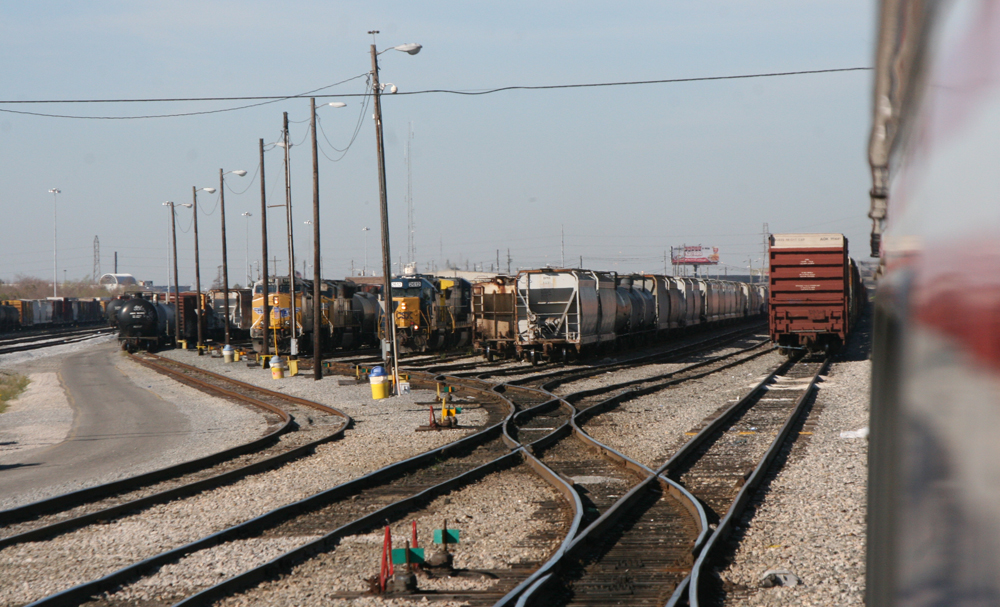
Oberman referenced evidence from CSX showing trains at Gentilly Yard, east of New Orleans, had to be assembled on the main track, “resulting in multiple hours of delay,” he says. “That has nothing to do with Amtrak trains.” Noting that CSX has paid over $30 billion for stock buybacks and shareholder dividends, he said he wondered “if Amtrak disappeared tomorrow,” why CSX hasn’t spent to solve the infrastructure problems outlined in its report. He also noted there are other portions of the RTC [traffic modeling] report that refer to infrastructure limitations for freight service.”
This, he said, is “no determination as how this case should be decided involving Amtrak,” but raising the issue makes it clear the STB will take a hard look at whether public funds are being asked to pay for overdue freight improvements.
A 3-minute response from CSX CEO Jim Foote, which began, “It’s called a pandemic,” clearly didn’t sit well with Oberman, who responded, “You’ve spent $6 billion less on capital than stock buybacks over the past 11 years.”
Board member Robert Primus added, “I want direct answers, and I don’t think we’ve got them.” The newest board member, Karen Hedlund, asked that CSX analyze in the March hearing “the additional benefits to the fluidity of your system from the improvements you are requesting that be made on behalf of Amtrak.”
In the hearing’s afternoon session, Oberman questioned the absence of any information in the RTC study on the impact of adjusting CSX’s current train lengths, given that only three passing tracks on the 144-mile New Orleans-Mobile route are more than 10,000 feet long. “What would be the impact on freight service if trains were only run long enough to fit into existing sidings today, and only be extended once new sidings were built?” he asked. “I would like CSX to enlighten us, if you can, on what kind of improvements could be made by making operational changes.”
Bridge openings and improvement timelines
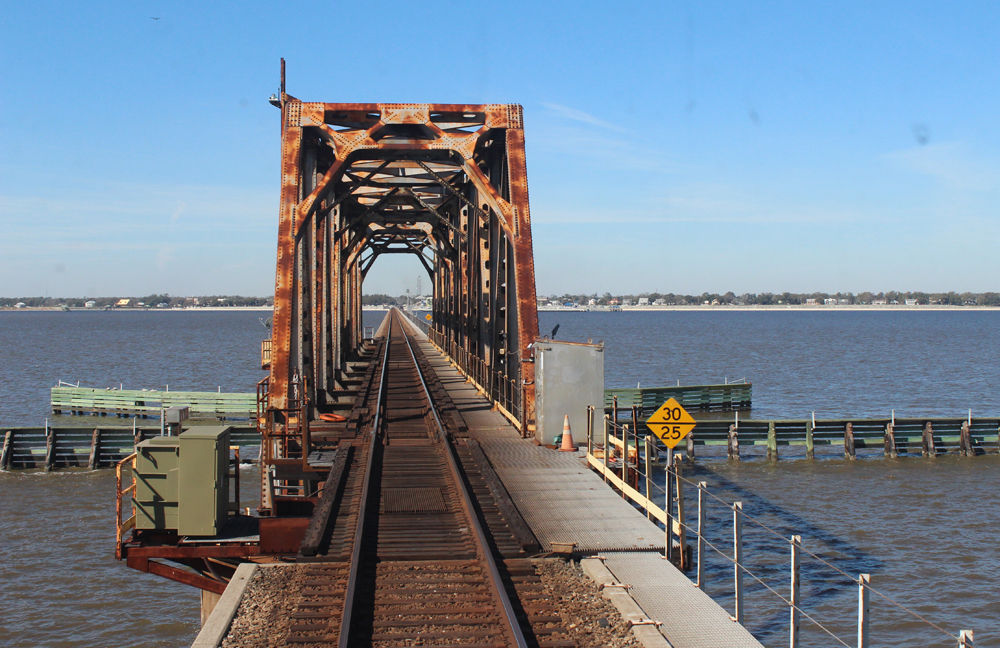
The STB chairman also zeroed in on the disconnect between the RTC modeling study’s constant reference to random bridge openings and the need to take bridge tenders to and from their work locations by hi-rail vehicle — while CSX is in the process of converting the bridges to remote operation, and has not acknowledged that the Coast Guard could be involved in scheduling bridge lifts.
Oberman noted he can’t “order anyone to do anything,” but said that before March 9, he would like “all parties to go arm in arm to the Coast Guard and report back to us on what you’ve learned. What is their willingness to work out a schedule and how long will it take?” He also asked CSX to determine when the remote process will be complete. The information that the railroad was working on remote operation was not provided by CSX, but by Transportation for America’s John Robert Smith during Tuesday’s hearing.
Oberman and Hedlund also asked Amtrak attorney Jessica Amunson at the afternoon session about the timing and scope of infrastructure improvements Amtrak might be prepared to make other than those CSX is suggesting. Amtrak CEO Stephen Gardner said, “We stand ready to make improvements” in the morning session.
Moorman’s insight
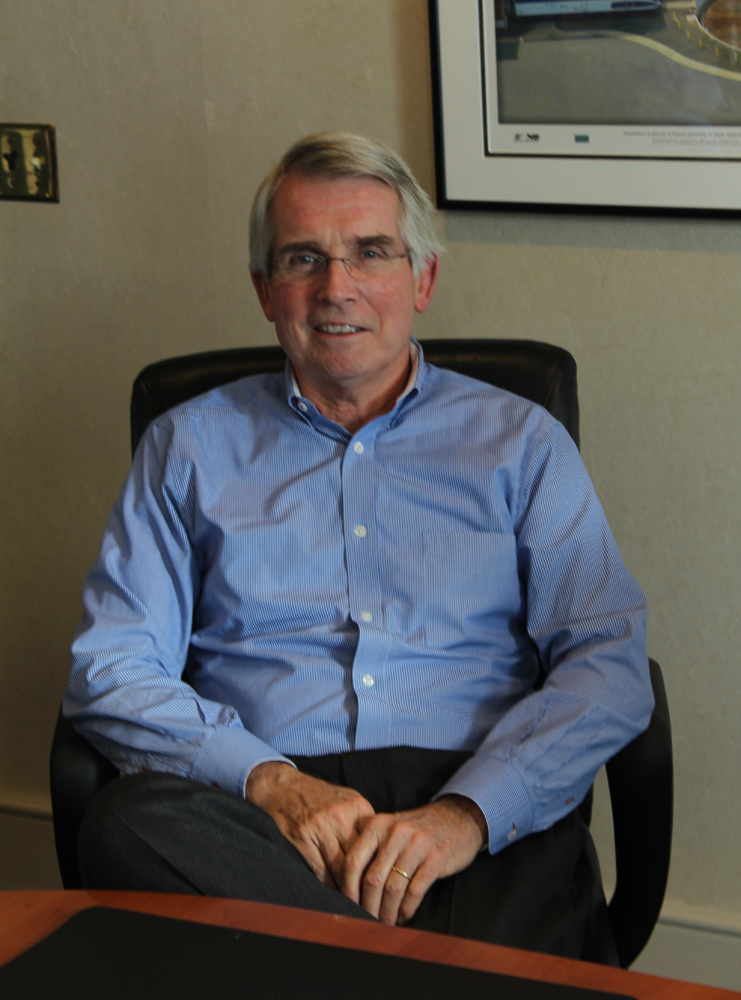
Earlier, former Norfolk Southern and Amtrak CEO Wick Moorman pointed to successful agreements between his two former employers in adding service to Norfolk, Lynchburg, and Roanoke, Va., and on North Carolina’s Piedmont corridor, as examples of “win-win” collaboration. Without that, he says, “a neutral party needs to step in.”
The essential requirements, Moorman says, are that both parties must be willing to work together, be totally transparent, acknowledge where delays exist even if no passenger trains are added, and not simply come up with a list of projects.
When he was at Amtrak in 2016, “and CSX said it was $2.4 billion [for the improvements necessary for passenger service] to go from New Orleans to Jacksonville — I say this with all due respect to my CSX friends — that was laughable.”
Regarding New Orleans-Mobile improvements, Moorman says, “There is some number. I don’t know what it is, but there is a process and tools” to decide what is necessary. One is RTC modeling, but he says, “We use the model to accomplish Amtrak’s on-time performance and reasonable freight train operation with the idea to spend the least we can to accomplish what we need to.”
The dispute between Amtrak, CSX, and Norfolk Southern came to the board last year, when Amtrak asked the board for a ruling allowing it to launch passenger service, given its inability to reach agreement with the freight railroads [see “Amtrak asks STB to require CSX, NS to allow Gulf Coast service,” News Wire,” March 16, 2021]. The freight carriers contend the passenger trains will be highly disruptive to their operations [see “CSX, NS say Gulf Coast passenger service would ‘devastate’ freight operations,” News Wire, Nov. 4, 2021].



Back in the 1920’s big new 2-8-2’s were coming on line and could pull trains longer than the sidings. What did they do? They used saw-by meets.
Extra 2516 East is too long for Blortman Siding? To meet Number 7, Eng. 1512, Extra 2516 pulls up to the East end of the siding, stops and flags #7 explaining he’s too long for the siding. Eng 1512 moves to the West end of the siding, prepared to stop. As soon as 7 is clear of the East end of the siding, 2516 lines the switch for himself (assuming there isn’t a second meet) and pulls. Once the caboose of X2516 is clear of the West end of the siding, the flagman lines the switch for the main and boards the caboose. No 7 should have clear track ahead.
It is clear that CSX,as is its wont, is being disingenuous. We should remember that as they take over PanAm here in New England.
Having watched much of the STB meeting I would have to say Train’s did a great job summarizing the proceedings.
I found Moorman’s comments to be quite balanced and educational for board members, but definitely had a slight negative CSX twist. I found the comments by STB members and especially the chair to show that they do have the public’s interest at heart and they are trying to balance public as producers, consumers and potential passengers. The pre-trial hearing on afternoon 2 and some comments during testimony clearly demonstrated they grasped the issues, explained to all parties the questions/considerations for which they wanted clarifications. In other words, a roadmap on what they need to do to argue successfully. On the other hand, I do wonder if the comments , especially Chairman Oberman’s concerning other related issues in front of the STB but not of direct pertanance, possibly would be a basis for appeal– e.g. the STB was not impartial.
I frequently driver to the Mississippi Coast & to Mobile. Every time I pass thru along Highway 90, the bridges over Bay St. Louis, Biloxi Bay, and over the Pascagoula River are always open or up. The bay at Bay St. Louis rarely gets any barge traffic (but some). The swing span is open for sailboats and other pleasure craft (NON SCHEDULED traffic). In Biloxi the swing span is mostly pleasure & sail craft but does receive a fair amount of commercial traffic from barges, small ship construction and the commercial fishing fleet. The Draw span in Pascagoula is up for a fair amount of commercial traffic for all the ship construction. These spans could have/should have been automated long ago.
Ironically the signaled though track at Gently yard shown in the photo and one just like in Mobile’s Sibert yard were payed for by Amtrak when the Sunset Limited was extended through Mobile years ago. And now CSX keeps them clogged up with their three mile long trains. As for the draw bridges between Mobile and N.O. I’m not sure what CSX’s argument is here. The tenders at two of them walk out to the bridge control cabins. At the others the incoming tender takes a hi-rail out and the outgoing takes it back. And they work 12 hour shifts so this only happens twice a day. The bridges north of Mobile are operated remotely and the ones on the NO&M side will be soon. Also if Amtrak were to check I’d suspect they’d find that a couple of those bridges are only rarely operated. It’s pretty obvious that CSX and NS are only trying to set a precedent for future dealings with Amtrak in order to squeeze as much money as they can out of them.
“When he was at Amtrak in 2016, “and CSX said it was $2.4 billion [for the improvements necessary for passenger service] to go from New Orleans to Jacksonville — I say this with all due respect to my CSX friends — that was laughable.”
All you need to know about CSX.
Here’s what’s really happening. CSX can’t move its own schlepediche freights so they want to blame Amtrak trains that don’t even exist as of the moment.
The railroads can’t fit a three-mile-long freight onto a siding …. but no one is allowed to ask how, sixty years ago, passenger trains and freights co-existed on the rails and both modes managed to get where they were going. Let me guess, maybe it was because the freights weren’t three miles long.
We should pass the hat, raise some dollars (or pounds sterling) to send CSX bosses to England for a week. There they can see freights zipping along on a route that supports 125 mph passenger trains at fifteen-minute intervals. How do the British do it? Two hints: (1) It’s double track. (2) The freights are shorter than three miles.
As to passenger/freight on same rails…..because 60 years ago they cared. Today they don’t. Passenger service required the railroads to run a tight and timely service. Their reputations depended on it. With no burdens of passenger service to deal with, they run a best effort freight service. The only reputations they have to maintain is with Wall Street now.
My memory recalls the Trains article where a writer was riding the Amtrak Southwest Chief, and it pulled into a siding to let a freight pass. The freight went by but the Amtrak never got a green to exit the siding. Many hours went by. It wasn’t until phone calls were made through Amtrak to the executives at then SP just to find out the signal operator had gone home and forgotten about the siding and left it closed for the night. Finally someone was rousted out of bed to get the signal set properly and the train was finally able to move on.
It took Metra many, many years to get their host railroads (or the ones that cross over their routes) to maintain themselves to allow Metra to run on time. After UP took over CNW and started dispatching, they were constantly allowing NS to bring their loads to Proviso over the Rockwell Sub. The problem was UP was allowing consists longer than what Proviso could take in and their arse would foul up the switch for Metra to cross over to the yard bypass track. The same thing started happening on the Elmhurst side, where Metra would have to sit and wait for the arse of a UP freight to clear the yard switch.
The only thing that changed was who was doing the dispatching. CNW cared, UP didn’t. That is all it takes. If a railroad CEO cared and passed it down, amazing things would happen. That is all it takes.
But Charles, freight trains in the UK are very short and have a very high HP/ Ton ratio when compared to North America, I was shocked at how fast a loaded coal train accelerated when I was trackside one day in Scotland.
Wish I could give you an accurate count but I seem to recall around 35 wagons (cars).
Found this, they are just upgrading to run 1/2 trains in the UK
https://www.railfreight.com/railfreight/2020/12/17/uk-longer-freight-trains-for-longer-term-growth/