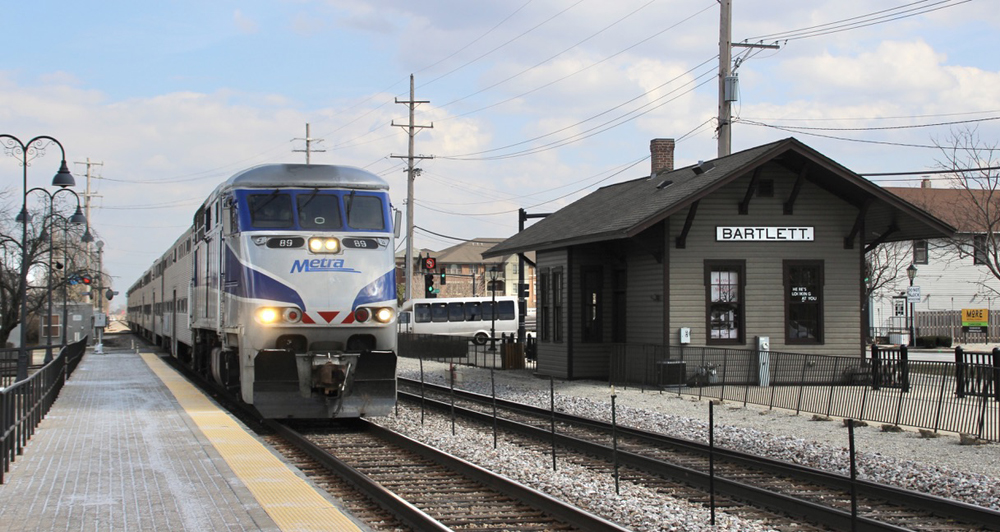
WASHINGTON — Chicago-area commuter rail operator Metra has come out against the Canadian Pacific-Kansas City Southern merger, telling the Surface Transportation board in a 946-page filing that the merger would bring delays, prevent expansion of service, raise safety issues, and increase Metra’s infrastructure costs.
The communter operator also says its traffic modeling indicates the operating plan cited in the CP-KCS merger document is unworkable.
While the filing says the merger is “inconsistent with the public interest and cannot be approved,” it also lays out seven conditions the STB should require if the deal is approved, including transfer of dispatching on the lines in question to Metra control, 10 years of STB oversight of dispatching if that transfer is not made,” and an extensive list of infrastructure projects.
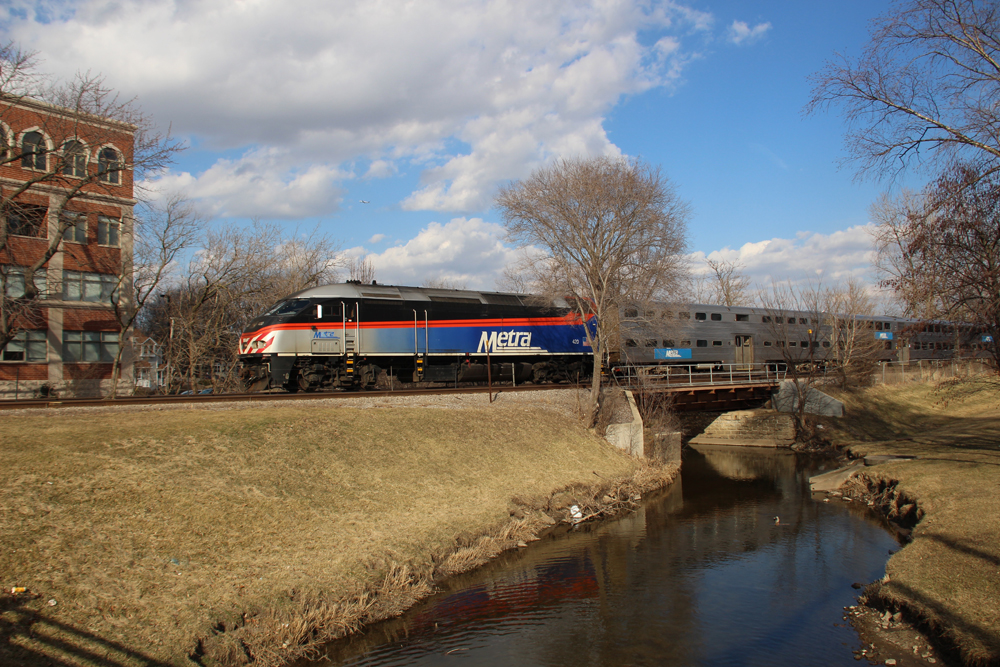
The document was filed Tuesday, after Metra was granted an extension from the Feb. 28 deadline for comments on the merger. It had requested that extension after saying CP had been late in providing requested documents [see “Citing ‘false response’ to information request, Metra asks for more time …,” Trains News Wire, Feb. 23, 2022]
Metra shares trackage with CP freight on two routes, its Milwaukee District-North and Milwaukee District-West lines — routes owned by Metra but dispatched by CP. The filing says CP has a “history of non-cooperation and contractual breaches with Metra,” that its “poor dispatching” leads to regular train delays, and that the Metra-owned infrastructure used by CP freights “cannot accommodate” the trains the merger would bring. It says modeling for its Milwaukee West line shows delays per 100 train-miles will increase by more than 400%.
While the STB has already asked CP and Kansas City Southern to address a discrepancy in traffic figures in their merger application [see “Traffic density data issue snags regulatory review …,” News Wire, March 16, 2022], Metra’s filing makes claims of additional errors. It contends the train counts in the merger application’s operating plan “completely exclude Metra passenger trains,” although they are mentioned in the application narrative, creating a more than 500% difference in total train counts in pre- and post-merger applications. Amtrak trains are also omitted, the filing says.
Metra’s involvement in the merger case could pose a problem for STB Chairman Martin J. Oberman, a former Metra chairman. Oberman has previously recused himself from STB proceedings involving Metra and Union Pacific.
Modeling projects traffic increases will ‘break system’
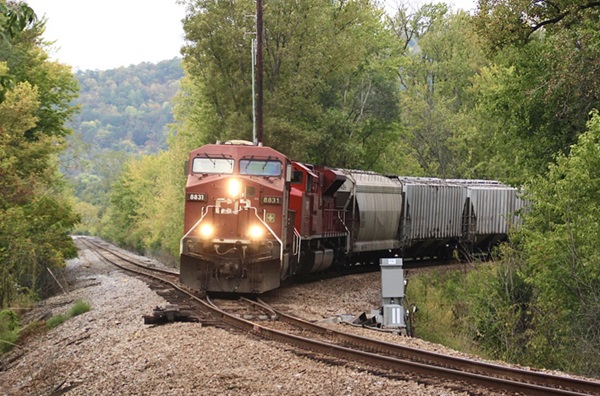
The modeling is a significant point of contention by Metra, which says CP did not use the Rail Traffic Controller modeling that is usually performed for such transactions. As result, Metra conducted its own RTC modeling, which it says shows that projected traffic will “break the rail system” between the Twin Cities and Chicago on what it calls “the critical ‘diamond’ juncture that serves as the only connection between Applicants’ northern and southern continental systems.
Metra defines this diamond as routes between River Junction, Minn. (across the Mississippi River from La Crosse, Wis.) and Chicago. One side goes east from River Junction through Milwaukee, then south to Chicago; the other goes south from River Junction to Sabula Jct., Iowa, then east to CP’s Bensenville Yard and Chicago.
Metra says its modeling shows the segment between River Junction and Sabula “cannot handle expected new traffic on it, even with proposed capital improvements.” As a result, Metra says, more traffic is likely to be diverted onto Metra lines.
Metra says that, in a simulation using projected increases in freight and Amtrak traffic, the modeling software “could not final a resolution that would accommodate the number of trains expected … even with additional infrastructure added” — which it says indicates the operationg plan proposed by CP and KCS is unworkable. “[T]he operations following the implementation of the proposed Transaction will inflict enormous disruption on Metra’s operation,” it says.
Commuter safety concerns
Metra also contends CP dispatching often leads to “unsafe conditions … when CP trains block passengers’ access to Metra trains.” This leads to passengers crossing tracks, dodging oncoming trains, or having to pass around stopped freight trains, it says. “In such cases, Metra conductors are put in the difficult position of choosing between waiting for impeded passengers to board or departing in order to adhere to scheduled operations.” Such issues are not recorded in on-time data, the commuter operator says.
“Metra routinely calls up on CP to cease interfering with Metra’s service, as more fully memorialized in e-mail communication,” the filing states. It says CP “too often” ignores these requests.
Additional mainline tracks part of infrastructure requests
Construction of additional mainline trackage is a significant part of the infrastructure work requested by Metra on both its Milwaukee District-North and Milwaukee District-West lines to mitigate the impact of the merger, should it be approved.
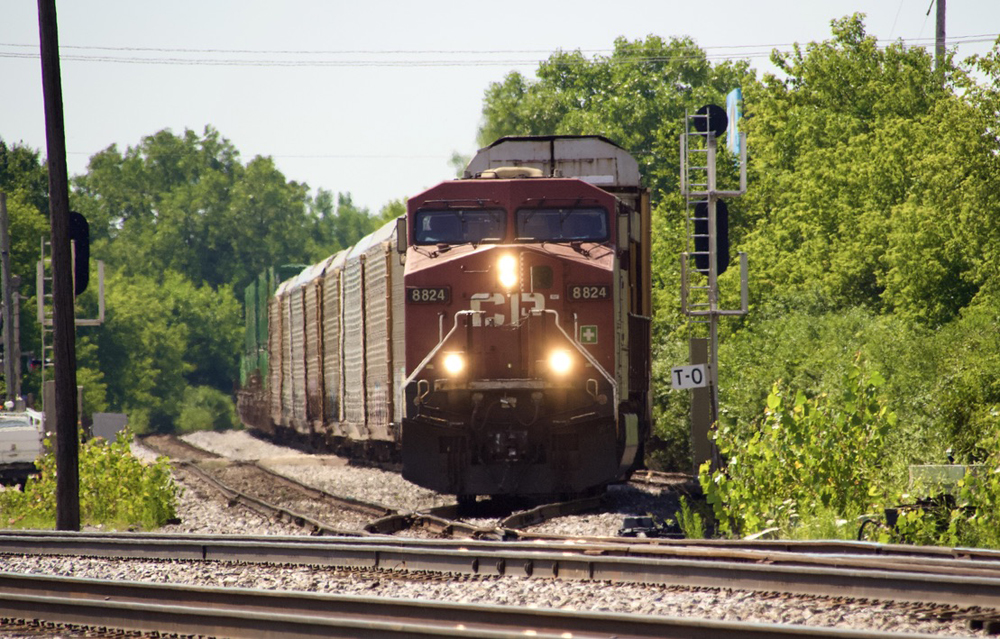
On the Milwaukee North, it proposes:
— Construction of a third main line between Tower A-20 and Rondout, a distance of 11.8 miles;
— Construction of a new connection at Tower A-20 to allow CP trains to exit the Metra line before joining the Union Pacific line used by CP to reach its Bensenville, Ill., yard;
— The addition of universal crossovers at its Lake Forest and Glenview stations.
On the Milwaukee West, Metra asks for:
— Two new main tracks adjacent to Bensenville Yard for 4.3 miles between Tower B-12 and Tower B-17, where Metra says “the current delays caused … by freight trains struggling to enter or exit the yard, blocking both towers in the process, is a chronic issue for Metra,” along with “receiving tracks equal to the length of incoming trains or equal to the maximum possible length.”
— Two new main tracks for 7.3 miles between Tower A-5 and Tower B-12.
— A new southeasterly wye leg at Cragin Junction to eliminate a current back-up move required for CP to go south to the Belt Railway of Chicago.
— Realignment of curves at Tower A-5, where the Milwaukee West and Milwaukee North join, to increase speeds from 10 mph to 25 mph, as well as separation of freight and Metra tracks and construction of a new flyover.
— New powered crossover at the Bartlett and Itasca stations.
Other mitigation requests
Along with the capital improvements and the request for Metra to gain dispatching control over the lines, Metra asks the board to require actions involving planning, financial compensation, and oversight.
On the planning front, the commuter agency asks that CP be required to adopt the Rail Traffic Controller modeling sponsored by Metra, rather than what it says is CP modeling using “a method that is totally inadequate for the task,” or that CP work with it to refine that RTC modeling. It also asks that “a binding mechanism” to address Metra requests for schedule changes and additions. “The current method, in which CP can unilaterally deny any proposed Metra expansion based on generalities regarding unreasonable impact on CP operations, will not work in the face of the expected increase in traffic,” the filing says. Elsewhere, Metra says CP has recently denied its request to add four daily trains to serve Lake Forest, Ill., citing a lack of capacity.
Financially, Metra says CP currently pays about 21% of the costs of capital improvements on the two lines, but that payment should be changed to reflect increased traffic — not just in more trains, but heavier and longer trains — on the Metra trackage. It proposes that CP pay all costs for capital projects which are undertaken because of increases in traffic volume, weight, and frequency; that maintenance costs based on train counts and ton-miles, rather than the current flat fee, and that its rental change from a flat fee to a dollar per car-mile.
Metra also asked that penalties be established for future interference with Metra operations, using baselines included in the filing, to “create an incentive for CP to respect its existing contractural constraints to Metra lines and … avoiding even further impacts on the essential service that Metra provides to its riders.”
Finally, along with requesting 10 years of STB oversight of dispatching — if dispatching is not transferred to Metra — the agency asks the STB impose 10 years of oversight on any other conditions it may set regarding Metra service.
Share this article