JACKSONVILLE, Fla. — CSX Transportation aims to round up shipper support before a Surface Transportation Board hearing this month regarding Amtrak’s controversial quest to launch passenger service on the Gulf Coast.
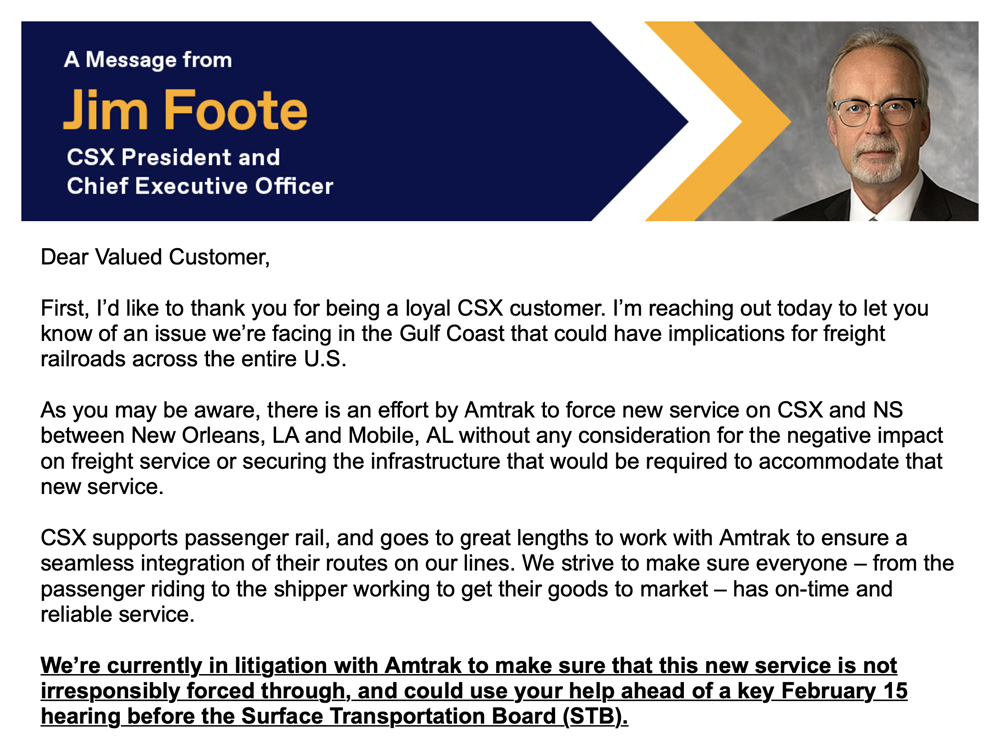
In an email to the railroad’s customers, CEO Jim Foote asked shippers to sign a petition or to write to the STB directly regarding the potential negative impact Amtrak service would have on freight traffic in the absence of any capacity improvements on CSX’s single-track route linking Mobile, Ala., and New Orleans.
“We’re currently in litigation with Amtrak to make sure that this new service is not irresponsibly forced through, and could use your help ahead of a key February 15 hearing before the Surface Transportation Board,” Foote wrote.
“As way of background, the completion of a Rail Traffic Control (RTC) study has been the standard industry practice for evaluating and implementing such passenger rail proposals,” he added. “An RTC study was completed last year and showed significant impairment to freight service if no infrastructure improvements are made. Yet Amtrak proposes to begin this service without implementing those improvements.”
Amtrak has hauled CSX and Norfolk Southern before the STB, arguing that host railroads must accommodate two daily roundtrips between Mobile and New Orleans [see “Amtrak asks STB to require CSX, NS to allow Gulf Coast service,” Trains News Wire, March 16, 2021]. Amtrak has accused the freight railroads of dragging their feet on the proposed service and wanted to begin service last month.
The Federal Railroad Administration and Amtrak have been critical of the RTC study, saying it lacked details and proposed expensive capital improvements without considering potential operational changes.
CSX warned shippers about the precedent that could be set if Amtrak were allowed to begin service before necessary capacity improvements are made that would limit passenger train interference with freight trains.
“We ask that you join us in signing a petition to let the STB know that Amtrak’s current position is untenable and that the STB’s decision will have broad implications impacting service to freight rail customers across the U.S.,” Foote wrote. “If this is allowed to happen on the Gulf Coast, Amtrak could deploy this strategy wherever you ship your goods.”
As part of its ConnectUS plan, Amtrak has proposed new routes and more frequent service on existing routes. And it now has potential funding for expansion thanks to the billions of dollars it will receive under the $1.2 trillion infrastructure bill that Congress passed last year.
“The primary message to convey to the STB is the expected impact on you, the customer, and a request that the STB requires the infrastructure improvements that protects freight service so you can ensure your goods are safely and efficiently delivered to your customers,” Foote wrote.
CSX supports passenger rail, Foote wrote, and aims to provide on-time service for both Amtrak passengers and its freight customers.
Amtrak reacted strongly to the CSX appeal to its customers.
“Desperate attempts by CSX to scare their already-dissatisfied customer base is the same tactic they’ve used before: misleading their shippers, shareholders and the public,” the passenger carrier said in a statement. “It is the kind of tactic used when the facts and the law are not on their side. The upcoming STB hearing will show that Amtrak has the right to use these tracks and the Gulf Coast community deserves to have passenger rail.”
— Updated at 5:40 p.m. CST with Amtrak statement.
Share this article