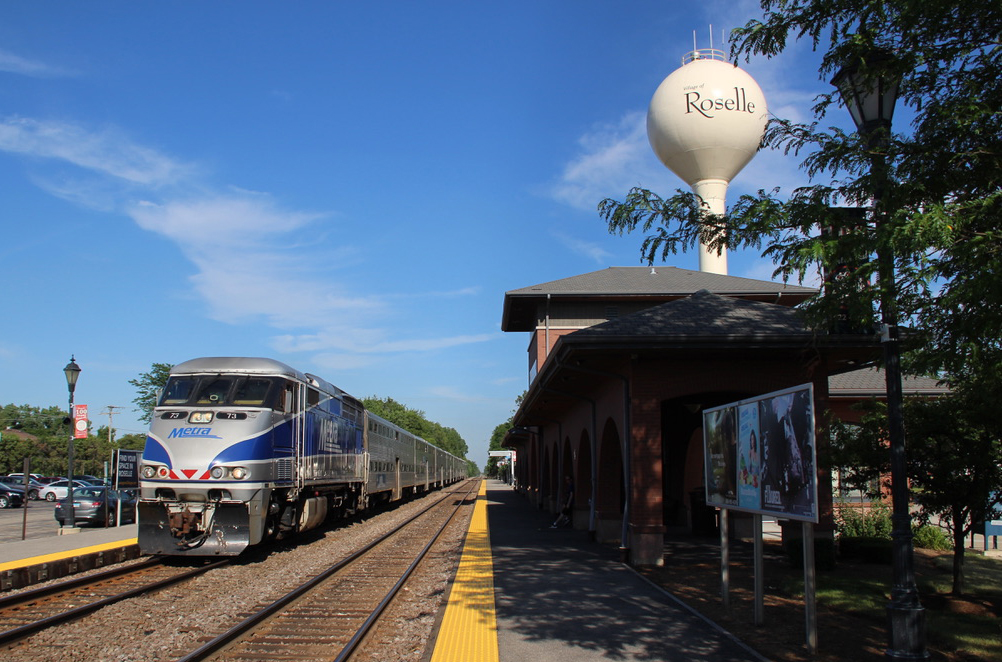
WASHINGTON — Canadian Pacific believes concerns by Chicago’s Metra over its proposed merger with Kansas City Southern are largely unfounded, based on erroneous analysis, and involve unreasonable requests for conditions to the merger. But for all that, CP says it is committed to supporting Metra operations and improving its relationship with the commuter agency.
The response to Metra is part of the three-volume, 4,374-page document filed Wednesday by CP and KCS, responding to filings by other parties regarding its amended merger application before the Surface Transportation Board. Metra’s filing in March opposed the CP-KCS merger, saying it would create significant service delays, and asked that the STB impose conditions including transfer of dispatching control of shared lines to the commuter operator, as well as an extensive list of infrastructure improvements [see “Metra opposes CP-KCS merger …,” Trains News Wire, March 17, 2022].
The CP-KCS document also responds to the demands of a group of Chicago suburbs for massive infrastructure expenditures, characterizing them as unreasonable and excessive.
The CP-KCS filing is highly critical of traffic modeling by outside Metra consultants, calling their work “irredeemably flawed” and “so riddled with errors that it is demonstrably incapable of modeling the status quo.” Metra earlier this week had to file a correction to its earlier document with the STB, noting that an estimate of the potential for a 1,200% increase in train delays should instead have used a figure of 299% [see “Metra scales back level of delays anticipated …,” News Wire, July 11, 2022].
CP and KCS also say that — contrary to Metra’s contentions — the merger will not result in “meaningful increases” in freight traffic on lines shared with Metra; that the Milwaukee District-West line has ample capacity to handle the anticipated increase in freight; and that CP demonstrably performs well in its dealings with Metra. The filing also says many of the infrastructure improvements sought by Metra as conditions to a merger are physically impossible, and that its request for dispatching control of lines shared by CP and Metra “would create more issues than it resolves.”
However, the filing also says “CP’s senior leadership — from CEO [Keith] Creel on down — is committed to cooperation with Metra so that the needs of both railroads and their customers can be met.”
Creel, in a statement included in the CP-KCS filing, says the Metra comments reveal CP needs “to work harder to build a relationship of trust” with the commuter operator. As part of the effort to do so, Creel says he has contacted Metra CEO Jim Derwinski, and that other CP personnel “have communicated extensively with their counterparts at Metra.”
And, with that relationship in mind, Creel says CP is “willing to provide concrete commitments that protect Metra’s operations over and above what our contracts require.” These include:
— Not forcing CPKC freight trains between Kansas City and St. Paul to operate on lines shared with Metra, except in emergency detour situations;
— Not objecting to Metra’s resumption of its full pre-COVID schedules on those lines;
— A commitment to work with Metra on improved real-time communications about dispatching decisions that might have an impact on Metra trains;
— Supporting collaborative assessments of proposed Metra operating changes outside of peak periods, when Metra needs CP consent to add trains;
— And committing to a process to avoid or resolve disputes when Metra believes CP has created performace issues for its commuter train.
“Nothing in the record,” the filing contends, “contradicts the simple truth that CP leadership has been and remains comittedf to supporting Metra’s operations and honoring CP’s obligations to dispatch Metra’s trains well, with our without the [merger].”
Suburban coalition derided for ‘overreaching, infeasible’ requests
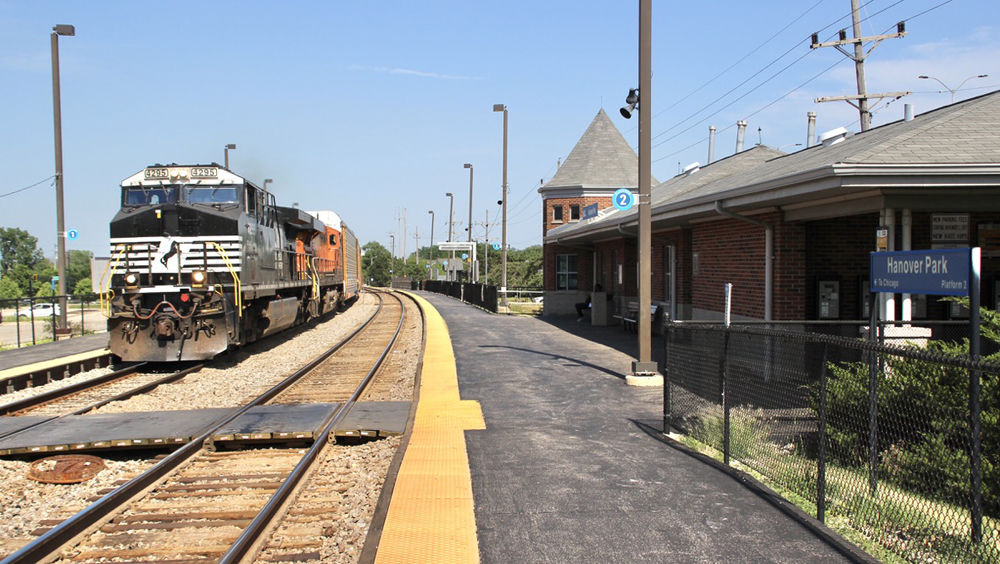
While the CP-KCS filing takes more than 70 pages to examine Metra’s contentions in detail, it dismisses the contentions of the Chicago suburbs of the Coalition to Stop CPKC in little more than five pages. The conditions sought by those communities, it says, are “simply untenable and disproportionate to any possible impact” of the merger, and are “not only overreaching, but also infeasible.”
Those eight communities, along the route shared by CP and Metra’s Milwaukee District West line, are seeking more than $9 billion in improvements to mitigate a traffic increase estimated by CP at eight trains a day [see “Chicago suburbs seek $9.5 billion …,” News Wire, March 1, 2022].
As an example, the CP-KCS filing cites the suburbs’ proposal to prevent any additional freight traffic on the western edge of the Elgin Subdivision “and to find other routings for such traffic.” CP and KCS says this would “cut the CPKC network off from the rail network at and beyond Chicago” and force lengthy reroutes “spanning hundreds of unnecessary miles, traversing dozens of other communities, and resulting in a myriad of additional costs and emissions. … This is quintessential ‘not in my backyard,’ never mind the impact on the public as a whole.”
While the board has previously required railroads to consult with communities in cases where mergers brought modest increases in freight traffic, CP and KCS say that is not justified in this case, since the railroads have already consulted with the communities, “and it is clear that no reasonable, mutually acceptable mitigation is available.”
Share this article