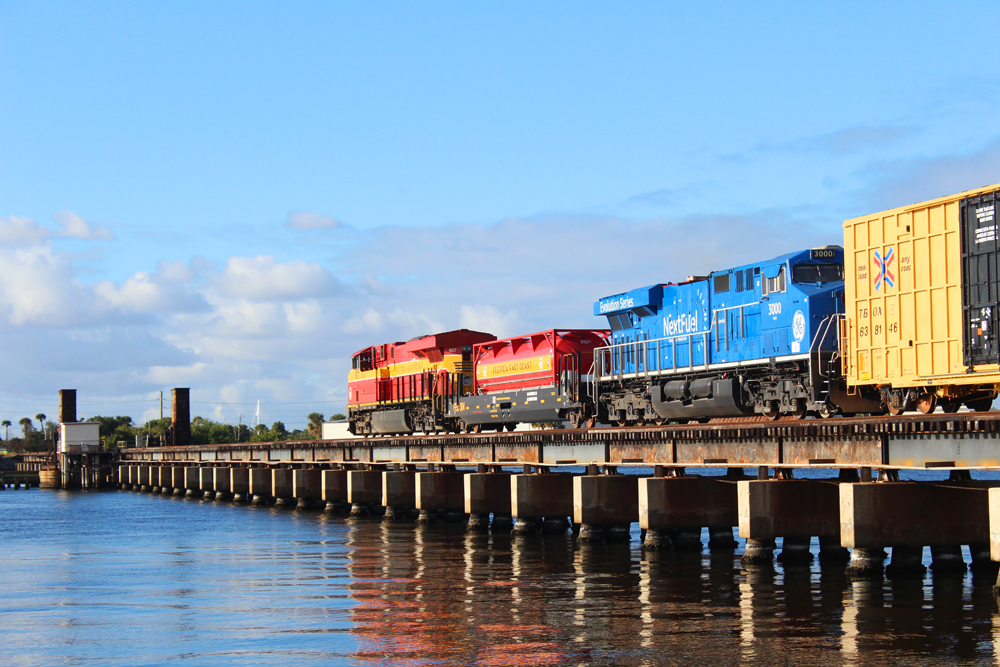
STUART, Fla. — The city of Stuart, Fla., will receive a $130.5 million federal Mega Grant to help fund replacement of the Florida East Coast Railway/Brightline bridge over the St. Lucie River, a bottleneck for rail operations and a point of friction between the rail operators and the local marine industry.
The TC Palm newspaper reports the office of U.S. Rep. Brian Mast (R-Fla.) announced the grant today (Monday, Dec. 18). The projected total cost of the project is $218 million, with additional funding coming from a grant from the Florida Department of Transportation.
The drawbridge is the only single-track segment on the FEC route used by Brightline between Miami and Cocoa, Fla., where Brightline trains veer off onto their own dedicated right-of-way to Orlando International Airport. The combination of single track and drawbridge scheduling creates significant limitations that played a major role in the construction of Brightline’s schedule to and from Orlando.
Stuart City Manager Mike Mortell told the newspaper the award was an “enormous benefit,’ and said “it solves the marine industry problems” because it will allow more than 80% of boat traffic to pass without raising the drawbridge. The design for the new bridge calls for a 16-foot vertical clearance; the current 90-year-old bridge has just a 6-foot, 6-inch vertical clearance, which only allows about 22% of marine traffic to pass without a bridge opening.
The effort to balance drawbridge openings to address the competing needs of Brightline, FEC, and marine interests has been a contentious one, at one point leading to a lawsuit from the marine industry.
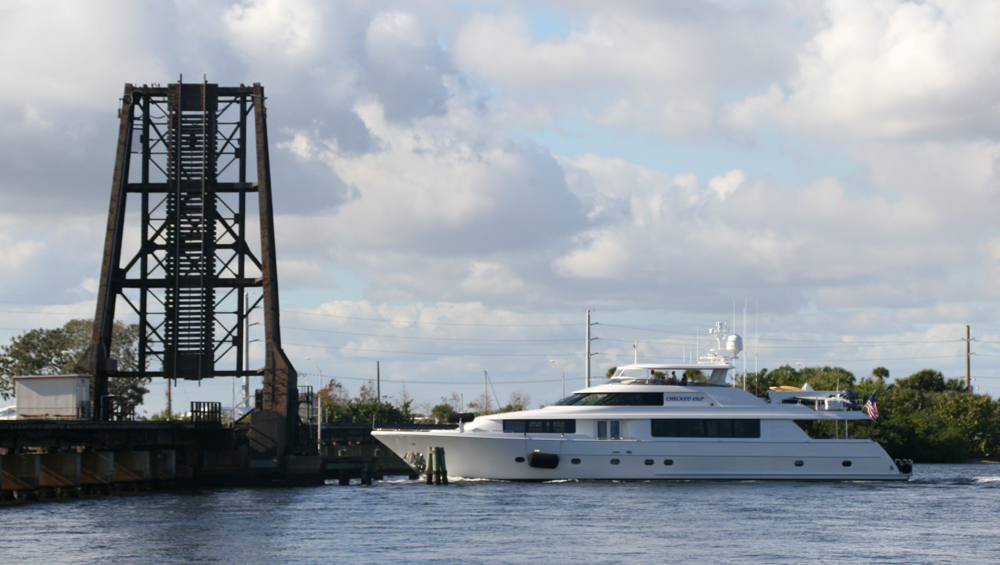
For years, the bridge remained open except when a FEC approached, at which time mariners received an 8-minute warning of an impending closure and the bridge was shut to allow the train to continue unimpeded. But with the anticipated increase in traffic from Brightline’s Miami-Orlando operations, the Coast Guard set new rules calling for the bridge to open at 15 and 45 minutes past each hour during daylight, for up to 15 minutes, to allow all boats to pass; an approaching train could delay an opening no more than 5 minutes [see “Coast Guard to impose twice-hourly bridge openings …,” June 9, 2023].
That plan would have been incompatible with Brightline’s already-announced train schedule, and a revised plan introduced in August created 10-minute openings at the top of each hour, with additional 5-minute periods at 8:55 a.m. each day and at four other times on weekends [see “Coast Guard revises Stuart bridge directive …,” News Wire, Aug. 11, 2023]. The bridge remains open if there is no rail activity but can be closed for up to 50 minutes as long as it is raised for those specified windows. The maximum closure increases to an hour overnight.
Brightline Vice President of Community Relations Ali Soule said earlier this year that there would be a four-year timeline to build the bridge, including design, permitting, and construction [see “Brightline says new Stuart, Fla., bridge would cost $218 million …,” Trains News Wire, Aug. 23, 2023.] Once the new bridge is finished, it will take about three months to demolish the existing structure.
The U.S. Department of Transportation describes its Mega Grant program — formally the National Infrastructure Project Assistance program — as supporting “large, complex projects that are difficult to fund by other means and likely to generation national or regional economic, mobility, or safety benefits.” More information is available here.
Trains News Wire is awaiting comment from Brightline.
Share this article