





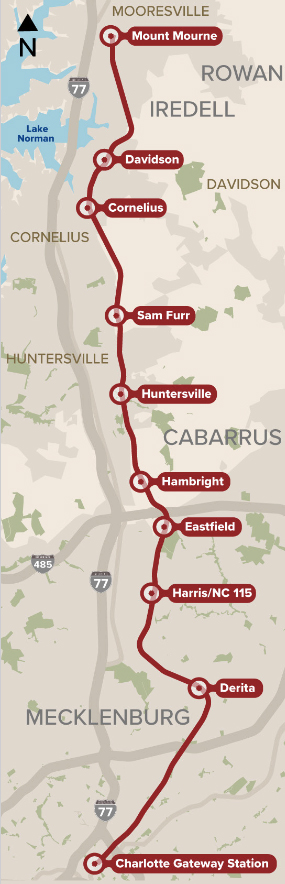
CHARLOTTE, N.C. —Charlotte would pay $91 million to Norfolk Southern for right-of-way and other land needed for a long-discussed commuter rail line running to the north under a proposal presented to city council members on Monday.
The plan includes $74 million for 22 miles of rail line and $17 million for 1.6 acres of land in the area of a downtown station site for the Red Line commuter rail project, the Charlotte Observer reports. There also is a $17.75 million option to purchase an additional 7-mile stretch to extend the line further north from its current planned endpoint at Davidson, in Mecklenburg County, to Mount Mourne in Iredell County; the agreement also allows for purchase for part of that section, or for a lease to gain access.
Norfolk Southern would retain the right to use the route for infrequent freight operations.
The Red Line concept dates to 1998, but Norfolk Southern had opposed the use of its rail line until last year, when it indicated a willingness to discuss its sale [see “Charlotte commuter rail proposal revived …,” Trains News Wire, Oct. 19, 2023]. An agreement between the sides was first reported in May, but details had not been disclosed [see “News report: Charlotte, Norfolk Southern have deal …,” News Wire, May 30, 2024].
The council is scheduled to vote on the proposal on Sept. 3, and on proposed state legislation for a 1-cent sales tax increase for transportation projects. The city plans to use short-term debt to purchase the rail line, but the proposed sales tax bill would allow reimbursement from the tax funds.





Adam Smith warned against doing things such as this.
The 10 times I’ve traveled that part of I-77 the traffic was very heavy. Only once did I do it doing commuter hours which was a mistake that I didn’t repeat. So there is a possibility there might be enough demand to justify it, especially considering it will take some years to get it ready to operate.
Mr Landey says: “What is ridership projection?”
I just went through all the presentation decks and feasibility research and there is no projected ridership data provided anywhere.
So I think this is a “build it and they will come” type of project. If they can’t get the rail funded they will have to settle for a BRT on Express Lanes on I-77.
Must be seeing declining freight service.
At 5% capital recovery, that’s a daily chunk of almost $10,000 a day just for the r/w purchase. Add construction of the tracks, maintenance facilities, stations and park-rides, plus purchase of rolling stock, plus daily O+M, hope for a whole big ridership. What is ridership projection?
It’s easy to draw a line on the map for a route with circles for the stations. Making it all work is a whole ‘nuther thingie.
What’s the return on capital for the interstate? Nada. Remove the double standard. Build the commuter line and make it free to ride, just like the road is.