LAS VEGAS, Nev. — With environmental planning completed for construction of a 200-mph electrified railroad from Las Vegas, Nev., only as far as Victorville, Calif., Brightline West has entered into a memorandum of understanding with California transportation authorities to explore extending tracks to an existing Metrolink commuter rail station in Rancho Cucamonga, Calif., where passengers could transfer for trains to Los Angeles.
The agreement with the California Department of Transportation (Caltrans), the California State Transportation Agency, and the California High Speed Rail Authority, “sets the framework regarding the use of 48 miles within Interstate 15 to be used for Brightline West to connect its planned Victor Valley station and a newly planned station at Rancho Cucamonga,” according to a Brightline announcement.
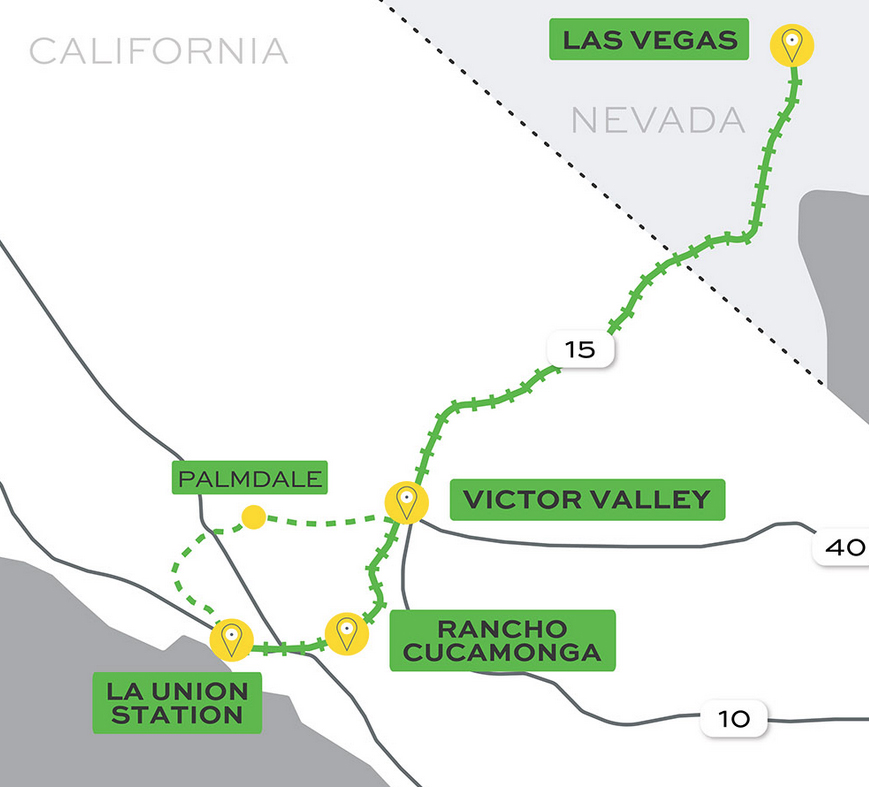
It formalizes the company’s intention to bring trains closer to downtown Los Angeles on two routes: utilizing I-15 over Cajon Pass to Rancho Cucamonga and/or building a line to Palmdale, Calif., known as the “High Desert Corridor Alignment Project.”
Metrolink’s Antelope Valley Line also serves Palmdale, which has been designated as an interim destination for California High Speed Rail Authority’s route from San Francisco and the Central Valley until a separate entry into the Los Angeles Basin can be built. Brightline already has agreements to coordinate planning with both of those agencies and the San Bernardino Transit Authority.
The document tasks Brightline with preparing “an initial high-level feasibility study for the Cajon Pass Project” within 60 days, under the assumption that trains will run on 45-minute headways. It isn’t clear how much preliminary engineering has already been done on the I-15 route, which has far more challenging grades and curvature than the already-vetted 170-mile Las Vegas-Victor Valley segment.
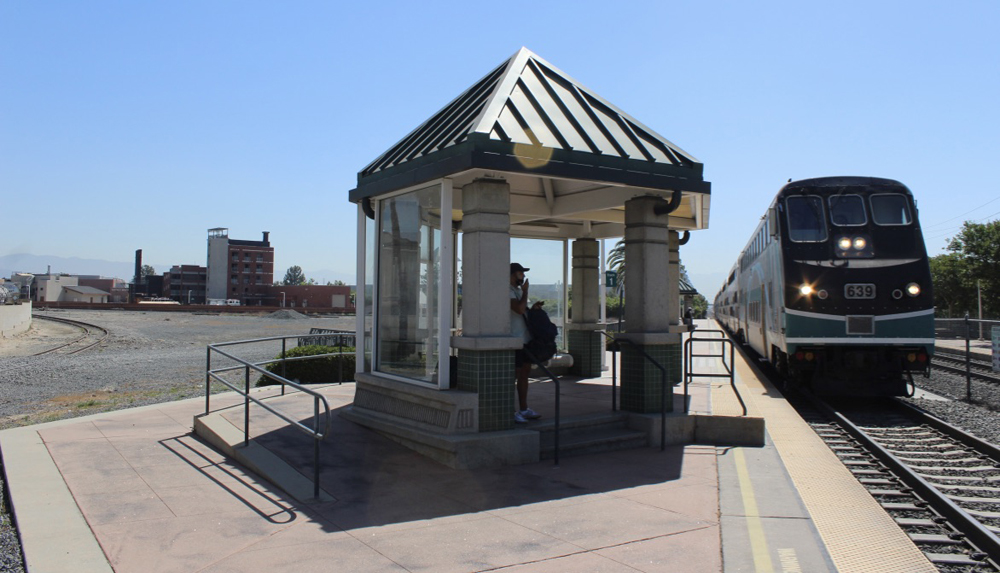
At Rancho Cucamonga, a little more than 40 miles from downtown LA, the document says “a full-service transit station building will include the existing Metrolink platforms and a planned underground tunnel to Ontario International Airport.” This separate $85 million, 4-mile people mover loop proposed by Elon Musk’s Boring Company would use 12-passenger Tesla electric cars traveling at speeds up to 127 mph.
Metrolink travel time could be an issue
Brightline West’s station would provide a cross-platform rail connection to Metrolink’s San Bernardino Line. However, although the route cobbled together from former Santa Fe,
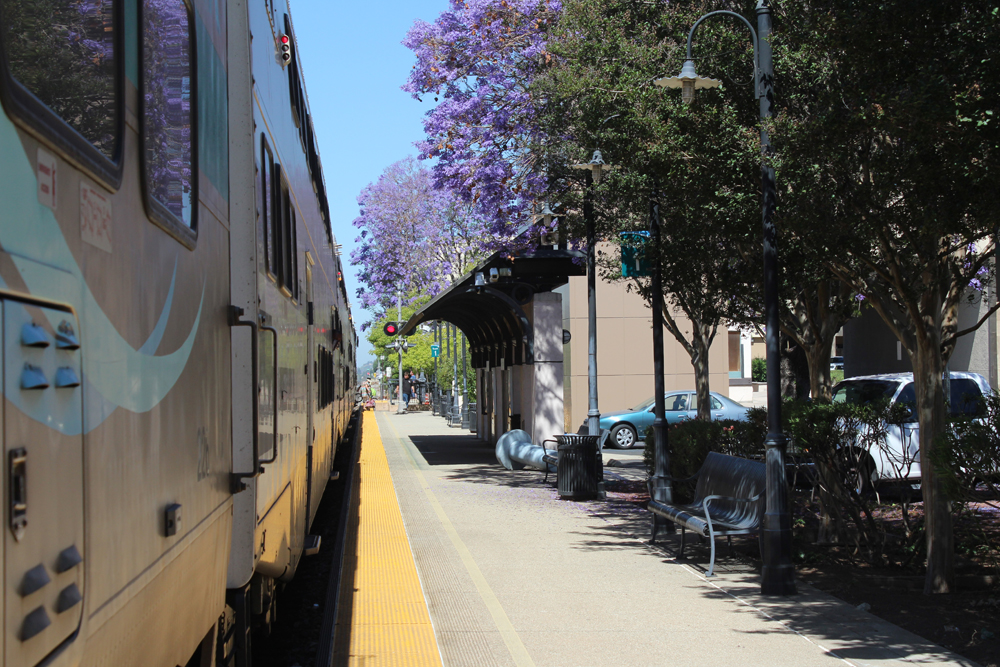
Southern Pacific, and Pacific Electric rights-of-way often allows 79-mph running, it possesses a number of single-track sections in the middle of or adjacent to freeways with little room for expansion. A pair of rush-hour expresses with three intermediate stops between Rancho Cucamonga and LA Union Station make the trip in about an hour, but other trains stop eight times and take 1 hour, 15 minutes.
Meanwhile, although some right-of-way preparation activities have begun on the Nevada portion of the route, financing issues have delayed construction the company originally said would start in 2021 [see “Brightline bond effort pushed back to 2022,” Trains News Wire, June 23, 2021].
The big question looming for this venture — as well as others including Brightline’s Florida expansion to Disney World, the California High Speed project, and Texas Central’s proposed 200-mph Dallas-Houston line — is whether Congress will finally pass infrastructure legislation that will permit greater use of private activity bonds and Railroad Rehabilitation and Improvement Financing loans.
Significantly, the memorandum also specifies that prior to construction on Caltrans rights-of-way, “Brightline West will demonstrate to the reasonable satisfaction of Caltrans that it has the financial ability to complete such portions of the Cajon Pass Project through equity or financing.”
The complete memorandum of understanding is available on the California State Transportation Agency site.
Share this article