WASHINGTON — Amtrak says its additional analysis shows its proposed Gulf Coast passenger service will cause “no unreasonable impairment” on the proposed route between New Orleans and Mobile, Ala., and argues that the case for such impairment by host railroads CSX Transportation and Norfolk Southern “has failed.”
Those contentions are included in the passenger railroad’s latest filing to the Surface Transportation Board in its ongoing effort for a board ruling allowing it to begin Gulf Coast operations. The supplemental brief is responding to a May 12, 2022, request by the board for additional evidence [see “Oberman: Gulf Coast litigants still need to fill in the blanks,” Trains News Wire, May 13, 2022].
The 139-page public version of Amtrak’s filing redacts many of the specific statistics involved in the analyses performed for the passenger operator. The document argues that “it is clear that Gulf Coast service can be restored without the extraordinary capital investments that CSX, NS, and the Port [of Mobile] have demanded, and that any impacts from Amtrak service can be mitigated with routine operational changes and cooperative service planning.”
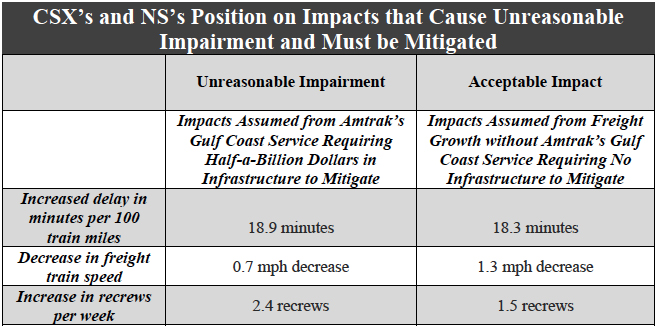
In arguing that the railroads have failed to make their case for unreasonable impairment, Amtrak cites results of their Rail Traffic Controller modeling, saying they show nearly equal or worse impairment developing as freight traffic increases, given that NS and CSX say no infrastructure improvements are needed for freight traffic. Amtrak summarizes what it says the model shows in this table.
Amtrak says in its filing that its position “remains that the evidentiary burden is on the host railroads to demonstrate unreasonable impairment” and that because the railroads have not met that burden, “Amtrak is entitled to an order in its favor” regardless of the material in its latest filing.
— Updated at 5:10 p.m. CDT to add link to Amtrak filing.
Share this article