





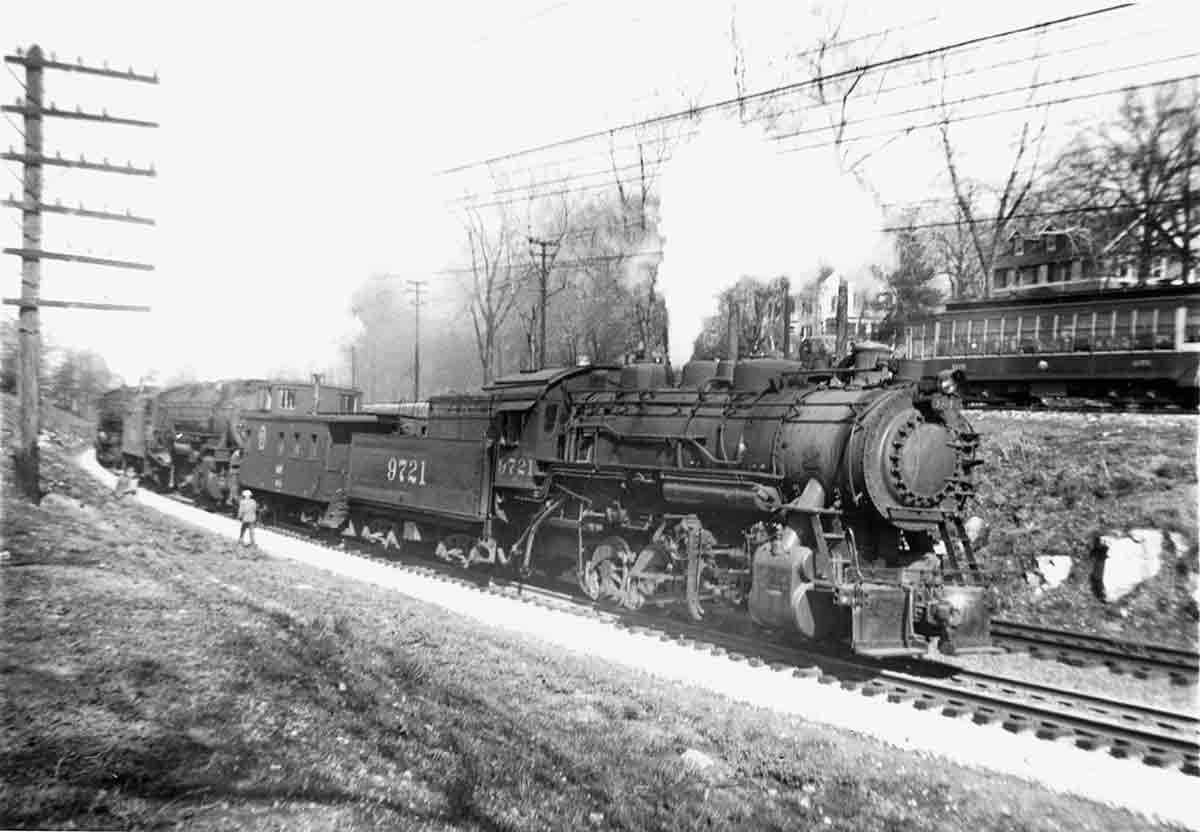
After a 2-10-2 and 4-8-4 stalled on MoPac’s Kirkwood Hill, an 0-8-0 and caboose couple up to render assistance.
Joe Collias
Heading west from St. Louis, Missouri Pacific trains faced the 6-mile-long, 1-percent grade known as Kirkwood Hill. Normal train length was 100 cars, powered by one of the rebuilt 2101-class 4-8-4s and led by an ex-Wabash 2-10-2 helper locomotive. Once out of the yard, the usual approach to the grade was to charge full speed ahead at 35 to 40 mph as far as possible, then settle down to a steady crawl once on the ascent.
No. 75 was a freight train of just that length and motive power, which followed, as per rules, train 15, the Scenic Limited, west at 2 p.m. each day. This day in March 1946 was no exception.
A well-worn path paralleled the tracks for most of the climb, enabling a train-smitten youngster on a bicycle to pace the train’s progress most of the way. I was doing just that when suddenly the driving wheels of both locomotives spun wildly, something the engineers seldom allowed. Both engineers worked throttles, valve motion, and sanders to no avail, and the train came to a stop. Crews alighted to find the reason for such lack of motion, including the conductor, who trudged forward from the caboose 100 cars to the rear and was obviously not too happy about the situation.
The crews discovered that a coating of fresh, slick oil covered the rails for well over 100 feet, enough to cause both engines to lose their footing on the uphill climb. Sanding the rails was of little benefit, as the driving wheels could not move forward enough to reach the sanded areas.
A call for help was made on a nearby lineside telephone, and the operator at Kirkwood Tower soon arrived, by auto, to assess the problem. Shortly after he left, considerably more physical help arrived in the form of a husky 0-8-0 switch engine that had been working in the small yard at Kirkwood.
Using wads of waste packing, the crew members wiped the railheads clean and tossed sand under the wheels. The low-drivered 0-8-0, accompanied by a caboose, coupled to the front of the train and, with a mighty surge of power from all three locomotives, No. 75 was once again in motion, albeit slowly. The trio crawled to the top of the grade, where the 2-10-2 and the 0-8-0 were uncoupled. The road engine and its train moved away rapidly down the west slope of the hill to continue the delayed journey west.
As was my usual practice, I had a small box Brownie camera, won on a grocery punch card, in my overalls pocket and was able to record the commotion. No explanation for the oil-covered track was ever found.
First published in Fall 2010 Classic Trains magazine.
No. 75 was a freight train of just that length and motive power, which followed, as per rules, train 15, the Scenic Limited, west at 2 p.m. each day. This day in March 1946 was no exception.
A well-worn path paralleled the tracks for most of the climb, enabling a train-smitten youngster on a bicycle to pace the train’s progress most of the way. I was doing just that when suddenly the driving wheels of both locomotives spun wildly, something the engineers seldom allowed. Both engineers worked throttles, valve motion, and sanders to no avail, and the train came to a stop. Crews alighted to find the reason for such lack of motion, including the conductor, who trudged forward from the caboose 100 cars to the rear and was obviously not too happy about the situation.
The crews discovered that a coating of fresh, slick oil covered the rails for well over 100 feet, enough to cause both engines to lose their footing on the uphill climb. Sanding the rails was of little benefit, as the driving wheels could not move forward enough to reach the sanded areas.
A call for help was made on a nearby lineside telephone, and the operator at Kirkwood Tower soon arrived, by auto, to assess the problem. Shortly after he left, considerably more physical help arrived in the form of a husky 0-8-0 switch engine that had been working in the small yard at Kirkwood.
Using wads of waste packing, the crew members wiped the railheads clean and tossed sand under the wheels. The low-drivered 0-8-0, accompanied by a caboose, coupled to the front of the train and, with a mighty surge of power from all three locomotives, No. 75 was once again in motion, albeit slowly. The trio crawled to the top of the grade, where the 2-10-2 and the 0-8-0 were uncoupled. The road engine and its train moved away rapidly down the west slope of the hill to continue the delayed journey west.
As was my usual practice, I had a small box Brownie camera, won on a grocery punch card, in my overalls pocket and was able to record the commotion. No explanation for the oil-covered track was ever found.
First published in Fall 2010 Classic Trains magazine.
Learn more about railroad history by signing up for the Classic Trains e-mail newsletter. It’s a free monthly e-mail devoted to the golden years of railroading.


I can’t help but notice the streetcar above 0-8-0!
I know west of Kirkwood station is a hill, I can hear trains growling as they come up and go past the station. Never paid any attention when I’ve rode Amtrak east or west that there was much of a hill. I never knew about any hill east of the station. Cool picture too and also wonder about streetcar. I could have been done by bo’s to hop on easier, makes sense. Or maybe kids pulling a prank. If an engine that passed there earlier and lost a lot of oil that would have been noticed.
Bo;s may have greased the tracks so that they could easily get aboard and stow away.
Great tale and photo. I echo Matthew’s comment about Kirkwood Hill, but come to think about it, it is an uphill climb out of Webster Groves, but surely not as steep or long as the climb from Valley Park. What I like about the photo is that you also captured a streetcar in the background. I’m curious what line that was.
Great story, Joe! But all this time I thought “Kirkwood Hill” was the EAST-bound ascent from down in Valley Park to Kirkwood. I wasn’t aware of a westbound hill of that steep of a grade approaching Kirkwood from the east!