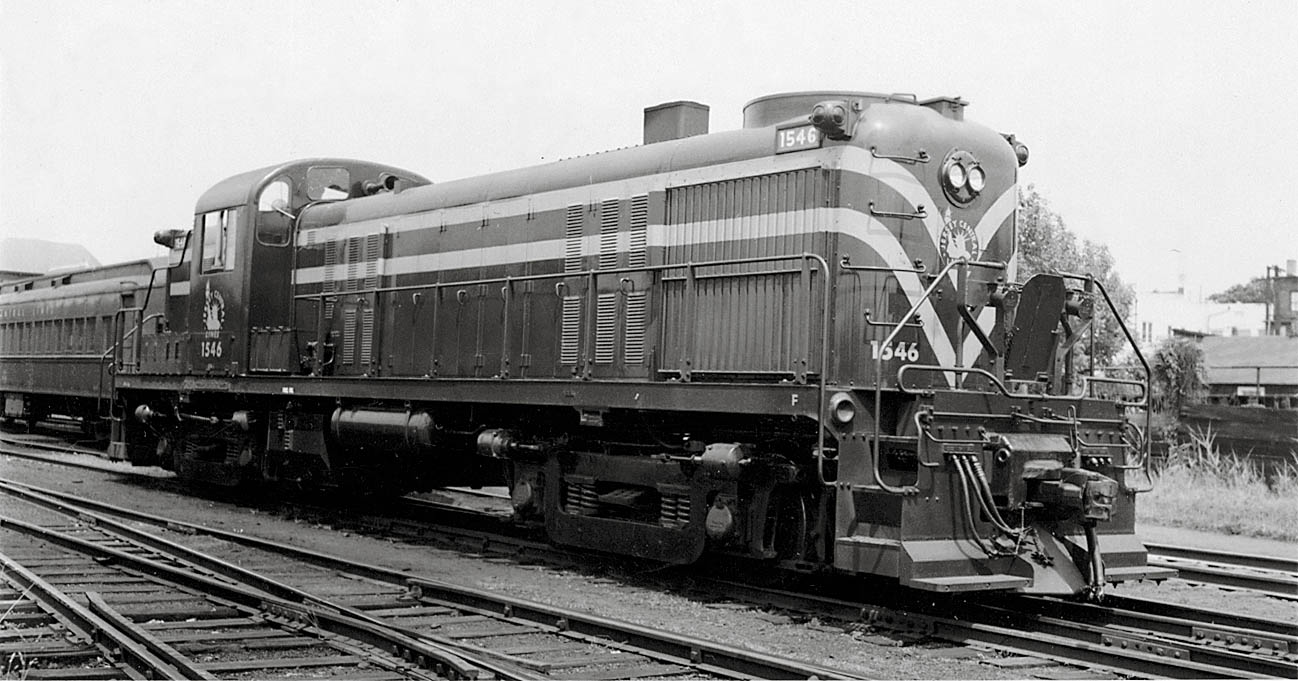
A First, it’s important to note on any diesel where the little “F” is painted. That end, of course, normally is the leading end, but its real purpose is to establish for the whole crew which way is “forward” and which is “reverse” when the conductor or designated ground crewmember gives hand or radio signals to the lead unit’s engineer to move the locomotive or train.
The first “hood unit” or road-switcher, the pre-World War II Alco RS1, was designed to run long-hood forward, as were most – but not all – later Alcos and Baldwins. EMD’s postwar GP7 usually was set up short-hood forward, but the set-up was a customer option. In the GP7/GP9 era, many Eastern roads, plus the Great Northern, chose long-hood forward, but they were the minority. Some roads specified dual controls, enabling the engineer to run either way from the right side of the cab; commuter carriers such as the pictured Central Railroad of New Jersey were good examples.The lack of a wye or turning facility on a given route often required a solo engine without dual controls to run long hood first, engineer on the left. Regardless, the fireman had lookout duty, especially on his side.
A few railroads (Southern and Norfolk & Western stood out) chose dual controls but ran long-hood first by agreement with the Brotherhood of Locomotive Engineers and/or Brotherhood of Locomotive Firemen & Enginemen; the stated rationale was to provide protection for the engine crew in the event of a grade-crossing collision. (The Pennsylvania Railroad’s GG1 electrics were designed with cabs toward the center for the same reason.)
By the 1950s, firemen in diesel cabs became a hot topic, and management fought to eliminate them. The issue wasn’t settled until the gradual transition mandated by the Presidential Railroad Commission of 1960-62, created by Executive Order No. 10891 to hold hearings and to resolve the long battle as whether firemen were needed on diesel locomotives and whether their positions could be cut.
While the fireman’s position was being eliminated, new RSs and Geeps featured low short hoods. Railroads still had a second crewman in the cab (head-end brakeman or, with elimination of cabooses, the conductor on freights). In any case, the second person needed to be qualified on locations and indications of all lineside signals. On many passenger trains today, only the engineer is in the cab. – Bill Withuhn, curator emeritus, National Museum of American History, Smithsonian Institution