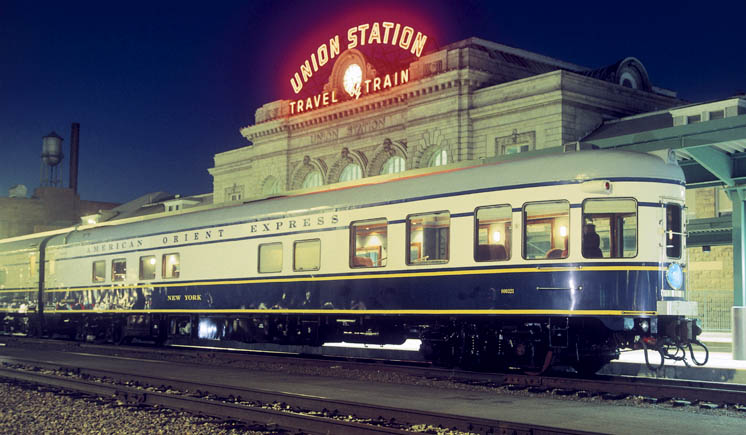
A The genesis of the American Orient Express was the American European Express, which begin operation in February 1989 between Washington, D.C., and Chicago. The service operated with a pair of consists each including a diner, lounge with grand piano, and three sleepers coupled to Amtrak’s Capitol Limited. Later, the service operated Chicago-New York as part of the Broadway Limited. Later yet, the two five-car consists were combined and an 11th car was added, former 20th Century Limited observation Sandy Creek. The service shut down in October 1991.
The equipment came to life again in 1994 as the American Orient Express, purchased by venture capitalist Henry Hillman in November 1997. The service would run under that name until spring 2006 when, under legal pressure from Venice Simplon-Orient-Express in Europe, it was rebranded as GrandLuxe Express, and sold to Colorado carbuilder Tom Rader.
GrandLuxe Rail Journeys, which left the cars largely as they were, declared bankruptcy in August 2008. Twenty-five of its 31 cars were purchased by Philip Anschutz’s Xanterra Parks & Resorts, which operates the Grand Canyon Railway. With the goal of starting the American Railway Explorer, an AOE-like operation but even more upscale, Anschutz began a multi-million-dollar conversion, which included gutting the cars for asbestos remediation. Floor plans were created, schedules planned, and brochures printed. Then, in August 2011, with most cars gutted, work stopped and never resumed.
Fifteen of the cars were acquired by the Greenbrier Presidential Express, a luxury parlor car train slated to run between Washington and the Greenbrier Resort in White Sulfur Springs, W.Va. The train was the brainchild of Ross Rowland, who hoped to use former Chesapeake & Ohio 4-8-4 No. 614 as motive power, and Jim Justice, the coal magnate who had acquired the resort. These cars were moved to the former Bethlehem Steel plant in Pottsville, Pa., but little work was done before the project stalled. In September 2014 nine of these cars were sold at auction. – Karl Zimmermann