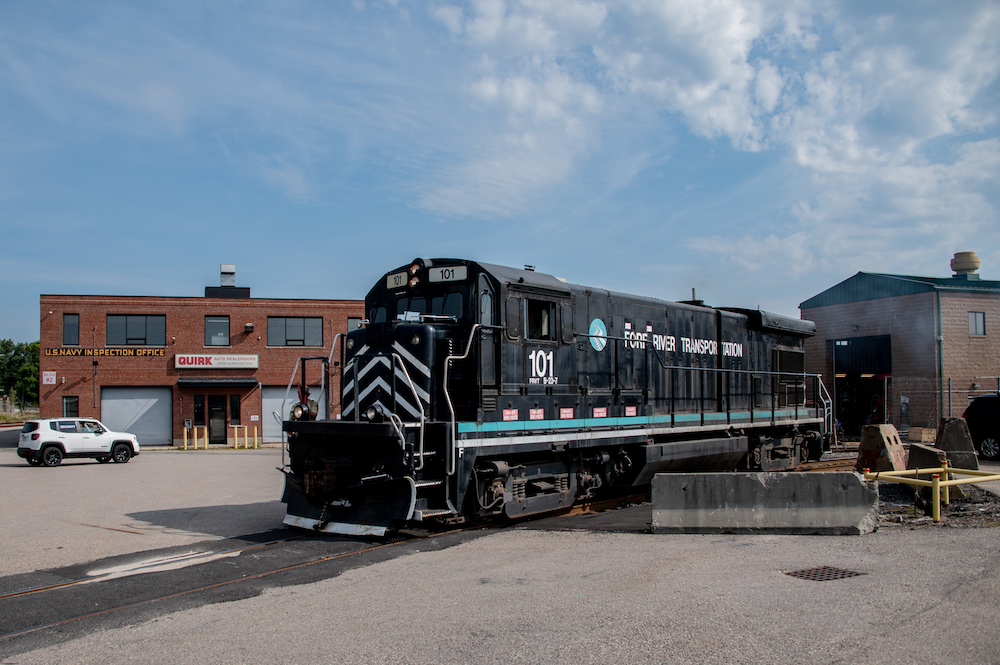
The Fore River Railroad, a 2.5-mile short line in Quincy, Massachusetts, has defied the odds by surviving and thriving for 122 years. Originally established in 1903 to serve a new shipyard, the railroad was formally incorporated in 1919. Despite the shipyard’s closure in 1986, the Fore River Railroad continues to operate, thanks to a combination of adaptability, strategic partnerships, and its role in the Boston Harbor cleanup effort.
Initially, the railroad was vital for the Quincy shipyard, which changed ownership several times, including periods under Bethlehem Steel and General Dynamics. When the shipyard closed after a long history of building various vessels, including warships during WWII, the Massachusetts Water Resources Authority (MWRA) acquired the property and the railroad in 1987. This acquisition proved crucial for the railroad’s survival, as the site became essential for the Boston Harbor cleanup. The facility now processes sludge from the Deer Island wastewater treatment plant, contributing to the area’s environmental efforts.
The railroad’s history is closely tied to Thomas A. Watson, an assistant to Alexander Graham Bell, who founded the shipyard. When the New Haven Railroad declined to build a branch to his shipyard, Watson constructed his own connecting line, which began operations in 1903. Over the years, the railroad’s motive power evolved from early steam locomotives to diesel engines, including GE 50 toners, Whitcombs, GE 70 toners, and an Alco S6 switcher, which remains on-site and is owned by the MWRA.
Today, the Fore River Railroad is owned by the MWRA and operated by Fore River Transportation. It connects the deepwater anchorage at Quincy Point to CSX in Braintree, Massachusetts, running over the MBTA’s Greenbush Commuter Line. While its role in MWRA operations is currently minimal, its primary customer is Twin Rivers Technologies, an oleochemical works. Twin Rivers receives raw materials by ship and rail and ships refined products via tank cars, resulting in over 5,000 car movements annually.
Daily operations on the Fore River Railroad are a display of efficient teamwork. The railroad operates five days a week, coordinating with CSX for interchanges. A typical day begins the night before at Twin Rivers, where crews prepare cars for the morning move. Train movements are handled by former-Conrail General Electric B23-7 locomotives. The crew, consisting of an engineer, conductor, and brakeman, navigate the line’s 2% grade and tight curves, coordinating with the MBTA for clearance on shared tracks.
Looking to the future, the Fore River Railroad’s current business is stable due to Twin Rivers Technologies. However, the railroad could benefit from diversifying its customer base. Its strategic location, with water access and a large yard, presents possibilities for growth and continued success.
Read Stephen Delaney’s full article on the Fore River RR in the May 2025 issue of Trains Magazine.
Share this article