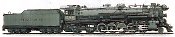
Texas & Pacific 600 was from the first group of 2-10-4’s.
In 1919 Santa Fe purchased a group of 2-10-2’s. One of them, No. 3829, was built with an experimental four-wheel trailing truck, but was otherwise identical to the rest of the group. The experiment was inconclusive: No. 3829 was not converted to a 2-10-2, nor were other 2-10-2’s fitted with four-wheel trailing trucks.
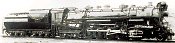
Central Vermont 700 and sisters had small drivers and low engine weight; they were more akin to 2-10-2 drag engines than later Texas types.
In 1925 Lima stretched its Super-Power 2-8-4 design with a fifth set of drivers to increase tractive effort while keeping the axle loading low. The new wheel arrangment, 2-10-4, was named Texas in honor of the first road to buy the type, Texas & Pacific. Between 1925 and 1929 the type was built with drivers in the 60″-64″ range, and suffered to some extent from the counterbalancing problems that plagued low-drivered 2-10-2’s. In 1930 Chesapeake & Ohio stretched Erie’s 70″-drivered Berkshire into a Texas with 69″ drivers, creating a 2-10-4 that was both powerful and fast. It set a pattern for 2-10-4’s designed thereafter. The only 2-10-4’s built with low drivers after 1930 were for railroads that already had such locomotives. The largest drivers used on the type were 74″, on Santa Fe 5001-5035 (No. 5000 had 69″ drivers).
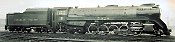
Canadian Pacific 5928 and CP’s other “Selkirks” were the largest engines in the British Empire and the biggest steamers ever streamlined, but nevertheless were rather modest by 2-10-4 standards.
With one exception the 2-10-4 was a freight locomotive – Canadian Pacific used semistreamlined 2-10-4’s in passenger service through the Rockies. While Texas types remained in service quite late on a few railroads to protect traffic peaks, the job they did – hauling heavy freight trains long distances at high speeds – was the one for which railroads were most willing to spend money to dieselize. They were generally outlived by smaller locomotives.
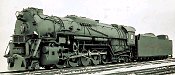
Pennsylvania 6456, with high headlight, drop-coupler pilot, and big tender, looked like a Pennsy engine, but was basically a C&O design.
- Other names: Colorado (Chicago, Burlington & Quincy), Selkirk (Canadian Pacific)
- Total built: 429
- First: Texas & Pacific 600, 1925
- Last: Canadian Pacific 5935, March 1949
- Longest lived: Central Vermont 707, 1928-1959; Chicago, Burlington & Quincy 6310-6321 may be runners-up
- Last in service: Duluth, Missabe & Iron Range’s ex-Bessemer & Lake Erie 2-10-4’s were scrapped in 1961, but it is doubtful they were used in the two years before that; 1959 scrap dates are listed for 2-10-4’s of Canadian Pacific (Nos. 5930-5935); Santa Fe, and Central Vermont (No. 707)
- Greatest number: Pennsylvania Railroad, 125
- Heaviest: Pennsylvania Railroad J1, 575,800 pounds
- Lightest: Central Vermont 700-709, 419,000
- Recommended reading: North American Steam Locomotives: The Berkshire and Texas Types, by Jack W. Farrell, published in 1988 by Pacific Fast Mail, P. O. Box 57, Edmonds, WA 98020 (ISBN 915713-15-12)
Excerpted from “Guide to North American Steam Locomotives,” by George H. Drury, Kalmbach, 1993.