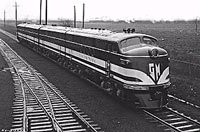
Tagged “the diesel that did it” by David P. Morgan, longtime editor of Trains Magazine, in a 1960 feature story, four-unit locomotive No. 103 of General Motors’ Electro-Motive Corporation was outshopped at a Grange, IL, plant in November 1939 (the firm later became GM’s Electro-Motive Division). The four-unit machine-193 feet long, weighing 912,000 lbs., and rated 5,400 hp – was painted dark green with yellow. It toured 20 railroads in 35 states, rolling out 83,764 miles in 11 months, and was so successful that it is considered the largest single factor that pointed U.S. railroads toward total dieselization, accomplished about two decades later. One cab from this quartet is preserved at St. Louis’s Museum of Transportation. A total of 1,096 FT’s were sold.
The prototype GP7, “GP” for General Purpose, was the first of three demonstrators turned out by Electro-Motive Division in 1948. This trio sired the most popular line of diesels in American history, the “Geep” (say it Jeep), which sold 7,376 units of three models into the 1960’s. The trio was numbered 100, 200, and 300, and painted silver with blue bands and yellow striping, with a black underbody. All three wound up on Chicago & North Western, numbered 1518-1520, and were later rebuilt with chopped short hoods. This unit, painted as C 1518, is preserved at the Illinois Railway Museum in Union, IL today.
Making a quantum jump at the time with its 20-cylinder 645-model engine, Electro-Motive’s 3,600 h.p. SD45 of 1965 was a success, selling 1,312 units, virtually all for long-distance freight service. Problems with some early units’ crankshaft gave the model and undeserved bad reputation, but proof of the SD45’s worth is that several dozen operate today, only moderately rebuilt. Regional carrier Wisconsin Central alone operated more then 100 of them, and much of the fleet migrated to successor Canadian National. No. 4353, painted in GM corporate blue and white, was one of several SD45 demonstrators and prototype units. The odd L-shaped engineer’s-side windshield was introduced on this unit, but most railroads chose the conventional shape, as it was easier to replace. Norfolk & Western and Southern bought high-nose SD45’s, and Chicago & North Western’s lacked dynamic brakes.
Representing over 400 units lumped under the “44-tonner” label is this General Electric example working for a Cuban sugar mill. The type of center-cab locomotive, with a small diesel engine (often Caterpillar brand, as on this one) under each hood, was common on industrial railroads. Its popularity spread onto common carriers after the “90,000 pound rule” of a 1937 labor agreement, which protected firemen’s jobs on any diesel above that weight. GE built the majority of “44-tonners,” from 1940 through 1956, but other builders did too, including Davenport, which did do first, in 1939; Porter and Whitcomb. All specialized in building small industrial locomotives.
General Electric broke from its historic concentration on straight electric locomotives, industrial diesel switchers, and electrical components for other builders’ big diesel-electric with U25B. The 2,500 hp road diesel was introduced in 1959 after trials with slightly smaller sisters. The designation means Universal series, 2500 hp, and a “B” (four-motor) truck. The second set of U25B demonstrations was the flashiest, in bright red and white, three with the then-standard high short hood, and 2501, with the new “low-nose” look. The latter style would prevail, and 2501’s single-piece windshield would eventually be replaced by a two-piece. GE’s challenge put Alco out of the U.S. diesel business within six years, and in the early 1980’s, bigger GE successors finally usurped the leadership position of GE’s ultimate target, GM’s Electro-Motive Division. GE had yet to relinquish the lead in in the early 21st century.
Not strictly a demonstrator, and A-B-A three-unit set of 2,000-hp passenger diesels destined to become Santa Fe No. 51 was designated by American Locomotive Company (Alco) as its 75,000th locomotive, and introduced in September 1946 on the private siding of New York’s Waldorf-Astoria hotel. The post-World War II passenger diesel entry by the partnership of Alco-GE (Alco engine, GE electricals) barely made a dent in the popularity of EMD’s E-series units, but the “PA’s” came to be known for their rugged good looks and lugging ability. The model designation was applied retroactively, standing for Passenger A (or cab) unit; a booster unit; a booster unit was a PB. Only 297 were built, through 1953.
Alco Products, as American Locomotive Company renamed itself, challenged EMD’s Geep line first with 1,500 and 1,600 hp, rounded-hood RS2’s and RS3’s, and then in 1956 with this sort-of Geep lookalike, the DL701. (DL was an Alco specification number; more popular was the later designation of RS11.) Alco’s new 251 engine required a higher hood than its older 244 did, hence the Geep look, but with Alco’s distinctive notched corners for the sand filler caps and numberboards. The 1,800-hp unit wore a color scheme of dark green and gray, with yellow striping; 426 RS11’s were sold.
EMD had its “bulldog nose” F unit series, and Alco its flat-faced FA’s, but you couldn’t mistake Baldwin’s second series of road freight cab diesels. Styled in the spirit of Raymond Loewy’s Pennsylvania Railroad T1-class 4-4-4-4 steamers, the “Sharknose” diesels were unmistakable, as this red, white, and gray demonstrator set reveals. Alas, looks don’t equal sales, and only 232 were sold, to Baltimore & Ohio, New York Central, and Pennsylvania Railroad. The demos themselves went to Elgin, Joliet & Eastern, and later to B&O. The “Sharknose” DR-4-4-15 series, at 1,500 hp, was introduced in 1949 (the 1,600-hp RF-16 followed in 1950), succeeding Baldwin’s even-less-popular “Baby Face” freight cab units, of which only 33 were built. The last Shark was built in 1953.
Fairbanks-Morse’s entry into the cab-unit road diesel market was with its Consolidation series. The “C Line” was offered during 1950-55 in several horsepower levels and wheel arrangements for freight or passenger service (or both). The passenger units, illustrated by this pair of 2,400-hp orange-and-green demonstrators, were unusual in having one B and one A1A truck; the extra rear axle helped accommodate a steam generator. FM’s model designation for these was CPA-24-5, indicating passenger A unit, 2,400 hp, five axles. CPA’s and CPB’s of three horsepower levels (1,600; 2,000; 2,400) sold to Canadian National, Long Island, New Haven (which got this pair), and New York Central, but only a total of 42 units; the C-Line altogether sold only 123 units.
Steam builder Lima Locomotive Works, seeing the diesel future, merged with engine-maker Hamilton in 1947 and made a worthy but short entry into diesel-electrics before Baldwin acquired the company in 1950 to become Baldwin-Lima-Hamiltion. Lima turned out 174 units in four switcher, one road-switcher, and one big center-cab transfer configuration, including this solid black 1,000-hp switcher. Lima’s switchers sold to a dozen railroads.