Railroad watches
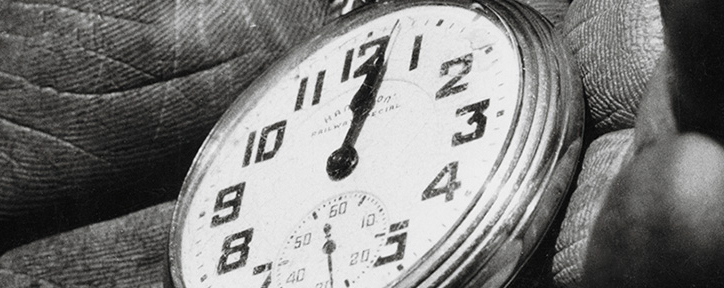
In the era of timetable and train order operation, railroaders had to have a standard railroad watch. In those days Hamilton, Elgin, and Waltham were among several popular brands.
Railroad pocket watch standards
But there were dozens of watch companies making “railroad approved” watches that had mandatory features by the 1930s: a minimum number of jeweled bearings or bearing surfaces (usually 21) for watch gears ensured consistent and reliable operation; white dials with black Arabic-only, no Roman, numerals ensured easy reading in dim light; and an internal setting “lever” prevented railroaders from accidentally re-setting the watch while working.
Railroad watches — almost exclusively all pocket watches until Bulova Watch Co.’s famed Accutron of the 1960s — also had to be adjusted so they would remain accurate in heat, cold, and regardless of how much power, or wind-up, was left on a watch’s main spring. Position adjustments were also important in these hand-wound time-keeping machines. Railroad-approved watches needed to tell time accurately — typically, plus or minus 3 seconds a day — regardless of whether they were held upright, tilted left, tilted right, face-down or face-up. Certain watch manufacturers took an added step and made sure their watches were accurate even if held upside down.
Watch crystals of the time were indeed made of glass that could break and needed periodic replacement. Water resistance was not even considered.
Railroad pocket watch maintenance
On the Santa Fe, as an example, a railroad watch had to be checked every 15 days by a standard watch inspector. Most larger towns that the railroad operated through had a jewelry store with a certified watch inspector. Railroaders watch cards were signed and dated every 15 days.
For decades, the formal inspection ritual was carried out without fail. Spot checks could be made by supervisors at any time, and if a railroader’s card was not signed that person was subject to discipline. The importance of a reliable watch in the operation of trains was a matter of deadly concern. Before Centralized Traffic Control, trains operating on single track depended on time accuracy to the second, to facilitate the safe meeting and passing of trains.
Railroaders with watches not keeping time might be able to obtain a loaner from the jewelry store while the watch was repaired or cleaned.
Railroad pocket watch use
Before starting a trip, the operating crews had to check their watches with the standard clocks located at round houses, dispatching offices, or where crews went on duty, indicating how many seconds slow or fast they were on the watch-register book. The clocks themselves could be updated from telegraph-sent time signals. Conductors and engineers compared watches, as did the engineer and fireman, all to ensure that all crew’s watches were accurate.
A typical new watch at this time cost $125. If bought in 1930, that same watch would cost about $1,982 in 2021. Railroaders with more money could also seek out “extras” such as cases made with gold-filling or even solid gold instead of the common nickel-copper or base-metal cases. Watch companies also offered watch models with a kind of power indicator showing how much wind was left on a watch, different styles of Arabic numerals on dials and even more elaborate case designs or machined artwork on the inside of the watch. None of those options, of course, were required for proper timekeeping.
For railroaders, monthly payments were available through payroll deduction and many new men took advantage of this method of securing the required standard watch.
For today’s railroaders, exact time is less important for train operations. A Timex or any watch is now sufficient. Trains are met and passed by the dispatcher pushing a button, sometimes hundreds of miles away.