I was hired as a yard clerk for the Southern Pacific in San Jose, Calif., in April 1960. On my first day, I was ushered into the general yardmaster’s office and given a short talk on safety. The general yardmaster, an old head named Ralph Fanning, stood behind his desk and regarded me suspiciously.
“Remember, kid, nothing in the world rolls as quietly as a boxcar. Don’t ever forget that. And when you pass around the end of a standing freight car, make sure you’re 10 feet from the end of the car before you start to cross that track. And another thing, this place is twice as dangerous at night as it is during the day. Be extra careful at night. If you get hurt, it might be 8 hours before anybody misses you.”
He said other things about safety that I don’t remember, but I never forgot those three gems.
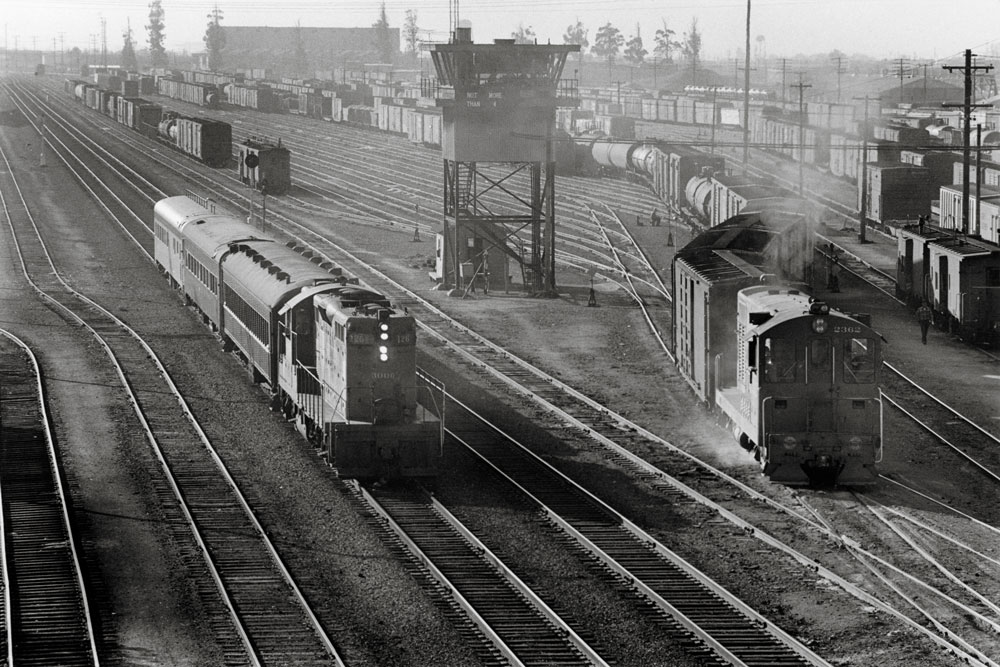
The San Jose yard was almost a mile long, and in 1960 it had 33 tracks. Normally, two switch engines worked each end, and they were kept busy. There was no hump, just flat switching. Several large banks of floodlights, high on poles, similar to those found in baseball parks, illuminated the yard at night.
SP yard clerks had a variety of duties, inside and outside. When you’re new, you spend most of your time outside. The most common outside job was checking the tracks where trains were being made up to see what cars had been added. Switch crews would break up cuts of cars at the end of the yard, and then kick them down various tracks, where they would coast along and couple to other cars. When the crew finished, the clerk would find his list for that track, locate the last car he had recorded, and then copy down any “adds” that had been shoved in since then. You might be working eight or 10 tracks at a time, so you had to be observant and not forget a track. When it looked like the crew was finished, you would either call your “inside man” with the adds or give him the new list in person. The order that the cars were in was important because that string of cars would soon be a freight train headed for Los Angeles or Oakland or San Francisco or Tracy, or one of several other Bay Area destinations.
I wasn’t on the job long before I pulled a night checker’s job. One chilly spring evening, I was working the east end of the yard. Track 4 had the last car quite a way down into the yard, so I had a long walk to get to it. I recorded some adds and then thought I should check track 5, since I heard cars couple up nearby. The switch crew was still working, and they had shoved two boxcars into track 4, which were slowly rolling toward me. Since I wanted to go around the end of the last car on track 4 and find the adds in 5, I peered down track 4 to make sure I had enough time to go around the end of the car and go back on the other side. Those two boxcars were getting closer, but still about 200 feet away, and I thought I could make it before they arrived.
For some reason, I suddenly got a strange feeling that I shouldn’t go around the end of that car. Again I looked down the track, and the two boxcars were a little closer, but I thought, “What the heck! Walk down two car lengths, and when they couple up, get the numbers, and then cross!”
I turned and started to walk away, when out of the comer of my eye, I was horrified to see the end of an empty flatcar go by me, no more than 3 feet away! It coupled up to the last car in track 4, the one that I just almost crossed around, with a loud crash. In the backlighting of the big floodlights, I could not see that between me and those two boxcars rolling toward me were two empty flatcars. Had I crossed when I first wanted to, I would probably not be here today. When I finally realized what had happened, I felt weak in the knees and barely made it to a switchman’s shanty nearby, where I sat down for a few minutes. I always said that the Good Lord was with me on the job that night!
BRUCE BATTLES grew up around railroads — his dad was a Western Pacific station agent. In addition to SP, he also worked for WP, before spending 26 years as a computer programmer. He retired in 1994 and lives in Menlo Park, Calif.
Share this article