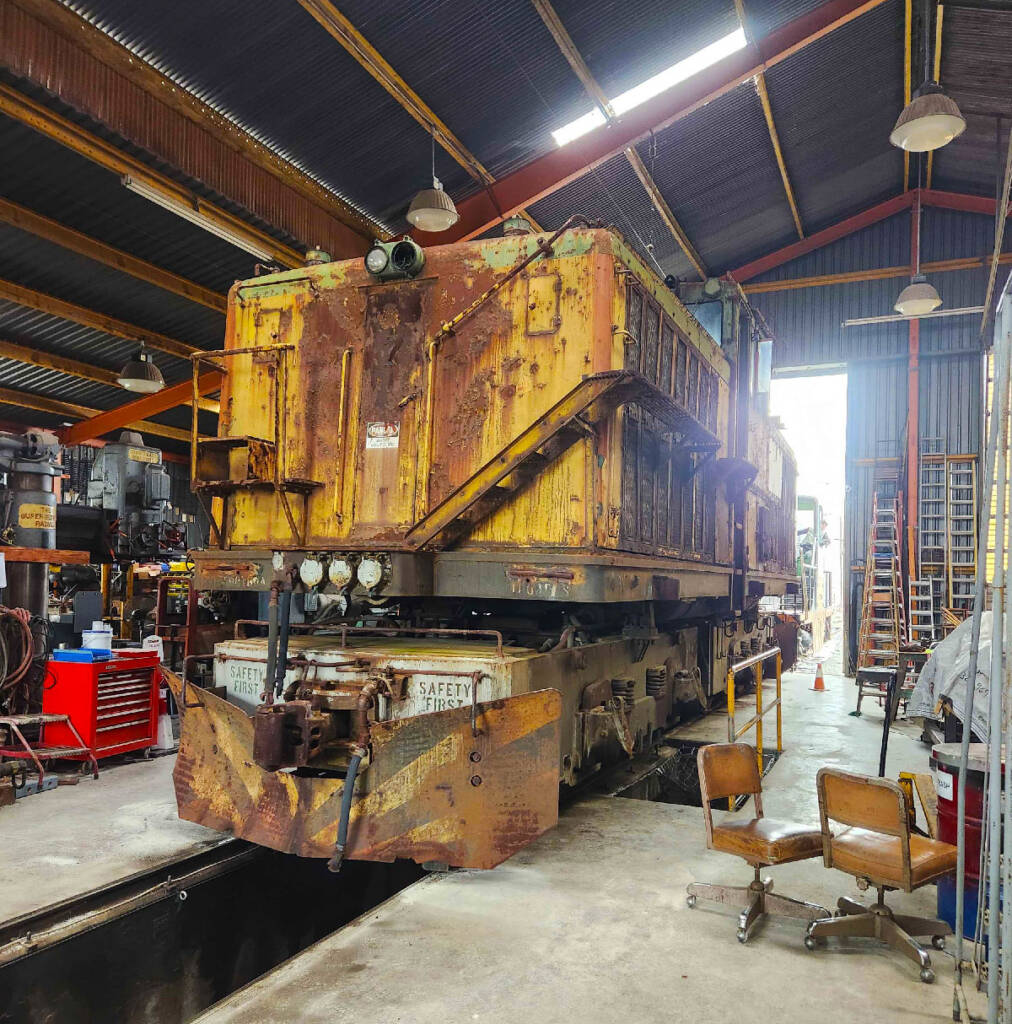
SUISUN CITY, Calif. — The Western Railway Museum is currently evaluating Kennecott Copper No. 407, a rare GE 125-ton center cab electric locomotive, to ascertain if it can be returned to operation.
“Based on our initial inspection and the work completed over the last two weekends, 407 is shaping up to be a very solid candidate for a return to demonstration service,” says Alex Marcopulos, museum project leader. “During the initial evaluation we removed years worth of accumulated dust and debris from the locomotive, likely including genuine ‘Utah dust,’ since the unit has effectively sat untouched since the day it arrived at the museum. We’ve also begun reconnecting the traction motor cables and air brake piping/rigging. That process has already required replacing a significant amount of hardware that was either rusted solid or was missing entirely.”
No. 407 is one in a class of seven units built by General Electric at its Erie, Pa., plant in 1947. With builder number 29120, and originally wearing No. 7, this locomotive was released by GE on Nov. 22, 1947. The numbering change came in May 1964. It was retired on March 31, 1982. The locomotive can operate on either 750 or 3,000 volts DC. At the time they were built, these locomotives were some of the largest electric industrial units in operation.
The 125-tonners worked in three rotating pairs to move 90-car copper ore trains between the open pit mine at Bingham Canyon, Utah, and ore concentrators at either Aurthur or Magna or the smelter at Garfield, Utah. The seventh unit was assigned to dumper service at either Aurthur or Magna. The locomotives powered 18 daily, 28-mile round trips between the Coppertown yard, near the mine, and either Aurthur or Magna. From 1948 through 1964, Nos. 1-7 averaged 50,000 miles annually.
In recent years, there have been numerous steam locomotive restoration projects. There are similarities between these and restoring an electric locomotive, explains Marcopulos. “A lot of the foundational railroad mechanics are the same,” he says. “You still start with the basics: Do the wheels turn? Do all the different bearings behave? Do the brakes apply and release correctly? Does the rigging move as it should? Is the truck/frame structure sound? In both steam and electric, you’re often dealing with long-stored equipment, corrosion, missing hardware, seized fasteners, and the need to prove that the machine can operate safely and repeatably.”
The mission of the Western Railway Museum is education regarding electric railways. The No. 407 restoration is also an educational project. Through work on the locomotive, the museum is engaging and developing younger volunteers. The volunteers learn museum, electrical, and mechanical skills through the project.
“For me, 407 is more than a restoration project,” says Marcopulos. “It’s a hands-on training platform. While getting the locomotive back to operational condition is a personal goal, the larger purpose is to educate and develop our next generation of volunteers. Over the last few years, we’ve been looking for better ways to engage younger members as that part of our volunteer base grows, and [No.] 407 has proven to be an excellent way to do that.”

Due to the locomotive’s size, multiple volunteers can work on the project simultaneously. The space in No. 407 is significantly larger than that in the museum’s streetcars. “On a streetcar, equipment is typically compact and densely packaged, often only one person, maybe two, can realistically get eyes and hands on a component at a time,” Marcopulos says. “On [No.] 407, the locomotive’s size and industrial design make it much easier for several volunteers to gather around the same component, talk through what they’re seeing, and learn together in real time.”
The museum collection holds two other Kennecott electric locomotives: Nos. 700 and 771. No. 700, a 1926 GE, is operational and in need of a paint job. No. 771 is the newest among the three electrics. It was delivered from GE on Oct. 14, 1955. While in good condition, No. 771 is not currently operational and needs to be rewired.
Today, railroad operations at the Bingham Canyon mine are significantly different from the days of electric locomotives. Rail use was severely cut back when the mine modernized in 1985-1986. Most ore haulage in the mine was replaced by a conveyor system to the new mill at Copperton and a slurry pipeline to the Garfield smelter. The railroad serves as a backup when the slurry pipeline is out of service.
To view a video clip of No. 407 being moved to the museum’s shop, visit the museum’s Facebook page.
For more information on the Western Railway Museum and No. 407’s restoration, please visit its website.
— To report news or errors, contact trainsnewswire@firecrown.com.

A wonderful decision! Many railfans never imagined it would be a candidate for restoration.