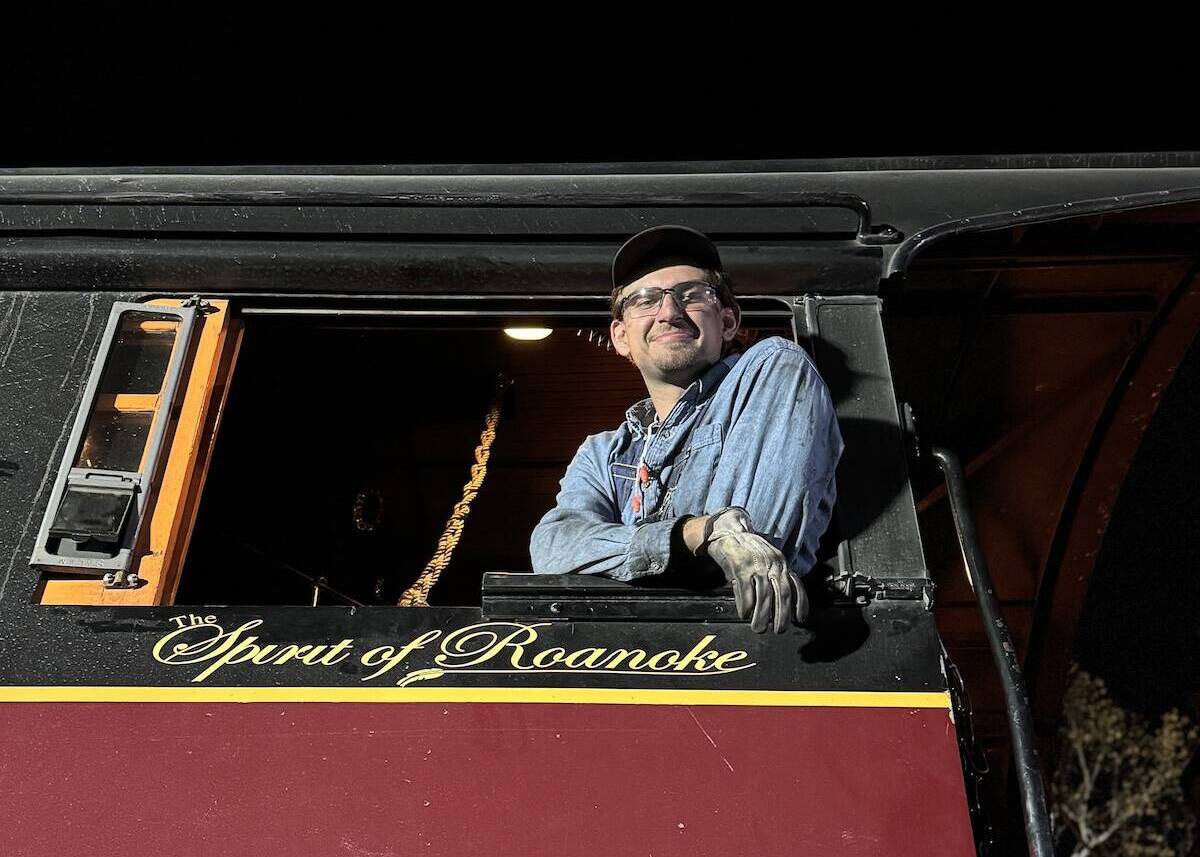
Since 2023, 22-year-old Nick Harding has been an active part of the engine crew for the Norfolk & Western J-class 4-8-4 No. 611. The work involves much more than just having smoke rise from the cowled stack. It demands round-the-clock maintenance and repair between operations, ensuring the locomotive is ready for its next trips out of its hometown of Roanoke, Va.
How did you get involved in rail preservation?
Nick Harding: Growing up, I was always fascinated with steam engines and trains, overall. As I got older, I had a chance in high school to get involved with a man and his son, who had steam traction engines. Both of them are on the [611] crew, and through them, I was able to get involved here at Virginia Museum of Transportation in Roanoke and with No. 611. I was with the locomotive right before it came back from the Strasburg Rail Road in 2023.
As a young preservationist, what have you found to be the most challenging aspects in the industry?
Nick Harding: There are challenges everywhere. From all sides, whether it’s funding, crew and people’s interest, we’re finding that it’s harder to get younger people, like myself, involved and stay interested. To understand that with a steam locomotive, and even railroading in general, it’s go, go, go all the time. But at the same time, there are periods where you have to be patient, wait, and work through the process to get things done. Not all the work is the glory of being on the locomotive when it’s running. There are days when the work is long and hard, that’s the easiest way to say. Getting people interested in that is a challenge.
The flip side of that is with something like No. 611, the locomotive is large. So finding a sustainable operation is challenging. Even though there may be tracks, it doesn’t mean we can go there. And even if we can fit somewhere and technically run the locomotive there, it doesn’t mean that it’s a sustainable operation. As a nonprofit, we have to be able to live to a certain extent off of the money we make from our excursions. If that excursion isn’t going to be a profitable endeavor, even if we’re just going to break even, then in the long run, we really don’t break even because you’re putting wear and tear on the locomotive without making money to put back into it.
What’s been the most rewarding for you so far?
Nick Harding: For me personally, I don’t do this for me. Number one is the people I get to work with. Everyone on our crew is fantastic. They come in, work hard, and are great to get along with. Even when there’s a problem, we all get together, come up with a solution, get to it, sort it out, and then keep going.
On the other side of that, it’s the engagement with the public, especially while we’re in operation mode. The most rewarding thing for me in that aspect is getting to see people enjoy this. We get people of every age, and everyone instantly turns into a little kid. I know many hear that a lot, but it’s the truth. When we did [Shenandoah Valley Limited] trips in 2023, there was a family of 18 people, and they enjoyed riding the train together. Stuff like that is one of the best parts of the job.
Where do you see rail preservation as it is today and what do you hope it’ll become for the future?
Nick Harding: There are a lot of things going on at the moment. Nickel Plate Road No. 765 has been around for a long time, but then there are projects like the Pennsylvania T1 and others that are really coming along. It’s great to see that the interest is out there for these larger projects. The issue that I could see arising in the future is we have so many large locomotives, but where do they all run? The possibility of getting too crowded is where I see that being a challenge in the future, but hopefully works out. The NS-UP merger has been talked about a lot, and that’s going to play a big factor into what happens in the future. All we can do is hope for the best.
What advice would you give for any young person looking to get involved in the industry?
Nick Harding: Ask questions, listen, and learn. You can’t learn this stuff in a day. I’ve just scratched the surface on big steam. So, try to get involved, put in an application to volunteer, and when you do get involved as a volunteer, show up on the work days. It can be hard and long, but put in the hours, and really take the time to understand what it takes to do this.