MISSOULA, Mont. — An obscure but classic motion picture about logging in the Northwest, and the unique log-hauling locomotive that starred in it, are returning to the spotlight.
In February 1955, “Timberjack” made its world premiere on the screens of the Roxy and Fox theaters in Missoula, not far from where the movie had been filmed a few months earlier. Seventy years later, Timberjack is scheduled for a celebratory re-screening on Jan. 19, 2025, in the Bonner School Gym east of Missoula, across the road from a lumber mill that provided the backdrop for several of the movie’s scenes.
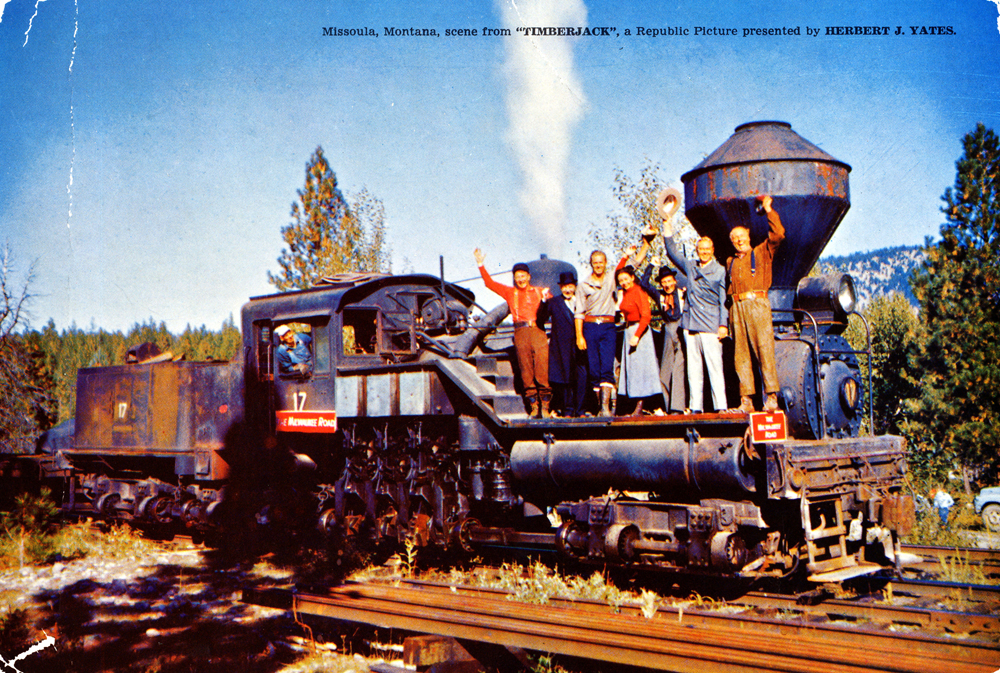
That same mill is where a Shay-style steam locomotive sat unused for several years before being fired up again to appear in Timberjack. Built in 1923 by the Willamette Iron and Steel Works in Portland, Ore., as Western Lumber Company No.3, this three-trucked “Willamette” or “Willie” looked for all intents and purposes like a Shay, but with a number of modifications. (The Ohio-based Lima Locomotive Works’ patents for such side-geared locomotives had already expired.) Even among its Willamette-built brethren, No.3 was a rarity, being a coal-burner whereas other Willies were fueled by oil. Western Lumber was sold in 1928 to the Anaconda Co. — part of the Anaconda Copper Mining empire — which transformed WL No. 3 into Anaconda No. 7.
The Willie spent most of its active years on logging railroads west and east of Missoula. But in the late 1940s, trucks took over, Anaconda quit hauling logs by rail, and No. 7 found itself confined to mill property in Bonner, where it entered retirement in 1948. Six years later, No. 7 was dusted off, prepped, watered, and fueled for an action-packed role in the Republic Pictures logging Western “Timberjack.”
The movie’s storyline is typical of the Western genre. It pits hero against villain, who compete not only for land and other fortunes but also for the affections of a woman at the local saloon. But for every shootout or fist fight there are plenty of action scenes involving log trains and handcars. Lead actor Sterling Hayden appeared in more than 50 motion pictures, many of them Westerns, including the railroad-themed “Denver & Rio Grande” (1952) and “Kansas Pacific” (1953). He is possibly best remembered for his brief, stunning, and hilarious performance as Brigadier General Jack Ripper in 1964’s Cold War spoof “Dr. Strangelove.”
Among train enthusiasts and historians, it’s old Anaconda No. 7 that steals the show in “Timberjack.” Sharp-eyed viewers will spot it running as No. 7 in some scenes, and No. 17 in others. The movie provides a rare opportunity to see — in color — a Willamette side-gear steam locomotive in action in the 1950s, not long after its official retirement. “Timberjack” shows No. 7 performing at the mills and Northern Pacific depot in Bonner, Mont., and also on sections of the Milwaukee Road’s 40-mile-long Big Blackfoot Branch east of Bonner. This scenic line along the Blackfoot River was begun by the Anaconda Co. in 1904, later sold to and expanded by the Milwaukee Road, and then abandoned in 1980.
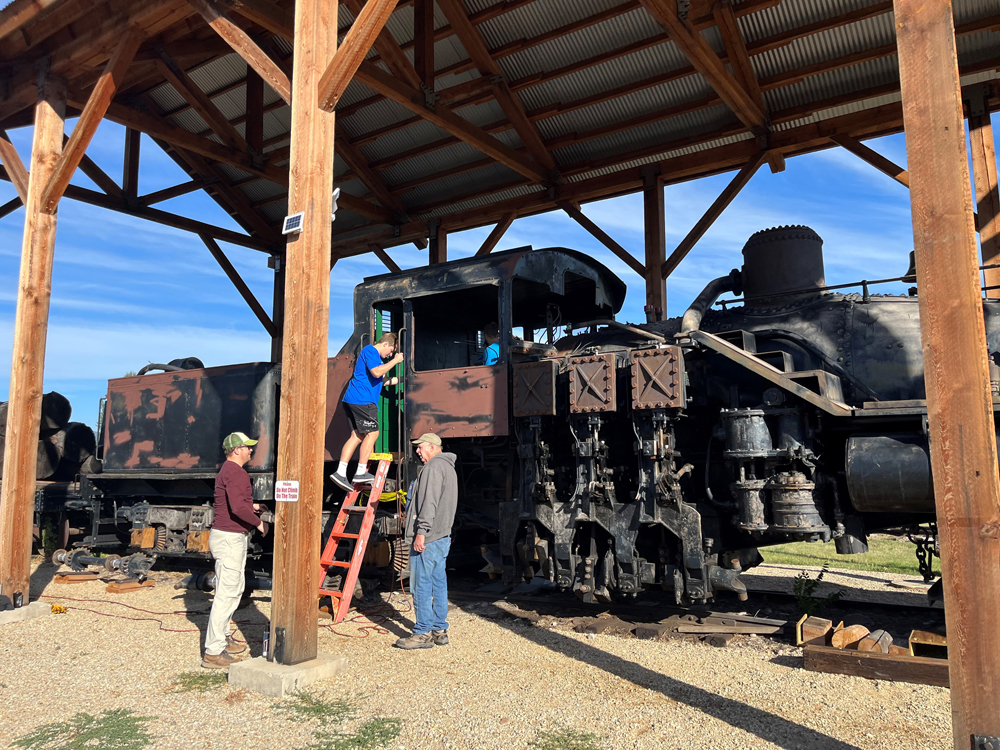
No.7 was donated in the 1980s for preservation and static display at the Historical Museum of Fort Missoula. In 2019, after months of inspection, cleaning, repair, and lubrication of vital components, a compressed air test proved that No. 7’s cylinders, crank shafts, and drive gears are operable. During the past four years, a roof has been built to protect No. 7 from the elements, and restoration efforts have broadened from cosmetic to mechanical. The Museum plans to operate No.7 using compressed air sometime during 2025, allowing it to move on nearly 800 feet of track that it shares with six other pieces of rolling stock. A boiler specialist will address the potential for the Willamette to eventually operate under steam.
“The restoration of No. 7 is one of the most exciting ongoing projects for the Museum,” says Austin Haney, education assistant at Fort Missoula. “It represents an interesting and unique part of our history as a center of the timber industry, as well as Montana’s place in pop culture through the film industry. As one of our most popular and loved artifacts, it’s important to have the continued opportunity to share No. 7 and its fun story with future generations of locals, movie lovers, and train enthusiasts alike.”
Share this article