Railroads & Locomotives Heritage Rail Heritage Railroads Cuyahoga Valley Scenic to convert two Alco locomotives to electric power

Cuyahoga Valley Scenic to convert two Alco locomotives to electric power

By Trains Staff | January 13, 2026

Ohio Environmental Protection Agency to help fund conversion of two FPA4 units

Email Newsletter

Get the newest photos, videos, stories, and more from Trains.com brands. Sign-up for email today!

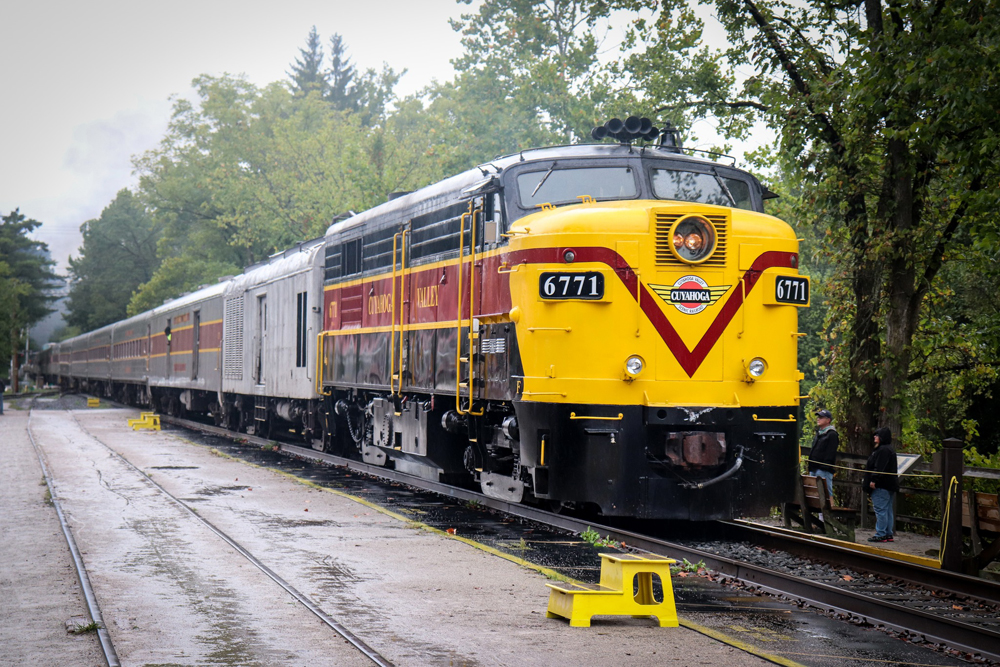
Yellow, maroon, and black FA locomotive with passenger train
The Cuyahoga Valley Scenic Railroad will convert two FPA4 locomotives to electric power through a partnership with the Ohio Environmental Protection Agency.  CVSR

COLUMBUS, Ohio — Two Alco FPA4 locomotives at the Cuyahoga Valley Scenic Railroad will be converted to electric power in a $3.5 million project announced Monday by the Ohio Environmental Protection Agency.

The partnership between the railroad and Ohio EPA will see the state agency provide $2.1 million in federal funding allocated to the state under a $2.7 billion U.S. EPA settlement reached with Volkswagen in 2017 for violations of the Clean Air Act.

“By repowering these historic machines with electric engines, it’s helping to keep Ohio heritage on the tracks, while not having to worry about diesel emissions,” Ohio EPA Director John Logue said in a press release. “Cuyahoga Valley Scenic Railroad provides such a unique opportunity for Ohioans to explore some of the most picturesque landscapes in the Midwest, and it’s an honor to contribute to that cause for generations to come.”

The two locomotives are in seasonal daily service on the 26-mile heritage railway, consuming approximately 12,800 gallons of diesel fuel annually while emitting a total of more than 700 tons of carbon dioxide. The Ohio EPA says those emissions impact air quality in Cuyahoga Valley National Park where the railroad operates.

“This grant from Ohio EPA marks an important milestone for Cuyahoga Valley Scenic Railroad,” said Cuyahoga Valley Scenic President Larry Stevenson. “Repowering our heritage locomotives from diesel to electric improves efficiency, supports our mission within Cuyahoga Valley National Park, and, most importantly, allows us to preserve the legacy of railroad travel by keeping these historic locomotives on the rails for future generations. We are grateful to Ohio EPA for their partnership and support.”

The Cuyahoga Valley Scenic Railroad equipment roster lists four FPA-4 locomotives. Trains.com has contacted the railroad seeking more information on the units involved and a timeline for the project.

More on the railroad is available at its website.

— To report news or errors, contact trainsnewswire@firecrown.com.

13 thoughts on “Cuyahoga Valley Scenic to convert two Alco locomotives to electric power

  1. While it’s truly sad to know the historic and getting-rarer sound of those Alco prime movers will go away, this is better than the locomotives getting retired altogether.

  2. What a colossal waste of money even considering the EPA is involved. Think of the actual preservation that could be done with this money instead of pouring it down a green rat hole.

    1. 100%, I notice the OHEPA is claiming ‘credit’ for a $3.5 million grant, when in reality, $2.1 million of that is from the Feral Givernment’s “Green New Scam Deal”

      SAD

  3. Let’s be accurate: they are removing the diesel engines replacing the power source with stored electricity components. The locomotives already have electric motors. There is no electric engine; even their EPA guy is unknowing of this. And, should this not work out well in the future, I would safely store the diesel engines for reuse. And, if it were not for VW’s money this would not have been done.

  4. If the only alternative is closing the railroad I guess it’s an ok compromise but the sounds those old locomotives make is going to be removed from the experience.

    1. Diesel fuel is not the only component that goes into the combustion process. Diesel engines draw oxygen which combines with carbon in the diesel fuel to make CO2.

  5. In reality these are already electric engines, they are just changing the source of the electric power from an on-board diesel generator to a bank of batteries. At least that is what I assume, although a conversion to hydrogen would be another possibility since press releases are often not complete.

  6. A good application for battery. Short distance per day, light train, low speeds.

    We’re going to need battery tenders for mainline electrification to economically bridge small gaps – tunnels, bridges, etc. – so good to get something going like this.

    1. So the real question is the source of the electric power to charge the batteries. If it comes from coal fired power plants then this is a negative. Ohio does not have large hydroelectric plants. I do not think they have much in the way of nuclear, so do they have a lot of natural gas powered plants?

You must login to submit a comment