





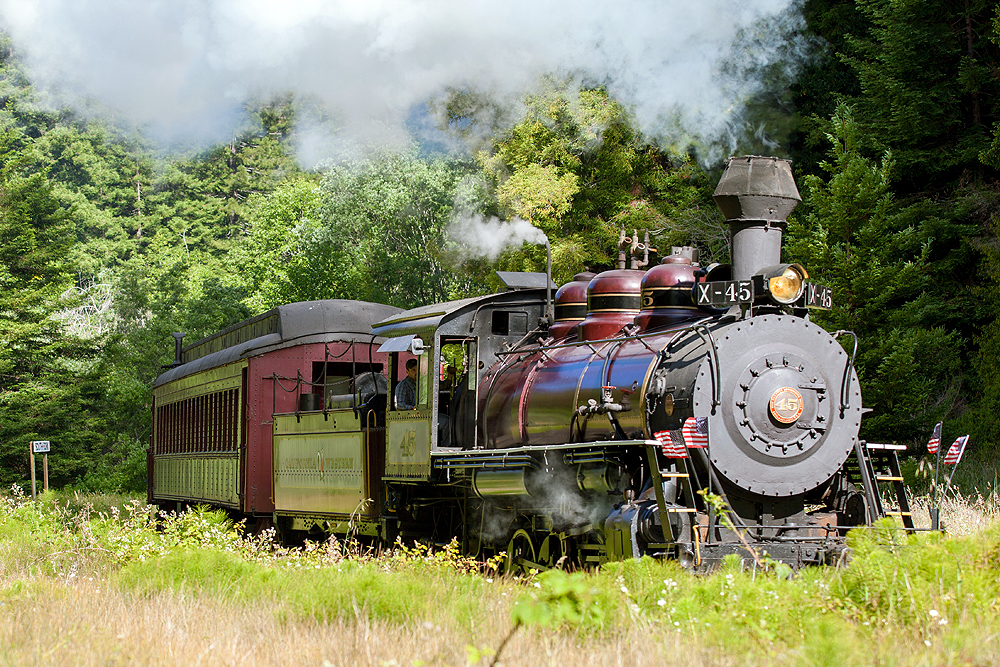
MENDOCINO, Calif. — A California appeals court has reversed the decision of a lower court and has granted the Skunk Train tourist railroad the right of eminent domain — the authority to condemn and acquire private property, according to reports in the Mendocino Voice.
The legal battle began in 2020 when Skunk Train owner Mendocino Railway filed an action to acquire 20 acres owned by local resident John Meyer.
Under California law, a public utility has the ability to condemn private property for public purposes, providing that it pays the owner “just compensation” for the land. To be deemed a public utility, a railroad must be willing to actually serve the general public, not just a private or closed group. And the property to be condemned must be for public purposes.
The Mendocino Railway argued during a six-day trial before Superior Court Judge Jeanine Nadel that while it does run numerous excursion trains, the railroad operates a commuter service and hauls freight. In her April 19, 2023 ruling, Nadel sided with Meyer, indicating that the Skunk Train tourist operations were dominant over any commuter or freight services. Additionally, the court felt that plans for the land to be acquired were not in the public interest. At the time, the railroad indicated the land was to be used for campsites and RV parking. Meyer was awarded $265,000 to cover his legal fees.
The matter was brought before the California Court of Appeals, which reversed the lower court’s decision on Dec. 9, 2025. In its decision the higher court stated that even though the Skunk Train offers private excursions — which account for 90% of its revenue — the fact that it does have some commuter and freight service is enough for it to be declared a public utility. The Court of Appeals also cited testimony by Mendocino Railway CEO Robert Pinoli that the campsite and RV parking plan had been abandoned. Pinoli stated that the land acquisition would allow the railway to “fully operate its freight rail services with storage yards, maintenance, and repair shops, transload facilities, rail car storage capacity, and a passenger depot.”
The case now returns to the lower court to determine what is “just compensation” for Meyer’s property. The appeals court also set aside the award of legal fees.
Last week the appeals court also denied Meyer’s request to reconsider its decision. Meyer’s lawyer indicates a petition will be filed with the California Supreme Court.
The Mendocino Railway runs for approximately 40 miles between Fort Bragg and Willits, Calif. Its line was cut in 2015 by a tunnel collapse. Since that time trains have run from each end of the line and then reversed at the blocked tunnel.
The entire situation has enraged local residents, according to reports on the SFGate news website.
“It has no function as a railroad here,” stated Bruce Broderick, a Fort Bragg resident, in an SFGate interview. “The train backs up because it can’t turn around, because there’s nowhere to turn around, and it can’t go forward because the tunnel collapsed. They do this four or five times a day. They block Highway 1, they block all of the streets, they blare their horns as loud as they can. And that’s kind of what they do. That’s their whole function.”
Broderick feels the railroad’s claims regarding passenger commuting and freight services are false.
“They transport nothing other than tourists who pay large amounts of money to ride three and a half miles out of town, stop at a little pavilion where they party, and then get back on the train,” he says.
Pinoli states that both commuter service and freight operations do exist. He cited loads of various materials hauled for landowners on the route’s eastern end and a bridge that was transported to a private property. “That bridge came via truck from Texas and was transloaded from truck to rail (the very definition of interstate commerce),” Pinoli told SFGate in an email.
Repairs to the collapsed tunnel have also been stopped by litigation. In 2019, the railroad executed a multi-million dollar hill stabilization project at the site. The company worked to seek additional project funding through a Railroad Rehabilitation and Improvement Financing loan, Pinoli says, but efforts were halted by the City of Fort Bragg and the California Coastal Commission, who filed a lawsuit against the railroad over attempts to acquire a former oceanside mill site via eminent domain.
Pinoli said he feels that without this blockade, trains would be running today through a repaired tunnel. The railroad has had previous legal troubles with the City of Fort Bragg and the California Coastal Commission over application of state and local regulations relating to the railroad [see “California short line sues to block regulatory efforts by state, local officials,” Trains.com, Feb. 23, 2024].
Meyer has established a GoFundMe page raising money to help defray his legal expenses. “I don’t want to stop the excursion trains from operating,” he writes. “I’m trying to stop the owners from [their] illegal and abusive use of power.”
— To report news or errors, contact trainsnewswire@firecrown.com.

The Skunk is one of my most memorable train rides (1982). And I recall a woman and child boarding at a flag stop to go to town for groceries! I’m going back this year. Didn’t know the tunnel collapsed. Would gladly contribute to its repair. Crazy that Fort Bragg would want to curtail its operations. It’s been a popular fixture there and in Willits for longer than I can remember. I hope they win all suits.
Nothing gets built in the USA, because of lawyers and lawyers in Government. The Chinese have Engineers in Government, they build stuff.