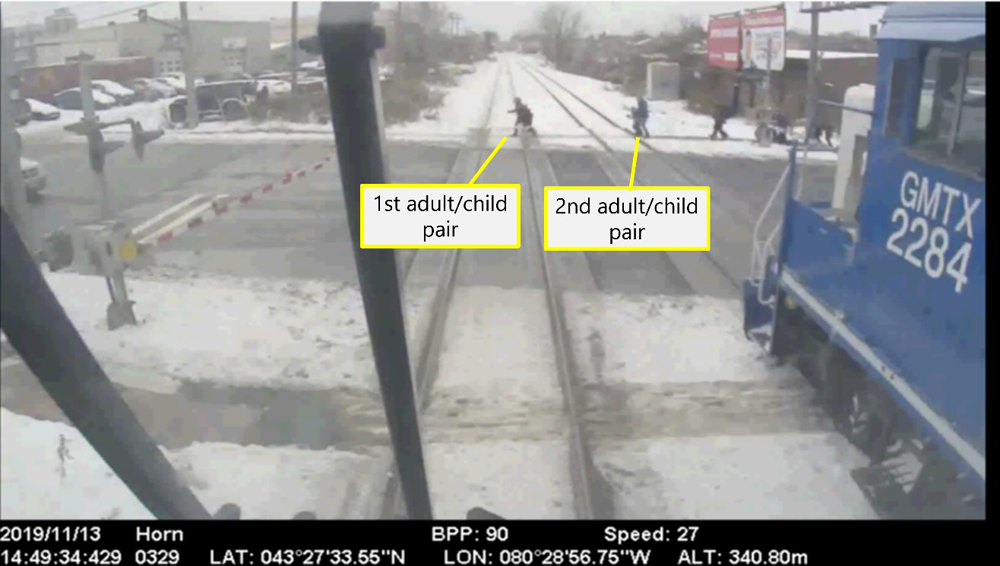
KITCHENER, Ontario — The woman injured in a 2019 grade crossing accident, cited last week by the Transportation Safety Board of Canada as a sign of issues with Ontario oversight of rail safety, filed a lawsuit last year seeking more than C$3 million as a result of the incident, the CBC reports.
Jenna Armstrong and her husband, Daniel Armstrong, filed a statement of claim in 2022 seeking $3.25 million from Metrolinx, Canadian National, Bombardier, the City of Kitchener, the Region of Waterloo, and two unnamed train operators.
Armstrong and a 6-year-old boy were struck by a GO Transit train in the Nov. 13, 2019, incident. According to the TSB report, they were part of a group of 11 people who went to cross a street when the gates were down for an extended period because of a CN train switching nearby, and were unaware of the approaching commuter train [see “TSB says 2019 GO Transit accident involving pedestrians raises questions …,” Trains News Wire, Feb. 10, 2023].
She suffered injuries including fractures to her head, neck and spine, as well as her shoulders, hip, ankle, and forearm, as well as psychological injuries, according to the suit, and has been unable to return to work. The suit claims the parties named in the suit failed to protect and properly warn pedestrians of a second train at the crossing, and were aware of the dangers of the crossing.
The TSB report found that CN trains switching at a nearby yard led to the crossing gates often being activated more than the 5 minutes allowed by statute. It noted that several safety changes have been made at the crossing, and that trains are now required to sound their horn when a second train is present. It had previously been a “no-whistle” crossing.
Share this article