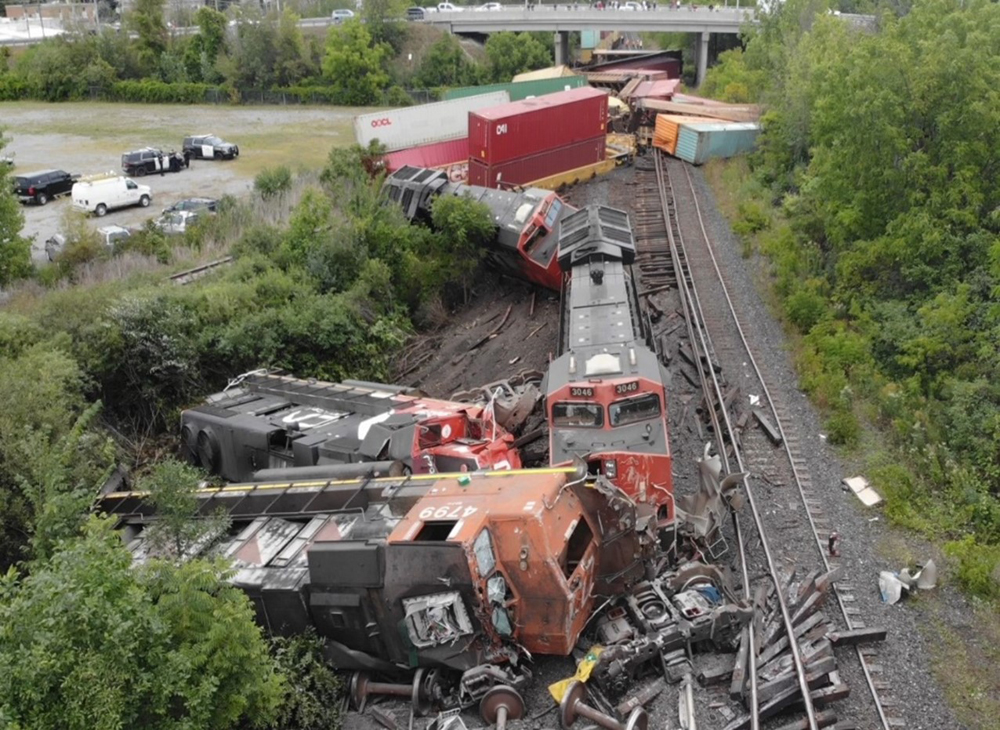
PRESCOTT, Ontario — The union representing rail traffic controllers and Canadian National Railway have both taken issue with a report by the Transportation Safety Board of Canada citing alcohol use by a controller as a factor in a September 2021 collision involving two CN trains — although for very different reasons.
The report issued March 13 called for regulation of the period between consumption of alcohol and work for those “safety-critical” positions as a result of the Sept. 2, 2021, collision that injured three crew members, one seriously. An intermodal train was sent through an incorrectly lined switch and collided with a local; the report determined the controller on duty was “likely affected by the persistent effects of alcohol consumption” that had occurred the morning of or night before his shift. [See “Effects of alcohol consumption by controller …,” Trains News Wire, March 13, 2024].
A Morrisburg Leader report under the Local Journalism Initiative says Teamsters Canada, which represents CN’s rail traffic controllers, feels the report ignores existing safety factors, particularly the lack of electronic locks, which the union says could have prevented the accident.
“Had the switch been equipped with an electronic lock, it would have detected the oncoming train, preventing the switch’s operation until safe,” Christopher Monette, the union’s director of public affairs, told the newspaper. He also said that switch and two others have since been upgraded with electronic locks, “a clear case of too little, too late.”
The incident could have easily occurred even if the controller was fully sober, he said.
The union says the report’s call for “dry periods” before work is “not a workable solution” given the on-call nature of many operating positions. Teamster Canada is challenging the dismissal of the controller involved in the incident.
CN, meanwhile, said in a statement that it is “disappointed that the report did not recommend a clearer framework regarding drug and alcohol consumption in safety-critical positions. CN remains firm in its belief that random testing employees in safety-critical positions is the only way to deter impairment at work.”
Share this article