





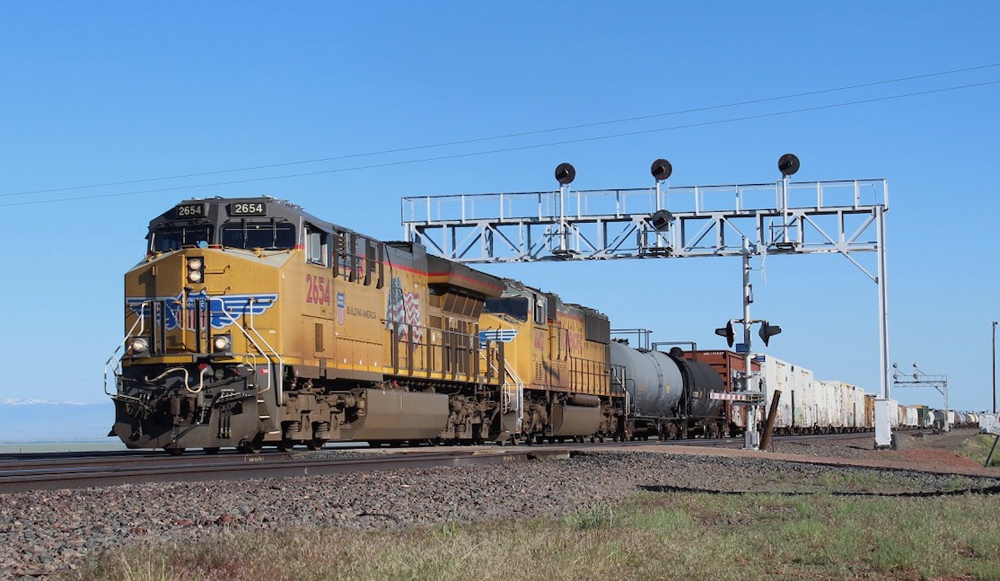
OMAHA, Neb. — A hedge fund, arguing that Union Pacific ranks dead last in every important operating metric, has asked the railroad’s board of directors to replace current CEO Lance Fritz with former Chief Operating Officer Jim Vena.
Soroban Capital, which has a $1.6 billion stake in UP and ranks among its top 10 investors, made the demand for change on Sunday in a letter to the board.
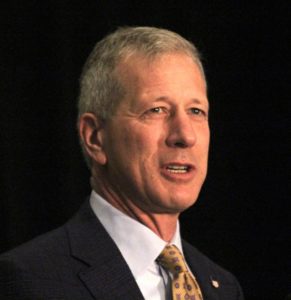
In response, Union Pacific said on Sunday afternoon that it will hire a new CEO to take over sometime this year as part of a succession process that began in November.
“I am confident that now is the right time for Union Pacific’s next leader to take the helm. I look forward to working with the Board as we identify our next CEO to lead the Company into the future,” Fritz said in a statement.
Soroban was highly critical of Fritz’s tenure, which began in 2015.
Union Pacific “has repeatedly and significantly failed to reach its potential under Mr. Fritz’s leadership,” Soroban Managing Partner Eric Mandelblatt wrote.
The railroad “has ranked the worst in safety, volume growth, revenue growth, cost management, [earnings before interest and taxes] growth, and total shareholder return,” Mandelblatt wrote. “These are highly underwhelming results despite [UP] having the premier railroad franchise in North America. We assume you share our disappointment, given that Mr. Fritz has consistently failed to meet the annual incentive compensation targets set by the Board.”
Soroban said it had just one goal: New leadership for UP.
“Unlike typical shareholder engagements which come with numerous demands, Soroban has only one ask: install new leadership who can get the trains to operate safely and on time,” Mandelblatt wrote.
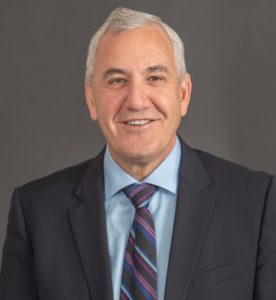
Soroban said the ideal candidate to replace Fritz is Vena, a longtime Canadian National executive who served as UP’s chief operating officer in 2019 and 2020.
Mandelblatt said Vena “very quickly established what was possible for the company, rapidly transforming [UP] from an underperforming to a top performing railroad only to inexplicably be allowed to walk away after less than two years. Operations almost immediately reverted to worst-in-class levels without Mr. Vena.”
This is the second time an activist investor has sought to get Vena into a CEO role. In 2021, the London-based TCI Fund touted Vena as a replacement for CN CEO JJ Ruest. Ruest ultimately stepped down but was replaced by former Canadian Pacific executive Tracy Robinson.
Soroban posted a presentation to its website detailing UP’s financial and operational performance compared to the other big railroads.
“The Board is grateful to Lance for his unwavering leadership, dedication and oversight in driving our Company forward over the last eight years as CEO. Lance created an environment that has allowed Union Pacific to make a measurable impact with our customers, communities and employees alike,” said Michael McCarthy, lead independent director of the board. “He has capably led our company during a time of significant challenge and change, positioning Union Pacific to deliver long-term sustainable value for shareholders and customers. We are immensely grateful to have Lance’s continuing leadership and support and know he will ensure a smooth transition.”
The board will consider candidates from inside and outside the railroad industry.
Investors cheered the news, sending UP’s stock up nearly 10% on Monday morning.
“We believe that Vena may be uniquely positioned to instill a strong operating culture at UNP and position the company to capitalize on the volume growth opportunities available throughout its network,” BMO analyst Fadi Chamoun wrote in a note to clients.
Independent analyst Anthony B. Hatch says the UP board has a history of being patient with the company’s leadership. Once Soroban went public with its concerns, however, the board had to respond, Hatch says.
Nearly everyone agrees that UP has the best network but that the railroad has not lived up to its potential, as Soroban points out in its 43-page presentation, Hatch says. “It’s hard to argue the facts there,” Hatch says.
Federal regulators and shippers will not be happy if UP’s CEO selection process pits boosting profit margins against ramping up volume growth, Hatch says. While UP clung to its 55% operating ratio goal, the rest of the industry has largely moved beyond cost-cutting mode, he says.
Canadian National, CSX Transportation, and Norfolk Southern are embarking on growth strategies under new CEOs, and Canadian Pacific needs volume growth to help pay for its merger with Kansas City Southern.
UP is poised for growth this year, Hatch says, thanks in part to gaining intermodal customers from rival BNSF Railway.
Note: Updated at 8:47 a.m. on Feb. 27 with analyst reaction.




““Unlike typical shareholder engagements which come with numerous demands, Soroban has only one ask: install new leadership who can get the trains to operate safely and on time,” Mandelblatt wrote.”
Manure! All they are interested is in increasing dividend payments, and of course, increasing the share price. And if they can do that vis stock buybacks, so much the better.
Service? a distant fourth on the list. If that. I mean…service costs money (at least in the short term, which is all a hedge fund manager cares about anyway).
Wow! Hedge funders are going to derail UP for good. And they think Vena will improve UP? Vena was COO when UP’s decline accelerated. Vena never wanted to spend money so revenue could grow profit. All he wanted to do was furlough employees and slash train counts. As a shareholder, UP needs to focus more on Chicago to Texas/Gulf Coast and westward to California than the Overland Route. The Overland Route has declined significantly the past several years, and it won’t return to its’ former glory. The Chicago to Texas and the Sunset route are bulging with traffic, and increasing. Vena won’t spend a dime if he thinks it will shrink the bottom line. Another Hunter Harrison with a different name.
Glad I left that mess and went to another railroad. The best thing they could do is buy back as much stock from these loser hedge funds as they can and run the railroad how it’s supposed to be ran. Railroads and anything else critical to the economy or infrastructure shouldn’t be allowed to be traded on Wall Street because then you end up getting the garbage that’s happening now with the class Is that are traded – Profits above everything else, no matter what. Vena will be the kill-shot. Good luck.
Ah … so much for sacrificing OR for growth. And UP didn’t even join NS and CSX in chanting that tune. Vena is a Hunter Harrison disciple. We know precisely what steps he will take.
Do ya think that mebbe NS and CSX will get The Message from this?
Comments by the board surely conflict with its member who is the activist investor who is so unhappy. His statement is totally opposite and highlights problems UP’s shippers are having. And, the board will take the action he requests. I doubt that profits will rise as fast as the activist wishes but they could see an increase in income when they get back to “WE WILL DELIVER”, if they do. But remember Vena wanted to handle less freight stating his model would not support more. And sure enough that turned out to be part of the problem. Suggestion: get engines out of storage, shop what needs it, get speed up to track speed. That should start the ball rolling.
Exactly Mr. Stanley. The western terminals are chuck full of SD70M’s and various older Wabtec products that could be converted to newer models of that product as NS is doing. If that is not the desire, put them up for sale and use the revenues to buy new tier 4 units, SD70Ace-T4’s for instance, Now that the bugs are worked out they seem to be running well. I think BNSF could have someone who would jump at the chance to run a railroad. And he/she should have SOLID rail management experience in OPERATIONS, not finance or marketing. What UP needs now is someone who knows how to run a railroad, not someone who thinks he knows. That was Fritz’ problem, who “…began his Union Pacific career in July 2000 as vice president and general manager-Energy in the company’s Marketing and Sales Department. What the heck does a marketing guy know about running a railroad? And for someone with a sales background he sure forgot the role the customer/shipper plays in a railroads success. DUH!
I agree Fritz must go but, Jim Vena as his successor?
One of the reasons UP is as screwed up as they are is Vena’s tenure as COO. Replacing Fritz with Vena will only accelerate UP’s descent into the crapper.
When that hedge fund talks about UP performance, they mean financial performance has it benefits the short term, hedge fund type activist investors. Not the operation of the railroad or benefits to customers.
Vena was “allowed to walk away” allegedly after refusing to go after some grain business that was going to move to west coast ports for export. It would upset the PSR balance of just having enough people and equipment for a set level of business. Running that extra traffic would’ve meant having to add people and locomotives for a temporary volume of traffic.
If anyone thinks Vena will make the UP better for anyone other than Soroban Capital and their ilk, I have a bridge for sale for you.
Requesting a comment from Foster Farms in California.
A new CEO? Bozo The Clown would be an improvement.
Finally, you got a laugh out of me….you may have the rest of the day off with pay!
Soroban’s presentation makes some compelling points.
Fred Frailey recognized this in his epic October 20, 2019 blog post “Whatever Happened To UP?”
It is true that underlying the volume growth performance of UP (and BNSF) that has been referenced by Soroban has been the continued precipitous decline in PRB coal loads and Colorado coal loads as more and more coal plants are retired each year. This was high-volume-low-operating-cost business that was a significant double-digit percentage of all UP loads not all that long ago.
But it is up to management to figure out how to make the transition to a low-coal-loads world, which necessitates figuring how to generate volume in other load categories of the railroad.
It’s interesting that the BNSF has kept more of its Powder River Basin coal traffic. A Trains article noted the BNSF management realized that the infrastructure was paid for and they don’t need to invest more (unlike when the BN first got into the business) so they could cut rates and still make money while keeping more of the traffic.
Good bye and good riddance.