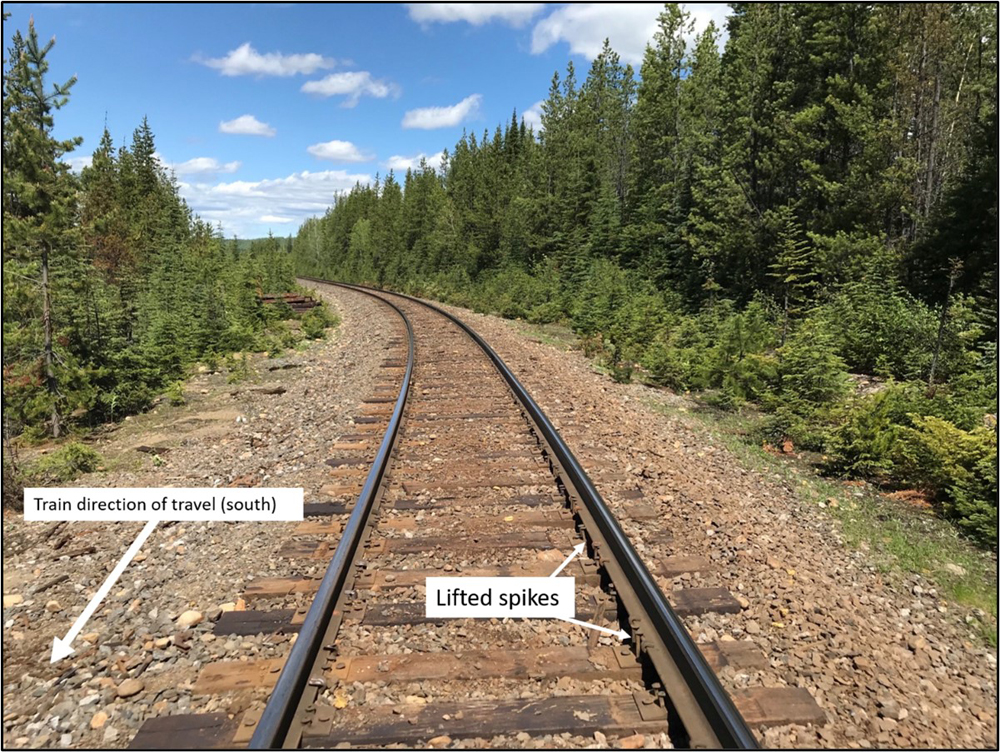
GATINEAU, Quebec — A “near-urgent” track defect was detected but not repaired several days prior to the June 2021 derailment of a Canadian National train at a remote location on the railroad’s Chetwynd Subdivision in British Columbia, the Transportation Safety Board of Canada said in an investigation report released Monday.
Thirty-eight cars of a two-engine, 71-car train bound from Chetwynd to Prince George, B.C., derailed at 9:15 a.m. on June 3, 2021. The derailed cars included one of hydrogen peroxide and one with residue of sodium hydroxide. There were no injuries and no release of hazardous material.
The derailment occurred some 85 miles north of Prince George, as the train negotiated an 8-degree curve into a bridge across the Parsnip River. Spikes on the high rail of the curve were found to have lifted out of the tie plates, allowing the gauge to increase and causing the cars to derail.
More than a week before the derailment, on May 25, a track geometry test car had recorded 30 feet of near-urgent outward rail cant on the low rail of the curve, which the report says is a sign of damaged ties, over-or under-elevated curves, spike issues (raised, missing, or broken), or excessive tie-plate cutting. No defects were recorded on an inspection the next day, the report notes, but adds “it is likely that signs of gauge widening (such as sliding tie plates, bent spikes, or plate cutting) were present, but not observed.” No repairs were made or other restrictions were put in place.
The safety message concluding the board’s report notes that during track inspections in curves, “it is important to pay particular attention to both rails for signs of instability, so that repairs or operating restrictions can be put in place.”
Share this article