

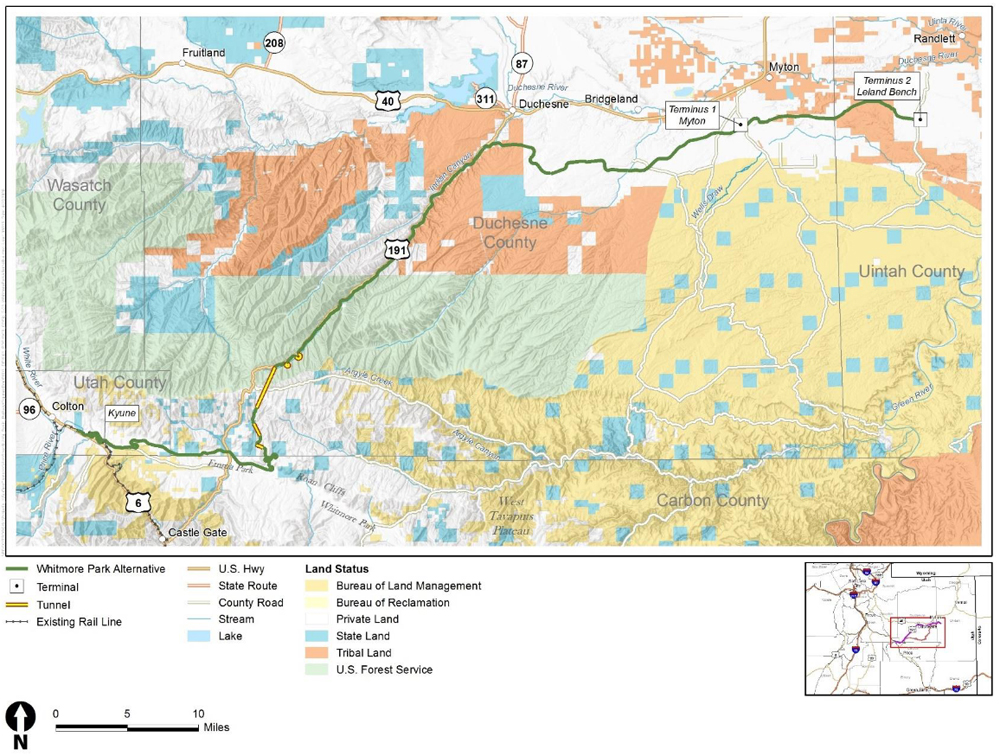
WASHINGTON — The U.S. Supreme Court agreed Monday to review the appeals court ruling blocking construction of the Uinta Basin Railway, the Associated Press reports.
The U.S. Court of Appeals for the District of Columbia last year struck down Surface Transportation Board approval of the 88-mile rail project in a remote portion of eastern Utah. The court’s ruling said the STB’s approval was “arbitrary and capricious” for failing to consider impacts such as the larger environmental impacts of the drilling and refining of the oil to be transported by the rail line [see “Federal court strikes down approval …,” Trains News Wire, Aug. 18, 2023]. That decision sent the matter back to the STB for a new review.
But the Seven County Infrastructure Coalition, the government group backing the project, petitioned the court to review the case in March. The group’s petition says courts of appeal have split on the question of considering downstream effects in an environmental review, and asked the Supreme Court to decide “Whether the National Environmental Policy Act requires an agency to study environmental impacts beyond the proximate effects of the action over which the agency has regulatory authority” [see “Organization behind Uinta Basin project asks Supreme Court to review decision …,” News Wire, March 13, 2024].
A number of briefs were subsequently filed in favor of a review on behalf of the Ute Indian Tribe of the Unitah and Ouray Reservation; the state of Utah; NACCO Natural Resources Corp., a mining company; the American Forest Resource Council, a logging trade organization; and the Utah AFL-CIO, among others. In opposition were the U.S. Solicitor General’s Office, and a group including Eagle County, Colo., and several environmental organizations, both of which argued that there was no fundamental disagreement among the courts of appeal that “an agency need not consider environmental consequences it lacks the statutory and regulatory authority to prevent.”
As is customary, the court simply announced it had granted the petition, with no other details. It will hear arguments for the case in its 2024-25 term, which begins in October.
Share this article