WASHINGTON — Norfolk Southern’s view of the impact of potential Amtrak service was a focal point of Wednesday’s third day of hearings on the passenger carrier’s effort to launch two daily round trips between New Orleans and Mobile, Ala.
Testifying in the Surface Transportation Board’s online hearing, Randall Hunt, the railroad’s senior director of interline services, used diagrams and drone footage to illustrate the impact on 3 miles of NS trackage, known as the “Back Belt,” connecting CSX’s Gentilly Yard and the route to the New Orleans Union Passenger Terminal.
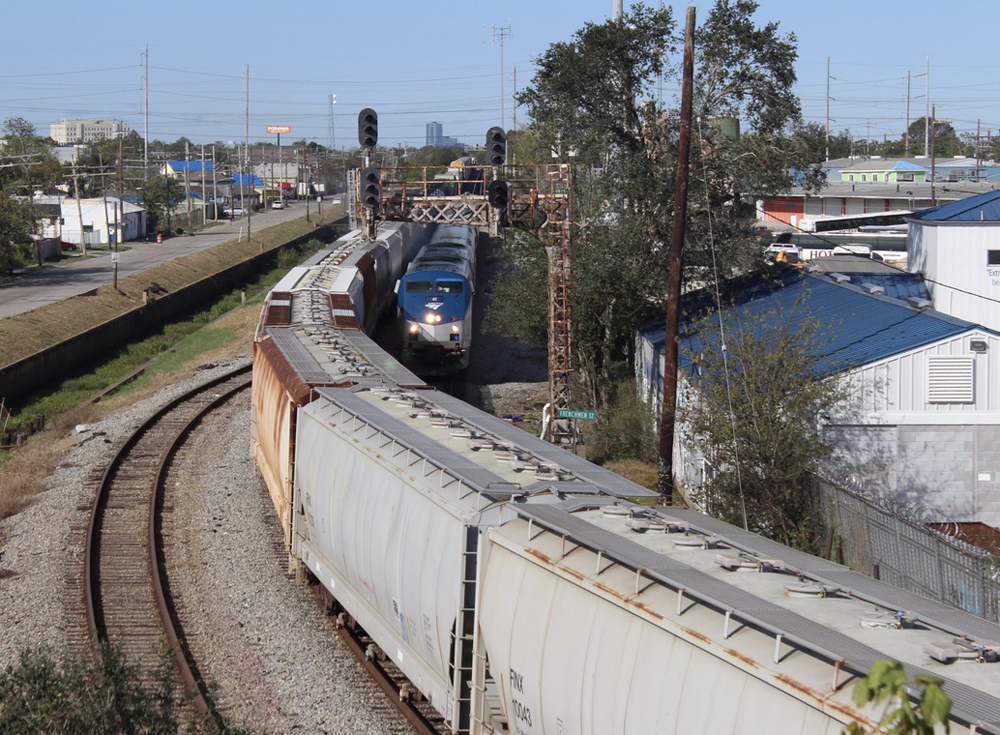
Freight trains from six Class I railroads converge on this double-track connection, Hunt said, most of which is also used by Amtrak’s New Orleans-New York Crescent.
One-hour windows for passenger movements
“We create a window around the schedule of the Amtrak arrivals and departures for about an hour,” Hunt said. The railroad essentially stops freight traffic on that segment, he said, “and that really eats into the capacity of the railroad for about two hours every day.”
The Gulf Coast trains would require similar one-hour windows, he said: “We would be forced to stop our freight business entirely, so your operating day would be reduced from 22 hours to 18 hours or less.”
Virtually all freight trains routinely stop on this main line to change operating crews or locomotives or both, according to Hunt, when passing from CSX or NS to Union Pacific, Kansas City Southern, BNSF Railway, or Canadian National, and vice-versa. Nevertheless, he insisted, “New Orleans is running great” and the “existing operation is hunky-dory” — so none of the infrastructure projects outlined as part of the traffic modeling study on the impact of freight movements would be required if the new passenger service is not introduced.
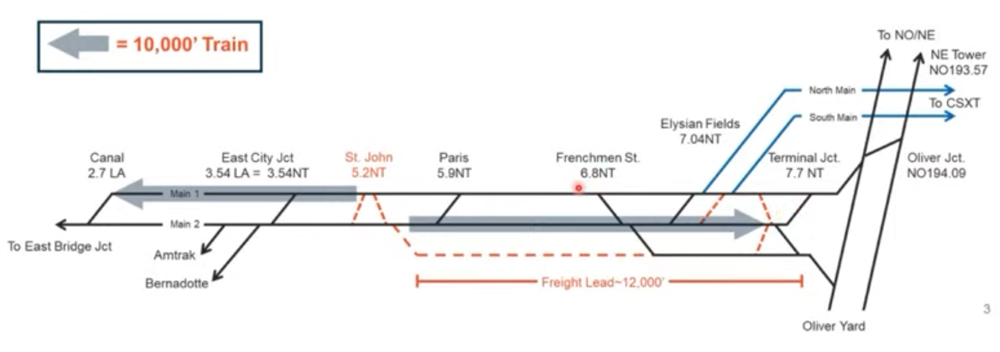
Hunt was responding to a question from STB member Karen Hedland on whether the railroads would benefit from adding to an existing track to create a 12,000-foot “Freight Lead Extension.” This $80 million to $90 million project would allow trains to clear one of the two main trains while waiting to enter NS’ Oliver Yard. This project is in addition to 14 others costing $440 million that were recommended before the RTC modeling was rerun in November with the extension added to the mix.
The NS executive, who also serves as the railroad’s designated liaison with Amtrak, used the drone footage and track charts to show how the extension, along with additional crossovers, would allow “getting back to a base line … so we can run trains as we do today” if the new Amtrak service is added.
Modeling details still in question
Asked about specific options included in the modeling, Hunt deferred to later witnesses more closely connected with the RTC work. CSX officials who testified previously had similarly deferred on modeling details.
Other passenger projects involving NS, such as North Carolina’s Piedmont Corridor improvements and the Virginia extensions to Norfolk and Roanoke, included extensive collaboration and agreement with Amtrak and state agencies on modeling inputs, Hunt said. Amtrak, the Federal Railroad Administration, and Southern Rail Commission members argue such collaboration isn’t the case here, since variables have never been shared and basic information, such as the number of trains CSX operates over its route today, never were explicitly revealed until elicited during testimony.
STB members’ questions have focused on whether operational changes, such as possibly adjusting freight train lengths or passenger train schedules, had been tested as part of the modeling.
After Amtrak attorney Jessie Amunson asked whether such a schedule adjustment to the Crescent’s “window” was attempted, the session went into a 2-hour, 46-minute “confidential” blackout when issues deemed “proprietary” were discussed.
Such issues illustrate the challenge the STB faces in finding a solution to the current impasse.
After an off day Thursday, the fourth day of the of the hearing is set for Friday starting at 9:30 a.m. A live stream of that session will be available on the STB YouTube channel, which also includes recordings of the first three days.
Share this article