WASHINGTON — The slow pace of the Surface Transportation Board hearing on Amtrak Gulf Coast service continued Tuesday, the proceeding’s second day, when just one additional witness testified and was questioned.
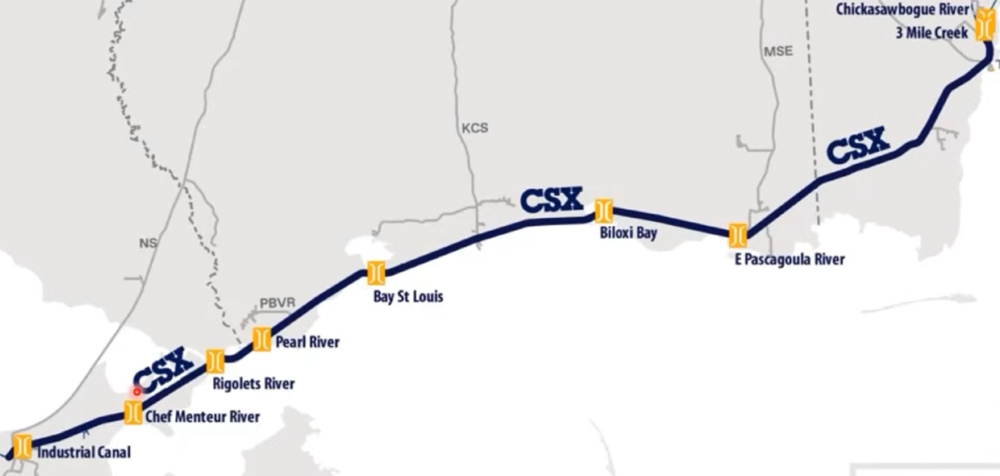
But the appearance of that witness, CSX Senior Vice President of Mechanical and Engineering Ricky Johnson, provided significant insight into how CSX operates on the New Orleans-Mobile, Ala., route where Amtrak seeks to add two daily round trips. Johnson illustrated his testimony with drone footage, maps, and track diagrams of Mobile and the area around New Orleans’ Gentilly Yard.
Testimony addresses drawbridge operation, train length
Much of the discussion revolved around operation of seven drawbridges on the route. Johnson repeatedly characterized bridge openings as “unpredictable” because “boat traffic has 100% priority over rail traffic.” He elaborated on CSX plans to remotely operate a number of the bridges, which the railroad had failed to account for in its modeling study.
Johnson said that although CSX has participated in a U.S. Coast Guard pilot project to schedule daily openings on a bridge north of Mobile’s Sibert yard, informal talks with the Coast Guard for coordinating that protocol on the New Orleans and Mobile Subdivision “were a non-starter” because there are “200,000 users of waterways and no one wants to take their priority away.”
More revealing, however, was his description of how freight trains are classified by length. “Non-clearing” trains of 10,000 feet or more don’t fit any of the line’s passing sidings, while “clearing” trains are 8,500 feet or less and will fit those sidings.
“If we run non-clearing trains from Mobile,” Johnson said, “then we plan the meets so that everything coming out of New Orleans is a clearing train, so they always take the siding and longer trains stay on the main line. Depending on the timing of our interchanges in New Orleans, the trains headed toward Mobile the next day may be all non-clearing trains.”
It isn’t clear whether this was built into the Rail Traffic Control modeling, which assumed all freight trains would have to clear for projected meets with Amtrak.
Issues at Gentilly Yard
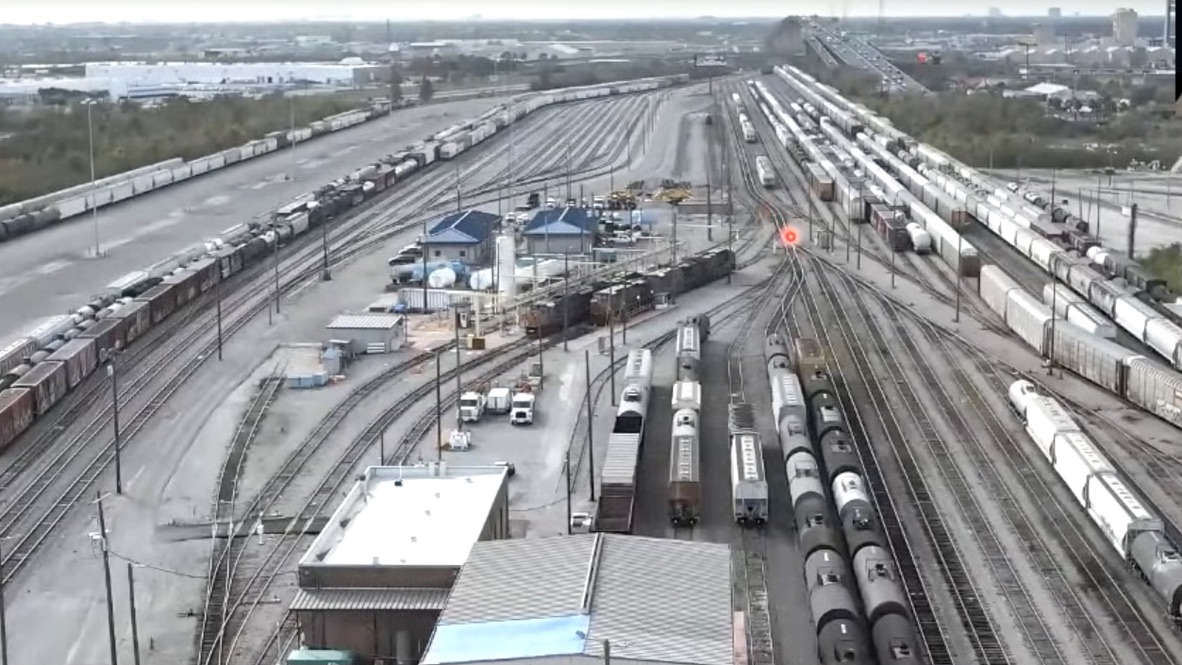
Johnson wasn’t aware that the state of Louisiana and Amtrak paid for signaling on a main track on the north side of Gentilly Yard when Sunset Limited operation was extended to Florida in 1993. That track, constantly blocked, has become just another yard track; CSX is now requesting a separate bypass track be built.
He also quoted a “4- to 5-hour” running time between Mobile and New Orleans for the Sunset prior to its discontinuance, compared to the 3½-hour schedule proposed for the new trains. But this was the schedule for the westbound Sunset, and included more than an hour of recovery time added to reflect delays on CSX en route from Orlando.
Drone footage of Gentilly shows how it consists of two smaller yards which may be ill-suited to assemble long trains. Overhead visuals and track diagrams for the Mobile terminal area showed how switching moves for short line Terminal Railroad Alabama State Docks are forced to run past the location of the former Mobile station in order to execute a backup move to get to the dock area from the TASD yard.
Railroad objections to questioning delay proceeding
Before questioning of witness Charles Banks resumed on Tuesday, attorneys from CSX and Norfolk Southern asserted STB board members, particularly Chairman Martin Oberman, were improperly cross-examining the witness on Monday, rather than simply listening to the testimony. They also objected to the members’ “reliance on press reports.” It was unclear if this referred to a Trains Magazine disclosure that a separate meeting had taken place between Southern Rail Commission members and CSX in September, in which CSX officials proposed a much lower capital expenditure than what was eventually put forth following the release of the RTC study.
After an hour of a closed “confidential” session in which Oberman conferred with fellow STB members, the chairman said he and the other members would not be “a passive arbiter” and had “an obligation to elicit the truth.” He subsequently overruled CSX objections to STB questions at least eight times.
The third day of the STB hearing will begin at 9:30 a.m. EDT Wednesday. A live stream of that session will be available at the STB’s YouTube channel, along with recordings of the Monday and Tuesday portions of the hearing.
Update, April 7
CSX has contacted News Wire to clarify that its criticism of STB questioning mentioned above was over the agency “acting in the role of an advocate.”
Regarding the signaling of the north main track at New Orleans’ Gentilly Yard, paid for with public funds when the Sunset Limited began operations in 1993, CSX contends Amtrak was contractually required to pay to maintain the signal system but never did. The signal system is still there, according to CSX. News Wire has asked Amtrak officials for a response on this point. First-hand experience has shown that when Amtrak was operating on the route, scheduled passenger trains were detoured through the yard at restricted speed because that north main was blocked.
With respect to the layout of Gentilly, CSX says that trains are assembled on the long tracks in the large departure and arrival yard, located to the left of the two smaller yards in the screen shot above. However, Johnson testified that the two main tracks toward Mobile are tied up when trains are made up.
— Updated April 7 at 10:55 a.m. with clarifications and additional information from CSX.
Share this article