WASHINGTON — A bipartisan group of senators has filed legislation designed to prevent derailments like the Norfolk Southern wreck that released toxic chemicals and upended life in East Palestine, Ohio.
But the Rail Safety Act of 2023 also goes much further by proposing rules that would limit train length and tonnage, mandate a crew size of at least two people, and require railroads to prevent blocked grade crossings.

“Through this legislation, Congress has a real opportunity to ensure that what happened in East Palestine will never happen again. We owe every American the peace of mind that their community is protected from a catastrophe of this kind,” said Sen. J.D. Vance, R-Ohio, one of the bill’s sponsors.
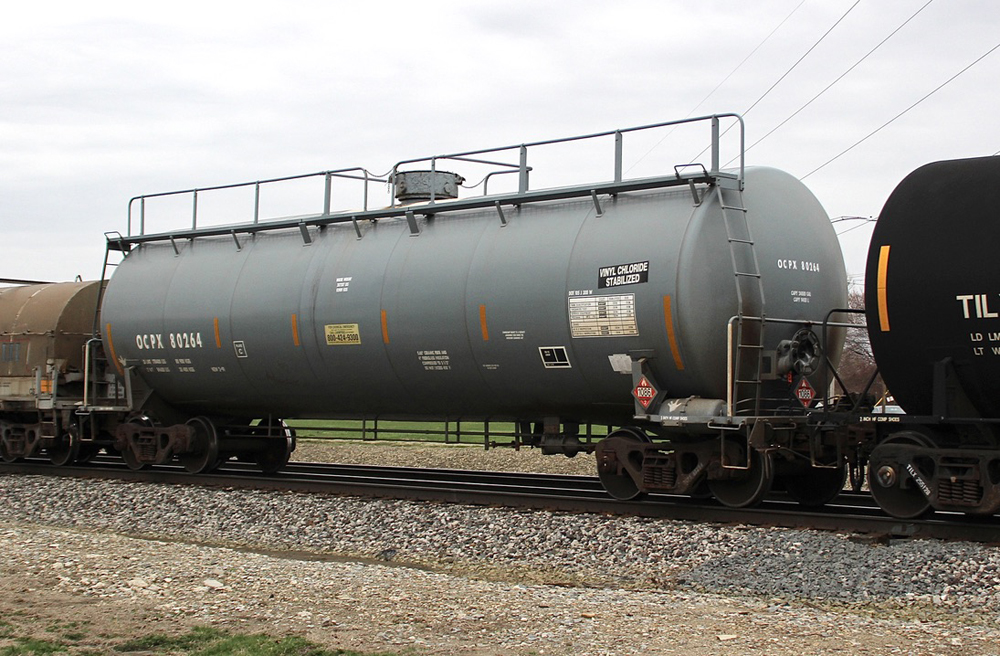
NS train 32N derailed in East Palestine on Feb. 3, just moments after a wayside defect detector warned of a hot axle on the 23rd car in the 149-car train. The National Transportation Safety Board has said the catastrophic failure of a wheel bearing on the hopper car likely caused the derailment, which released hazardous chemicals including vinyl chloride.
The measure, introduced in the Senate today, would broaden safety regulations covering trains carrying hazardous materials. Any train with hazardous materials would have to follow procedures that currently apply only to high-hazard flammable trains, such as speed restrictions through urban areas.
Currently, high-hazard flammable trains are defined as those transporting 20 or more loaded tank cars of a Class 3 flammable liquid in a continuous block, or a train carrying 35 or more loaded tank cars of a Class 3 flammable liquid throughout the consist.
Railroads also would be required to provide state emergency management officials with advance notice of hazardous materials shipments traveling through their states.
The bill also would enhance safety, the senators said, by imposing the first rules governing train length and weight. Instead of specifying limits, the bill would order the transportation secretary to determine appropriate rules.
To reduce the risk of wheel bearing failures, the bill calls for the first regulations governing wayside defect detectors. Chief among them: Requiring railroads to place hotbox detectors every 10 miles on trackage that carries hazardous materials. Detectors are currently spaced around 20 miles apart on most railroads.
The bill also orders the secretary of transportation to develop a minimum amount of time car inspectors must spend checking out each freight car and locomotive before a train’s departure from a yard.
The lawmakers also called for the faster phase-out of older design tank cars. DOT-111 tank cars would no longer be permitted to carry hazardous materials as of May 1, 2025, or four years ahead of the current deadline.
The Rail Safety Act also proposes significantly higher fines for safety rules violations.
Many of the bill’s provisions mirror Transportation Secretary Pete Buttigieg’s Feb. 21 call for legislation that would improve rail safety, including increased funding and hazmat training for first responders.
The Association of American Railroads and the American Short Line and Regional Railroad Association are reviewing the legislation and were not able to immediately comment on the bill this morning.
The Rail Safety Act is sponsored by Vance and Sens. Sharrod Brown, D-Ohio; Bob Casey and John Fetterman, D-Pa.; Marco Rubio, R-Fla.; and Josh Hawley, R.-Mo.
The East Palestine derailment has become a political football, with Democrats and Republicans accusing each other of not doing enough to regulate rail safety or respond to the disaster.
“It shouldn’t take a massive railroad disaster for elected officials to put partisanship aside and work together for the people we serve — not corporations like Norfolk Southern,” Brown said. “Rail lobbyists have fought for years to protect their profits at the expense of communities like East Palestine and Steubenville and Sandusky. These common-sense bipartisan safety measures will finally hold big railroad companies accountable, make our railroads and the towns along them safer, and prevent future tragedies, so no community has to suffer like East Palestine again.”
To date, Norfolk Southern has provided $11.9 million in direct aid to East Palestine.
Share this article