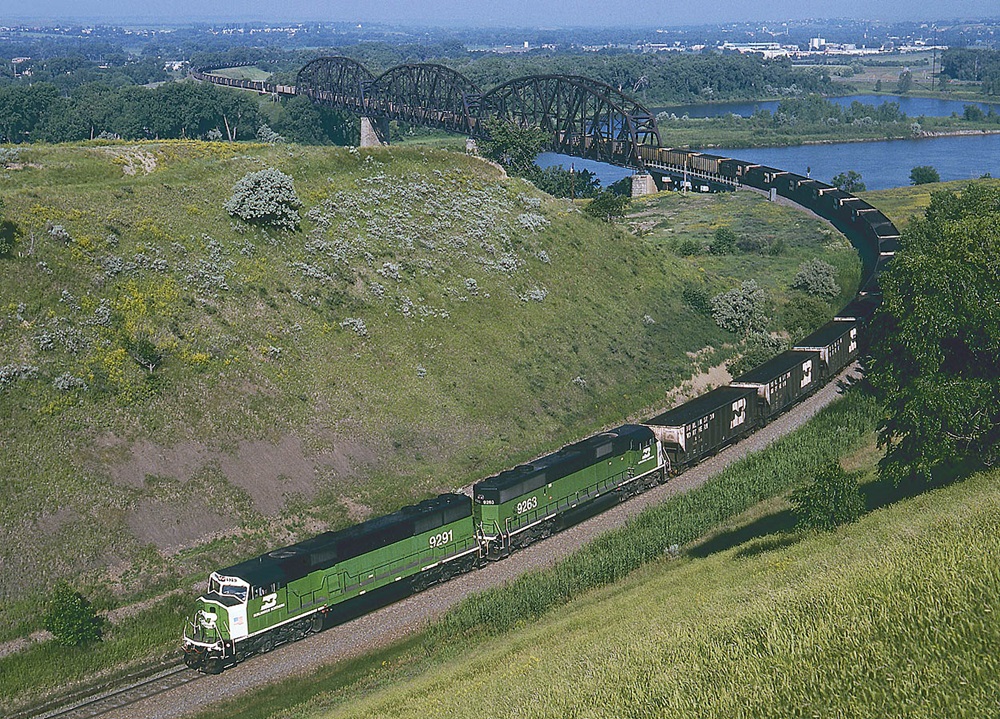
BISMARCK, N.D. — As part of its long-running effort to prevent BNSF Railway from replacing a 140-year-old bridge over the Missouri River, a preservation group argued in a Friday hearing against granting a state permit needed for the project.
The Bismarck Tribune reports the group Friends of the Rail Bridge argued in the hearing before the state Department of Water Resources that the project is a precursor to double-tracking BNSF’s line through Bismarck. A former state senator said such expansion“threatens downtown” Bismarck. The group again claimed the bridge is actually owned by the state, an argument the railroad has previously called “absurd” [see “BNSF calls preservation group’s claim …,” Trains News Wire, March 15, 2022].
The hearing was for two “sovereign lands” permits, which the railroad needs for construction within state jurisdiction, defined as lying within the ordinary high-water marks of navigable lakes and streams. One permit is needed to built the new bridge and one to remove the existing structure.
The preservation group says it does not oppose BNSF efforts to build a new bridge, but wants the current Bismarck-Mandan Rail Bridge — with piers built by Northern Pacific in 1882 — saved and turned into a walking and biking path. A 2019 study said that would cost about $7 million.
BNSF says the bridge, which has been the subject of a 25-mph slow order for several years, is nearing the end of its functional life.
The U.S. Coast Guard issued a construction permit for the new bridge in December, as did the U.S. Army Corps of Engineers. The Coast Guard’s final environmental study said there was no feasible proposal to retain the existing bridge because of the additional costs that would result, as well as the “projected floodplain rise” that could occur with side-by-side bridges in the river channel. The Friends group says that could be made moot by building the bridge further north, which the railroad and federal officials say is not feasible.
BNSF plans to build the new bridge with piers wide enough to eventually support a second track, and the preservation group says that indicates an intent to double-track the route through Bismarck, the impact of which must be considered before the bridge is approved. But BNSF attorney Laura Mona said no other work to accommodate a second track would be part of the construction, and any double tracking would require additional permits and approvals.
Also, BNSF Bridge Construction Director Mike Herzog testified that a rail bridge in Valley City, N.D. — some 135 miles east of Bismarck — was built for two tracks in 1908. “Here it is roughly 115 years later, and we still have one track across that bridge,” he said.
The preservation effort has now slowed the railroad’s efforts for at least four years, since a BNSF outlined the permitting challenges involved in the bridge project at a 2019 industry conference [see “BNSF focuses on regulatory challenges …,” News Wire, Jan. 8, 2019.] The permit requests before the state water agency are among the last permissions needed for the project.
Share this article