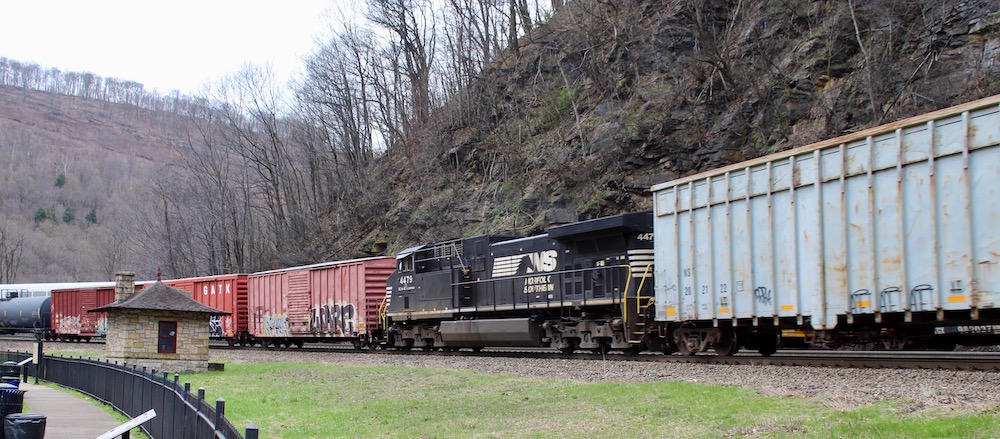
ATLANTA — Norfolk Southern has tightened its train makeup standards for long, heavy trains in order to reduce the in-train forces that can cause derailments.
The new restrictions — part of the railroad’s broader push on safety in the wake of the disastrous Feb. 3 derailment in East Palestine, Ohio — have caused significant increases in terminal dwell, slowed the merchandise and bulk networks, and clobbered on-time performance for merchandise shipments.
The railroad’s key performance and service metrics had already been deteriorating this year due to the impact of the East Palestine derailment, harsh winter weather, and a bridge outage.
NS warned customers in a March 31 advisory that service won’t improve overnight. “As the benefits of these changes materialize, we are confident we will see service improve over the next few months,” NS said.
Norfolk Southern has been under intense scrutiny since the East Palestine derailment. The Federal Railroad Administration and the National Transportation Safety Board have both launched separate investigations of the railroad’s safety practices, and two Senate committees grilled CEO Alan Shaw last month.
The railroad’s new train building guidelines come after in-train forces contributed to the March 4 wreck of a 212-car merchandise train in Springfield, Ohio, and the March 9 derailment of a 108-car merchandise train in Anniston, Ala.
NS began changing its train-building standards systemwide several weeks before the FRA issued its April 7 safety advisory calling on railroads to address the safety risks of how they build long trains.
“Since the implementation of our new operating plan TOP | SPG last year, we’ve been studying the way trains operate across our network. With safety and continuous improvement in mind, we introduced a number of operational changes in March that address the way trains are built with the goal of minimizing train incidents, including derailments, by managing potential in-train forces,” NS spokesman Connor Spielmaker says. “Trains over certain lengths and weights, for example, require the use of distributed power units. We’ve also adjusted the positioning of lighter and heavier cars to further manage weight distribution in trains, as well as the positioning of cars equipped with cushioning devices to further manage slack.”
NS merchandise trains over 10,000 feet or 14,000 tons are now required to operate with distributed power, which can reduce in-train forces. Intermodal trains, which have less slack than merchandise trains, require distributed power if their length exceeds 12,000 feet or 14,000 tons.
The train make-up rules require empty cars to be toward the back of the train and also restrict the placement of other types of cars, such as multilevels. As a result, it can take longer to build trains due to the extra switching required. If distributed power is not available, trains either have to leave tonnage behind or under certain circumstances can operate at reduced maximum track speeds, both of which reduce in-train forces.
Ultimately, NS wants to create route-by-route standards that would be more strict on main lines with grades, undulating terrain, significant curvature or a combination of these factors.
An unintended consequence of the train makeup restrictions is their impact on the railroad’s key performance metrics.
Systemwide terminal dwell increased to 32.5 hours for the week ending March 31, with cars spending more than 40 hours at six yards: Bellevue, Ohio; Birmingham, Ala.; Chattanooga, Tenn.; Decatur, Ill.; Macon, Ga.; and New Orleans. At the end of January, overall dwell was 24.6 hours and no yard was higher than 37.5 hours.
Merchandise train speed averaged just 14 mph for the week ending March 31, down 23% from the first week in March. Average velocity for unit grain trains tumbled to 13.7 mph from a year to date high of 19 mph for the week ending March 17.
On-time performance for merchandise shipments fell to 51% for the week ending March 31. The railroad entered 2023 with more than 80% of merchandise shipments arriving within 24 hours of original estimates.
Norfolk Southern’s intermodal network seems immune: Average train speed has held up, and in the last week of March was 25.3 mph, with 97% of trains arriving within 24 hours of the original estimate.
“We think NS is right to take some time to make some tough decisions and implement changes, even if it causes some short term pain, in an effort to build a more resilient platform that will benefit customers and shareholders over the longer term, but it does add to the current industry quagmire,” Loop Capital Markets analyst Rick Paterson wrote in a note to clients.
NS says it remains committed to its goals of providing consistent and reliable service over the long term.
“Last December we announced a new strategy built around reliable and resilient service for our customers as an enduring competitive advantage for Norfolk Southern. We remain committed to that strategy and confident in its execution,” NS told customers in its March 31 advisory.
Share this article