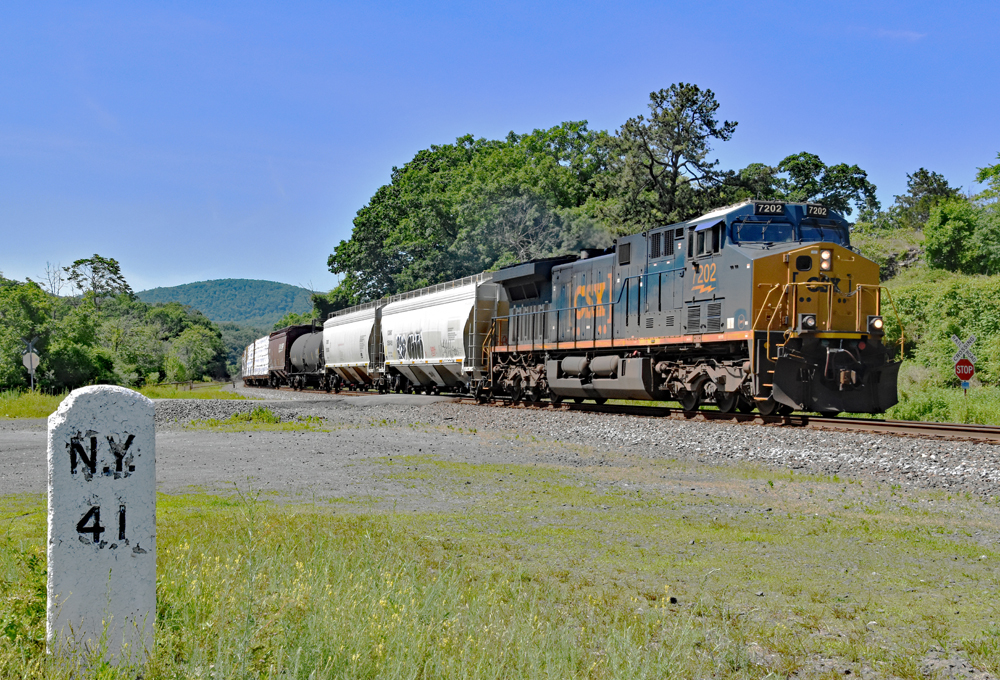
CSX Transportation is on a roll. In the past 12 months or so, nine new major manufacturing plants and one inland intermodal terminal project have been announced for sites located alongside its tracks. Many of them are the direct result of the railroad’s long-term industrial development efforts.
If there’s a theme from these wins that will drive new volume to the railroad, it’s electric vehicles.
Last fall Ford announced it will build a $5.8 billion BlueOval SK Battery Park battery plant in Glendale, Ky., on a 1,500-acre CSX Select Site adjacent to the former Louisville & Nashville main line. The plant will employ 5,000 people and will begin production in 2025. Ford also announced a massive $5.6 billion electric vehicle assembly plant, called BlueOval City, that will be built on 3,500 acres in Stanton, Tenn., outside of Memphis. It’s expected that electric F-series trucks will roll off the assembly line beginning in 2025.
In December, electric vehicle upstart Rivian announced it would build a $5 billion assembly plant in Stanton Springs, Ga., near Atlanta, that will be able to produce 400,000 vehicles per year. It’s expected to open in 2024.
Vietnamese company VinFast announced in March that it will build a $4 billion battery and assembly plant outside of Raleigh, N.C. The first phase of the complex, which will produce 150,000 sport utility vehicles annually, is expected to open in July 2024.
In May, Hyundai announced it will build a $5.4 billion battery and electric vehicle assembly plant outside of Savannah, Ga., on Genesee & Wyoming’s Georgia Central Railway, with interchanges with both CSX and Norfolk Southern. The plant will have a capacity to build 300,000 vehicles per year when it opens in 2025. While not on CSX proper, new business is new business. (This factory is not included in our tally of new facilities on CSX.)
In September, Piedmont Lithium announced it will build a $600 million lithium hydroxide processing, refining, and manufacturing facility near Etowah, Tenn., to support lithium-ion battery production in North America. The plant will be the largest lithium processing facility in the U.S. when it opens in 2025 on the CSX Select Site.
“The CSX Select Sites program helps companies identify high-quality sites that meet their development criteria, while also enabling them to reduce their carbon footprint through fuel-efficient rail transportation,” says Tom Tisa, CSX’s head of business development.
The other new CSX-served facilities in the works include steel, aluminum, paper, and beverage plants.
In February, Nucor announced it will build a $2.7 billion sheet steel mill in Apple Grove, W. Va., near Huntington. The mill will have the capacity to produce up to 3 million tons of sheet steel per year for the automotive, appliance, HVAC, heavy equipment, agricultural, transportation, and construction markets. It’s expected to be operational in 2024.
In May, Novelis announced it will build a $2.5 billion aluminum recycling and rolling plant at the 3,000-acre CSX Select Site in Bay Minette, Ala. The facility, the first fully integrated aluminum mill built in the U.S. in 40 years, will serve the aluminum can and automotive industries when it opens in 2025.
In September, Georgia-Pacific announced it will build a Dixie paper products plant on a CSX-served site near Jackson, Tenn. The $425 million plant will make paper plates. It’s expected to open in 2024.
Last month Manna Beverages & Ventures said it will build a $600 million beverage production and supply plant at a CSX Select Site in Montgomery, Ala. CSX will deliver raw materials to the complex, which will offer beverage companies packaging services, warehousing and a production facility for alcoholic and non-alcoholic drinks. The plant will open in 2025.

Also in Montgomery: The Alabama Port Authority announced in January that it will build an inland intermodal terminal that will connect the Port of Mobile with manufacturing, retail, distribution, and agricultural producers in the Montgomery area. When the terminal opens in 2024 CSX will launch scheduled intermodal service between the fast-growing port and Montgomery. The railroad is spending $12.5 million on infrastructure as part of its partnership with the port authority on the $54 million project.
The Montgomery intermodal terminal is the latest in a string of inland ports that have sprung up across the Southeast as Gulf Coast and East Coast seaports have gained container volume at a rapid clip.
What’s exciting about the manufacturing facilities is that they will bring new carload business to the railroad. Yes, the electric vehicle traffic ultimately will cannibalize existing moves of gas-powered finished vehicles. And CSX has not quantified how much traffic it expects the new facilities to generate. But if you assume that CSX can hold on to its current merchandise traffic, all of these high-volume plants coming online by 2025 will lead to the first meaningful growth in carload business on CSX in years.
That’s a big deal. CSX’s merchandise volume has fallen 27% since 2000, by far the deepest drop among the Class I railroads. CSX stopped the downward trend in 2019. Now it’s time to reverse it.
You can reach Bill Stephens at bybillstephens@gmail.com and follow him on LinkedIn and Twitter @bybillstephens
Share this article