WASHINGTON — A supervisor operating an out-of-service train lost radio communication with his flagger and did not receive a message to stop, passing a red signal and colliding with another train in a Jan. 4 incident involving two trains on New York City Transit’s No. 1 subway line, according to the preliminary accident report issued today (Thursday, Jan. 25) by the National Transportation Safety Board.
The collision and subsequent derailment near the 96th Street station on Manhattan’s Upper West Side led to minor injuries for 22 passengers and three crew members [see “New York subway trains collide at low speed …,” Trains News Wire, Jan. 4, 2024]. It shut down service through the area for more than two days [see “Full New York subway service restored …,” News Wire, Jan. 7, 2024].
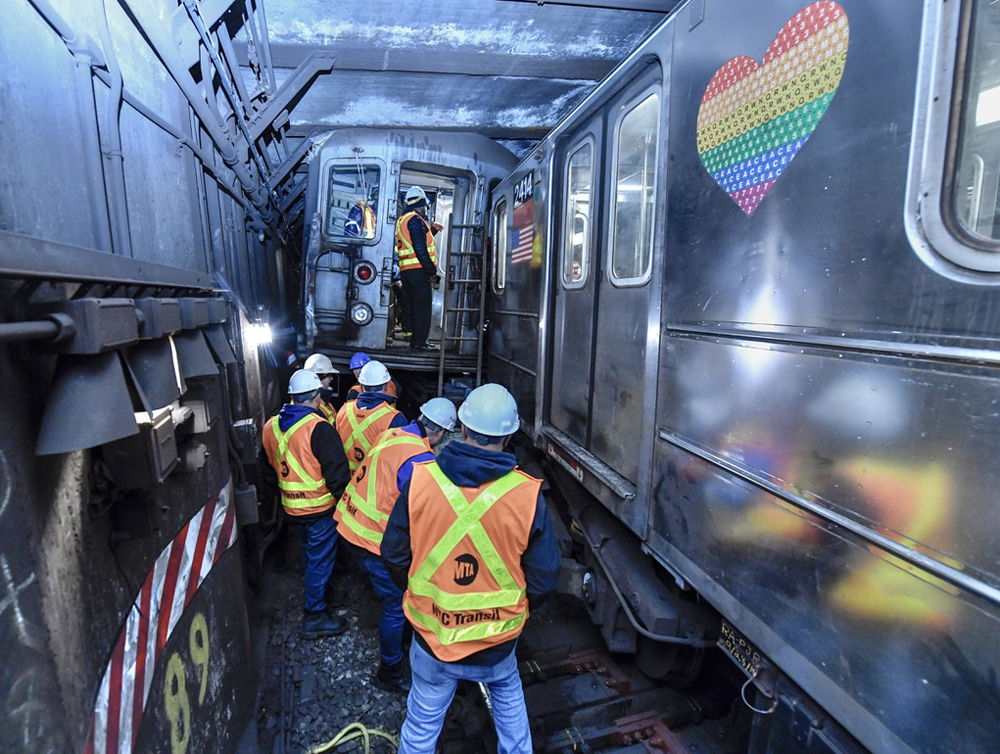
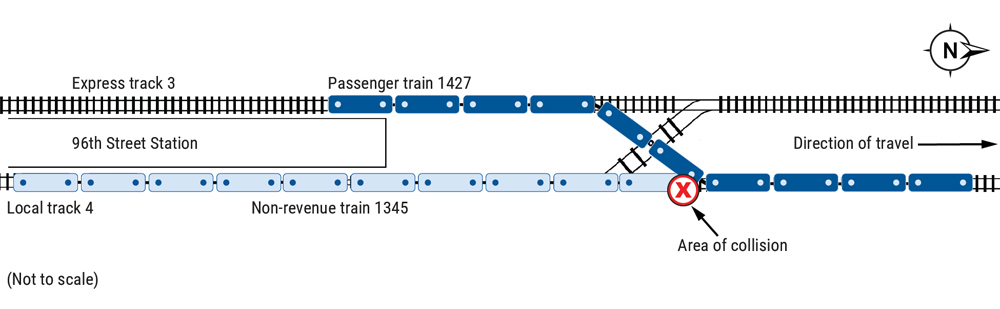
Train No. 1345 had been taken out of service after an unruly passenger pulled emergency brake cords on the train’s first five cars about 2:11 p.m., and the brakes could not be reset. After brakes and traction motors on those cars were cut out so it could be moved, the train was being operated from the sixth car by a supervisor, with a flagger in the lead car communicating by radio to coordinate the movements. But the flagger said in interviews with the NTSB that he had lost communication with the supervisor near the 96th Street station, so the supervisor did not receive his instruction to stop, and because of the brakes being cut out, the train did not activate the trip-stop mechanism that would normally stop the train when it passes a stop signal. As a result, the disabled train struck the fifth car of train No. 1427, which was crossing over from express track 3 to local track 4. A total of five cars derailed — two on train 1345 and three on train 1427.
Neither train was equipped with event recorders, cameras, or other recording devices.
The preliminary report sets basic details of the incident and is subject to change. The NTSB says its ongoing investigation will focus on New York City Transit’s operating procedures when moving bad-order cars; radio procedures; mechanical procedures when placing a revenue train in bad-order status; and the lack of federal requirements for railcar event recorders.
Share this article