BALTIMORE – The blame for ongoing railroad service problems can’t be placed entirely on cutbacks related to Precision Scheduled Railroading. The pandemic, a surge in freight demand, and a labor shortage were a recipe for disruption all on their own.
That’s the message that Peter Swan, associate professor of logistics and operations management at Penn State Harrisburg, delivered at the North East Association of Rail Shippers conference last week.

“Any system that’s designed for maximum efficiency doesn’t do well with disruption,” Swan says of railroads as well as the global supply chains that stretch across continents and oceans.
Sudden increases in demand – like the tsunami of containers landing at U.S. ports beginning in late 2020 – quickly overwhelm an optimized system and cause delays, Swan explains.
When the supply chain slows down, it results in longer trip times, which require more resources. For railroads, that means more locomotives, crews, and freight cars. For intermodal operators, that means more chassis.
Labor shortages at warehouses had an impact at ports, railroads, and intermodal terminals. Chassis that carry international containers are in short supply because of longer turn times between intermodal terminals and warehouses. “If it takes eight days instead of six days, that means you need another 30% of chassis, which we don’t have,” Swan says. “As a result, we get congestion because containers are sitting at ports, they’re sitting at rail terminals. That lowers driver productivity. So, now we need more drivers than we had before.”
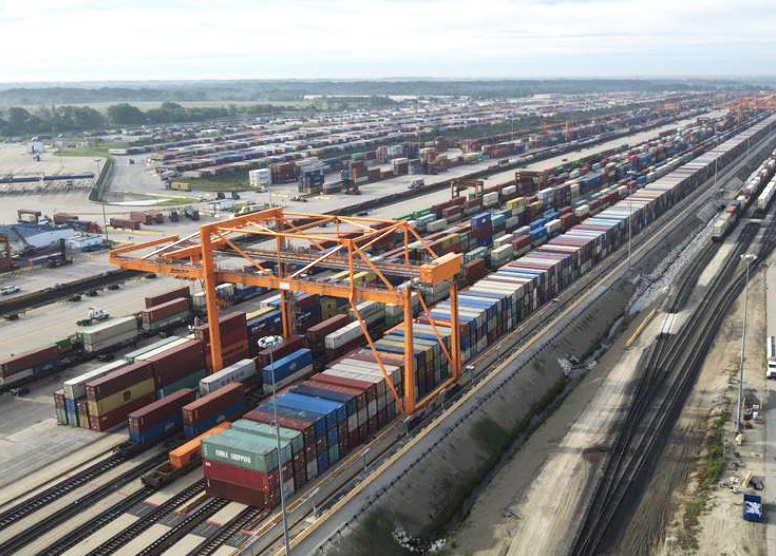
Last summer, this snowball effect produced congestion at the ports of Los Angeles and Long Beach and inland intermodal terminals, particularly in Chicago.
“Spikes in demand have overwhelmed existing capacity, and that counts for labor, that counts for equipment, and that counts for infrastructure,” Swan says. “The great resignation has made problems worse.”
A record number of Americans left their jobs last year in what economists have called the great resignation or the great retirement, which has exacerbated worker shortages. Railroads furloughed train crews as traffic sank at the onset of the pandemic, called them back slowly, and now find themselves short of crews in a tight job market.
“Labor shortages at rail are partly because the railroads laid off people, but they’re also partly because people have left and not come back,” Swan says.
Changing demographics make it likely that the tight labor market and challenging hiring conditions are not short-term issues for railroads because there are fewer young people available to take the place of retiring workers, Swan says.
Quality of life issues are becoming more important for employees, yet Swan notes that railroads are adopting more restrictive attendance policies for train crews. “It’s very difficult now for railroad crews to take time off or know when they can get time off,” he says, noting BNSF Railway’s new attendance policy, which is similar to one in place at Union Pacific.
“If the rail industry is to attract the people it needs, the bonuses like NS is offering are not going to be enough to attract and retain people,” Swan says. “They’re going to have to, at some point in the near future, address quality of life issues.”
Railroads also will have to address job satisfaction issues that arise from operational changes, Swan says. Crews are frustrated, for example, when they are headed uphill with a heavy train but aren’t permitted to fire up an idled unit in the consist and wind up stalling.
PSR: Both good and bad
Federal regulators have ordered BNSF, CSX Transportation, Norfolk Southern, and Union Pacific to appear at a two-day hearing this month on rail-service problems. Surface Transportation Board Chair Martin J. Oberman has blamed the service failures on a wave of PSR-related layoffs since 2017.
Swan, who has been a critic of PSR, doesn’t entirely agree.
“We’ve had Covid, we’ve had the great resignation which is affecting everyone, we’ve had the surge in demand. So is it PSR? Not entirely, for sure,” Swan says.
He adds: “Railroads didn’t do a great job of maintaining their pool of people. Is it their fault? I don’t know.”
Reductions in capacity – from smaller locomotive fleets and yard changes – and operational changes certainly have not helped rail service, Swan says.
“CSX is running trains now that are longer than any of the passing sidings,” Swan says, pointing to the controversy surrounding launching Amtrak service between Mobile, Ala., and New Orleans. “As a consequence, they have to fleet trains instead of having them meet anywhere. Well, they’ve reduced the capacity of that line dramatically.”
Railroads also have closed yards, turned hump yards into flat-switching facilities, and cut yard crews. “So the sorting capacity of the industry is now limited as well,” he says.
But Swan says many PSR practices are simply good management. The industry had too many hump yards. More restrictive demurrage policies have increased car velocity. And the use of longer, general-purpose trains has increased railroads’ asset utilization, he notes.
On the flip side, the reduction in crews and power limit railroads’ ability to respond to disruptions and traffic surges, he says. And reduced yard capacity has resulted in less reliable local service, partly because the use of longer road trains ties up yards and reduces the time available for switching. “This is an area where PSR, to make the linehaul part of the railroad function efficiently, has really hurt service to customers,” Swan says.
Share this article