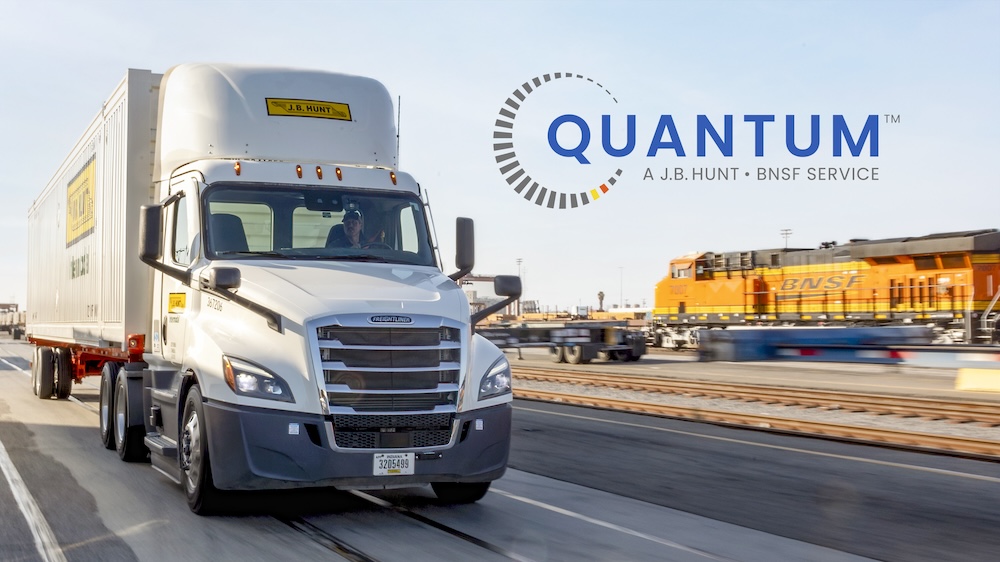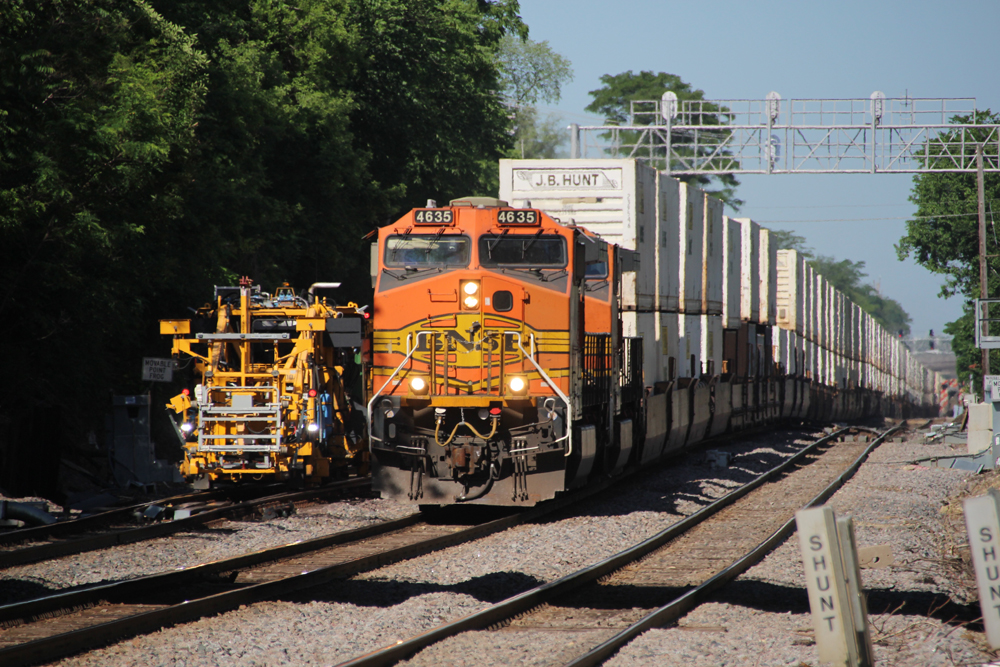
J.B. Hunt and BNSF Railway today launched faster, more reliable premium domestic intermodal service that they say will eventually convert millions of truckloads to rail.
The Quantum service — which revives a name that Santa Fe and J.B. Hunt used when they began their TOFC alliance in 1989 — shaves as much as a day from traditional schedules while offering truck-like 95% on-time performance. Flexible rates range between those of traditional intermodal and over-the-road service.
 Quantum takes aim at highly service-sensitive freight that’s never been on rails before.
J.B. Hunt and BNSF have been working to improve their core intermodal service in order to regain market share lost to the highway over the past few years of service disruptions. “Quantum is over and above that. We believe there’s been quite a bit of freight that our customers thought was too service sensitive and they didn’t want to risk service failures and … they never considered intermodal,” Spencer Frazier, executive vice president of marketing and sales at J.B. Hunt, said in an interview.
“We’re going to expand the intermodal market,” he says.
The keys to Quantum: An unprecedented level of coordination involving J.B. Hunt, BNSF, and the customer, plus transit-time customization that’s built around each customer’s needs.
J.B. Hunt and BNSF began test moves shortly after a team of Hunt employees began working alongside railroaders at a new intermodal innovation center at BNSF headquarters in Fort Worth on July 5. The tests included shipments for several customers on several intermodal lanes on the BNSF network.
“The reliability on the loads’ door-to-door, on-time performance that we’ve seen in that proof of concept is 98% on time,” Tom Williams, BNSF’s group vice president of consumer products, tells Trains News Wire. “So we’re pretty excited about the results that we’ve seen through the pilot. And we’re ready to launch this now and see more volume at scale.”
Knowing precise transit time requirements is what enables J.B. Hunt and BNSF to offer faster door-to-door schedules for each customer.
A traditional intermodal load might involve a customer moving a container from a transload center near a port to an inland distribution center. In those cases, J.B. Hunt offers a transit guide that includes some built-in flexibility on pickup and delivery times.
“With Quantum, what we’re doing is asking for the opportunity for a transit guide on something that they consider more sensitive, more specific,” Darren Field, president of J.B. Hunt intermodal, said in an interview. “And you’re highly customizing and planning on the front end. You’re going to have the order ready by time x, noon. We’re going to have a driver there to pick it up shortly after that. We’re going to make the cutoff at the front end, probably same day. BNSF is loading it on the train assigned to that transit — however we designed it. Again, it’s customized. It’s not necessarily an expedited product. It’s a product built around meeting a very specific set of parameters that the customer needs.”
J.B. Hunt will provide priority dray movements for Quantum shipments.
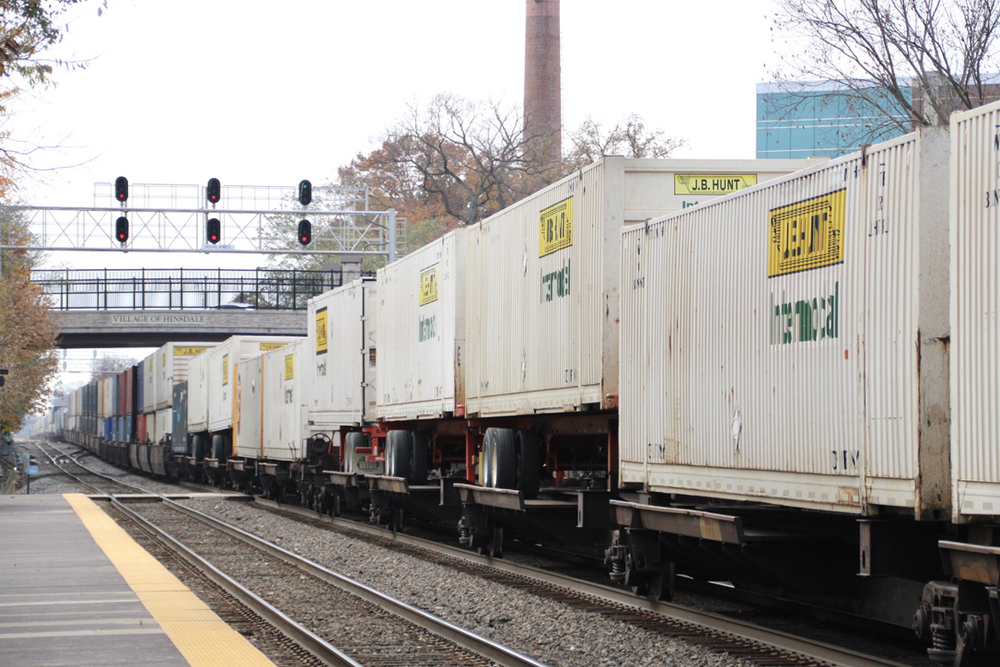
For its part, BNSF aims to provide the capacity necessary to efficiently and reliably handle Quantum loads within existing service. “We’re not planning a Quantum train,” Williams says.
“Train starts will flex on volume growth over time,” Williams says. “And so as we grow our volume we’ll add train starts, but it’s really a function of having that train capacity there so that the overall consistency and network reliability supports layering on this managed product so that we can squeeze that door-to-door transit time for the Quantum freight.”
Quantum loads will get priority in terminals, where new BNSF systems driven by artificial intelligence have streamlined the loading and unloading process. BNSF’s Load Planner Optimization tool manages the complexities of where containers should ride on each train. The system is operational at six terminals and will go live at five more next week.
“It’s important because we’ve got the service priority needs built into that optimization tool,” Williams says, noting the tech systems reduce the miles hostler rigs drive and speed track turn times. “A key piece of that is also making sure that we’re tapping into the customer service needs for the individual units.”
Based on customer reaction to the pilot program, J.B. Hunt expects Quantum volume to ramp up right out of the gate.
“We’ve been able to convert highway freight and feel like with this particular launch, and a couple other deep service designs we’re doing with customers right now, we’ll be able to expand this pretty quickly,” Frazier says.
Ultimately there are between 7 million and 11 million loads that J.B. Hunt believes can move via intermodal on the BNSF network. J.B. Hunt handled 2 million intermodal loads last year, while railroads carried 7.9 million domestic intermodal containers and trailers in the U.S. last year.
Intermodal analyst Larry Gross says the Quantum service seems to have the right combination of speed, reliability, and price to attract volume off the highway.
“Service consistency is key to unlocking potential intermodal growth. Shippers will accept that intermodal is slower than truck in order to take advantage of the savings that intermodal has to offer,” Gross says. “But the tolerance level of shippers to unreliable service is very low, because not delivering the load when promised is hugely disruptive to their operations. Trucks provide on-time service to shippers 95% of the time or more. If intermodal can provide that level of reliability while saving shippers money, many more will be willing to trust their freight to the rail and intermodal’s share of the market will grow.”
Field says Quantum could become a double-digit percentage of its overall BNSF volume in the next couple of years. No interline service is planned, but he wouldn’t rule it out if there were customer interest and a way to make it meet tight on-time performance standards. “We can certainly serve eastern markets with the drayage resources we have today, and we’re going to be constantly looking for ways to solve for our customers,” he says.
BNSF directly serves Atlanta and Northwest Ohio via haulage rights agreements with CSX Transportation, and shipments to those terminals are not considered interline moves.
Currently three J.B. Hunt employees work alongside a handful of BNSF employees at the railroad’s headquarters. Two more J.B. Hunt employees will be joining the team soon. “There’s thousands of J.B. Hunt employees and thousands of BNSF employees focused on delivering something unique,” Field says. “But that team of 10 people will just keep us all focused on the right things.”
The J.B. Hunt-BNSF intermodal innovation center in Fort Worth provides 24/7 oversight of every Quantum load. They aim to detect and resolve issues before they affect on-time delivery. Service and technology integration allow the Quantum team to identify variability and recommend an alternate solution among standard intermodal, expedited intermodal, and over-the-road options.
The unique revenue-sharing agreement between BNSF and J.B. Hunt dates to the 1989 business car handshake deal between Santa Fe President Michael Haverty and J.B. Hunt, who founded the eponymous firm, saw the potential of intermodal, and became the first trucking company to align itself with a railroad.
BNSF and J.B. Hunt in March 2022 said they would be working even more closely together in the coming years. The departure of three longtime BNSF intermodal customers for rival Union Pacific over the past two years has left J.B. Hunt as BNSF’s lone remaining truckload intermodal partner. That cleared the way for BNSF and J.B. Hunt to act like one company as they jointly look for ways to increase capacity, improve service, and convert freight off the highway.
The Quantum name and logo is a throwback to the first 150 trailers that J.B. Hunt put into service on the Santa Fe. “We like the tie in, we like the history, and we’re really looking forward to using it,” Frazier says.
The company now has 117,400 containers and plans to expand the fleet to 150,000 in the next few years.
J.B. Hunt and BNSF announced the new service this morning during a keynote at the FreightWaves F3: Future of Freight Festival in Chattanooga, Tenn.