WASHINGTON — The Federal Railroad Administration has proposed requiring the Class I railroads to provide monthly data that tracks train length and tonnage as well as the number of reportable accidents for trains over and under 7,500 feet.
The FRA, in a notice published in the Federal Register today, says it wants to use the data to better understand the impact of train length on safety and whether trains over a certain length are disproportionately involved in derailments or incidents such as stalls or a loss of communications.
The proposal springs from a pair of FRA safety advisories issued this year on train length and makeup. The non-binding advisories encourage railroads to take steps to address the complexities of operating long trains.
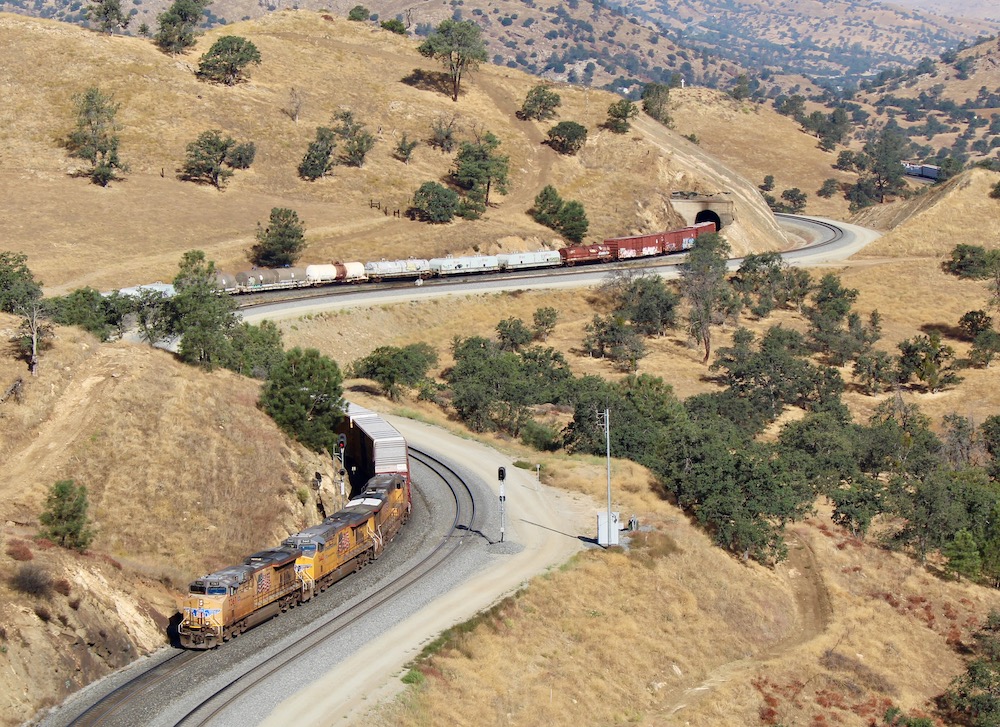
The advisories came in the wake of three derailments involving trains with more than 200 cars, a length of 12,250 feet or more, and a weight of more than 17,000 tons.
“Freight train length has increased in recent years, and while research is ongoing related to operational aspects of long trains, including brake system performance, it is known that the in-train forces longer trains experience are generally stronger and more complex than those in shorter train consists,” the FRA said in its April 27 advisory.
The data-collection proposal notes that the FRA has entered into an agreement with the National Academies of Sciences, Engineering and Medicine to examine factors associated with the operation of freight trains longer than 7,500 feet.
But FRA is concerned that train data from the National Academies study will be limited, much like a 2019 Government Accountability Office report that obtained relevant train length data from just two of the then seven Class I systems.
So the FRA wants the Class I railroads to provide detailed information every month that would include the total number of trains operated, the total number of cars in those trains, as well as the total trailing tonnage in specified train length categories, such as above or below 7,500 feet.
In addition, FRA proposes to collect monthly safety-related data such as the number of emergency events, the number of communication event losses, the number of broken knuckles, the number of air hose separations, the number of PTC enforcements, and the number of locomotive engineer certification revocations.
“Of note, FRA is seeking to collect data on train length on an ongoing basis, as opposed to this being a one-time study,” the agency says. “FRA will use the collected data to establish an initial baseline for the length of trains operating within the U.S. rail system as well as to determine if train lengths are changing over time. FRA may also use the collected data in future analyses to better understand the impact of train length on safety.”
Rail labor unions have been critical of long trains, which have reduced the number of daily train starts and therefore the number of train crews employed at the Class I systems. Unions have raised safety concerns about the handling of long trains and the dangers posed from losing communication with end-of-train devices or between the engineer and a conductor who walks to the rear of a long train in search of defects.
Long trains are operated safely every day, the Association of American Railroads notes. The Class I railroads have said that they take proper precautions when operating long trains, including following sophisticated procedures for train makeup.
Union Pacific CEO Lance Fritz has said there’s no correlation between long trains and the number of main line derailments. “On UP, since 2019 train length is up something like 20% and our mainline and siding derailments are down 26%,” he said on the railroad’s first quarter earnings call in April. “So there’s zero corollary between train length and derailments.”
Several of the Class I systems — including Canadian National, Canadian Pacific Kansas City, CSX Transportation, and Union Pacific — regularly report average train length alongside their quarterly financial results, and some report average train tonnage as well.
But the data the FRA seeks is far more detailed than what the railroads report voluntarily.
A 60-day public comment period is required before the FRA rule can take effect. Comments can be filed online.
The Association of American Railroads says it’s reviewing the proposal.
A copy of the data sheet the FRA plans to require the railroads to submit is available here.
Share this article