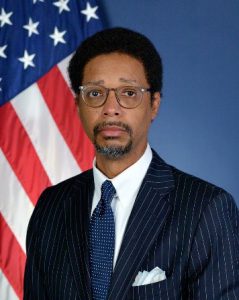
PORTLAND, Maine — Surface Transportation Board Vice Chairman Robert Primus says railroads need to improve service in order to regain traffic lost to trucks over the years.
“One of the biggest areas of concern that I have … is in the area of service,” Primus told the North East Association of Rail Shippers on Thursday. “I think there are a number of service concerns that have been around long before I’ve been on the board. There are some that have been around longer than I’ve actually been alive. I think it has challenged the network and it is impeding the network’s ability to grow beyond existing customers.”
Primus, a longtime congressional staffer who joined the board in January, said railroads need to rise to the challenge posed by more reliable trucking.
“Service has taken a bit of a back seat to operating ratios, profits, buybacks, and stock dividends,” Primus says.
“I really want to see improvements in service,” Primus says, noting he wants to work with railroads and shippers to make it happen.
Precision Scheduled Railroading is, by definition, a good thing that should improve service, Primus says. But the implementation of E. Hunter Harrison’s operating model across the industry has been a bumpy road that has led to problems for shippers and a deep reduction in rail labor.
Primus’s comments echo those made by STB Chairman Martin J. Oberman in recent months, suggesting the board may take a more activist role than it has in recent years. Oberman has been critical of Wall Street’s influence on the industry and has encouraged the Class I railroads to focus more on traffic growth and investment in the network.
The STB has a big agenda, and has talked about implementing reciprocal switching, making it easier for shippers to challenge rates, tackling Amtrak on-time performance issues on host railroads, and regulating some commodities that are currently exempt from board review.
Yet the board has a relatively small toolbox. How can the STB encourage railroads to increase capital investments, provide better service, and focus less on profit margins and more on volume growth?
“That’s the brass ring question right there,” Primus says. “We may not have the biggest toolbox, but I think we have what we need in it to help … bring about the type of change that I believe is needed to improve service, efficiency, and effectiveness, and to spur development and investment in the network.”
“There are tools that we haven’t used in the past. There are newer tools that are at our disposal that we can utilize. And I want to use them all. I do. My goal is to improve the network, enhance the network while I’m there,” he adds.
“My job is actually to get under the hood, take the tools that we have, and try to supercharge this effort to get it moving. Some things people won’t like. Some things people will like. I’m open for that debate and that dialogue,” Primus says.
Independent analyst Anthony B. Hatch, who addressed the NEARS conference on Friday, was critical of the direction the STB is heading.
Board members are smart and personable people who don’t understand economics well and certainly don’t understand investors, Hatch says. Implementing some form of reciprocal switching, for example, would be a disincentive for railroads to invest in their physical plants, Hatch says.
Hatch also said the board’s criticism of PSR was off the mark. The Canadian railways, which implemented PSR first, are growing and provide good service, he notes. The big three U.S. systems that have adopted PSR – CSX Transportation, Norfolk Southern, and Union Pacific – would have pivoted to growth last year if not for the economic disruption caused by the pandemic, Hatch contends.
Share this article