WINNIPEG, Manitoba — A track subgrade consisting of soft, saturated peat with poor drainage likely led to a sudden failure of that subgrade, triggering a derailment of 53 cars of a Canadian Pacific grain train near Ignace, Ontario, in May 2020, the Transportation Safety Board of Canada indicated in an accident report released Tuesday.
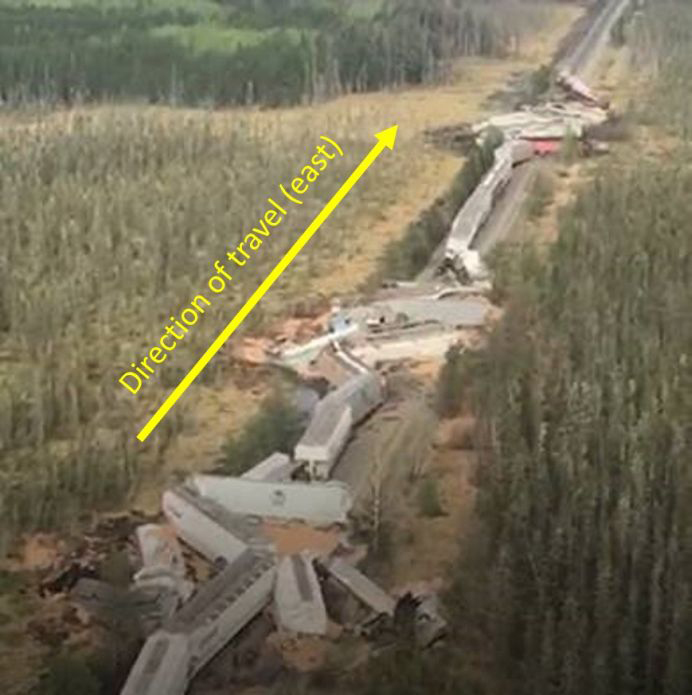
Operating a heavy unit train over such track may have contributed to the incident, the report also suggests.
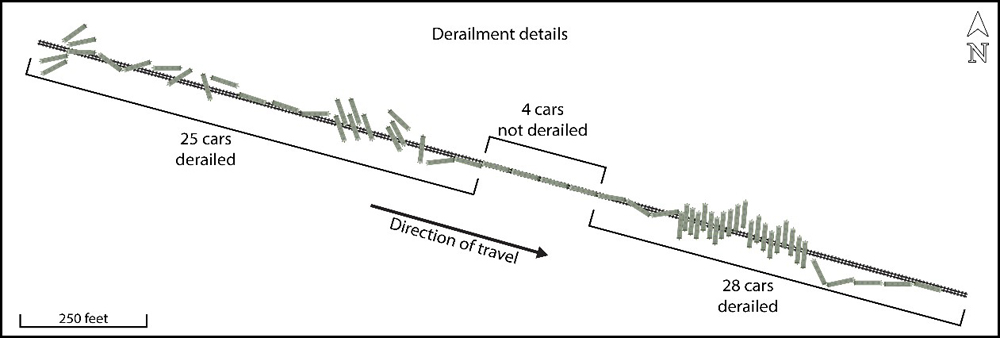
The May 25, 2020, derailment involved a train with two head-end locomotives, one mid-train distributed power unit, and 222 loaded grain hoppers. The train weighed 30,307 tons and 12,896 feet long, and was traveling at 46 mph at the time of the derailment. The train separated after the 26th car, with 28 cars (in positions 27 to 54) derailing, followed by four cars that remained on the track, and 25 more that derailed. About 1,600 feet of track was damaged or destroyed.
While the subgrade failure was the likely cause of the accident, the report also found that the operation of unit trains of loaded high-capacity cars created longer periods of loading and “provided little opportunity for the elastic recovery of this track with geometry anomalies, accelerating the deterioration of the inherently unstable track upgrade.”
The report also notes that inspection procedures and technologies based on surface observations cannot measure subgrade conditions, increasing the risk an impending subgrade failure will not be detected. It also said a train with a tail-end remote locomotive reduces in-train forces during emergency braking more effectively than one with a “sense and braking” unit, which requires more time to communicate an emergency braking signal.
As a result of the derailment, CP performed work to stabilize the track embankment and modified its use of distributed power on grain trains of 224 cars, adding a tail-end remote locomotive as a fourth unit in a 2-1-1 power configuration.
Share this article