





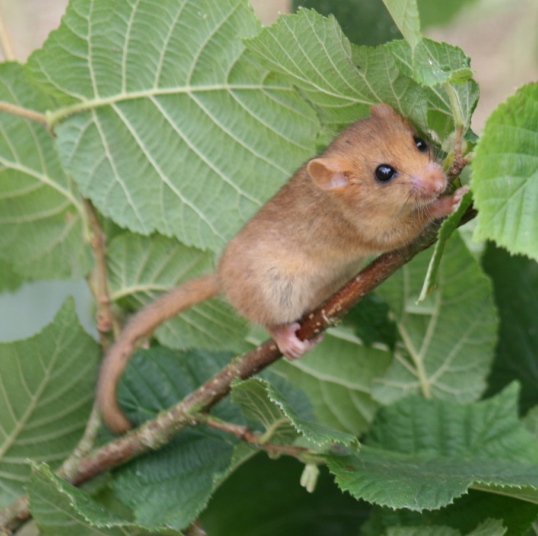
LANCASHIRE, England — Wildlife bridges are sometimes built over major highways at select locations in North America, trying avoid collisions between vehicles and animals that are often fatal to the wildlife and sometimes to drivers, as well. In Canada’s Banff National Park, such bridges have seen significant use by bears, moose, and elk.
In England, plans have been announced to build a bridge over a rail line to protect a somewhat smaller creature: the hazel dormouse.
Network Rail, the owner of most of Britain’s infrastructure, has announced plans to build a tiny crossing over its Furness line in Lancashire in northwest England, in an effort to save the endangered mammal from extinction. The £40,000 (about $52,900) project will build a 12-meter long treetop structure, shielded to provide protection from predators, on the side of an existing overpass. It will connect two areas chosen to establish new populations for the dormouse, which is about 3.9 inches in length (6.3 inches with tail) and weighs about an ounce. The dormouse population has decreased by more than 50% since 2000.
“We hope that this new bridge will enable two neighboring populations to create a local metapopulation in the area, which will really to help bring this rare and beautiful species back from the brink,” Ian White, dormouse and training officer at the People’s Trust for Endangered Species, said in a press release. The organization is partnering with Network Rail on the project. Network Rail senior sponsor Rory Kingdon said the company was “delighted” to take part in the project so the dormice “have a fighting chance to thrive for generations to come.”

I clicked on this article purely to see what Mr. Landey’s comment was going to be. Impressive effort on his part.
I’ll second that. Oh wait, Rupert, Gary, and Anthony got there ahead of me.
It’s their money, so what.
LOVE your humor Charles, well done!
Maybe one of these days Mankind will be on this list, people always thought it would be nuclear war perhaps Covid will lead to our slow demise. Oh well, we’re just as insignificant as those species others scoffed at their passing.
Charles perfect!!!! You said exactly what I was thinking. Maybe we could name the head of the mouse council Herman Vermin.
Establish a neighborhood council of the hazel doormouse community to review the design of the bridge and to liaison with the underrepresented doormouse communities and to tutor doormice on the use of the bridge. Set aside a minimum of 50% of the project budget for the council’s expenses and gratuities.
The council shall be inclusive of all colors of hazel doormice and affirmatively include representatives of the LGBTQ++ doormice communities.
Ongoing, hire underprivileged doormice, two per shift 24/7/365, to guide the population over the bridge from each end. Salary will be the prevailing wage plus full benefits. Prevailing wage is defined as 2.5 times UK minimum wage.
Network Rail to survey the population count of hazel doormice and to fill out the appropriate census forms weekly with copies to wildlife preservation authorities in Lancaster, in London, and at the United Nations.
Prince Charlie Chuck (or maybe by that time King Charlie Chuck) to attend the bridge dedication and to be the first hazel doormouse to officially and ceremoniously cross the bridge.
You grew up on Monty Python, didn’t you? That, sir, was brilliant!
YEP! Brilliant!