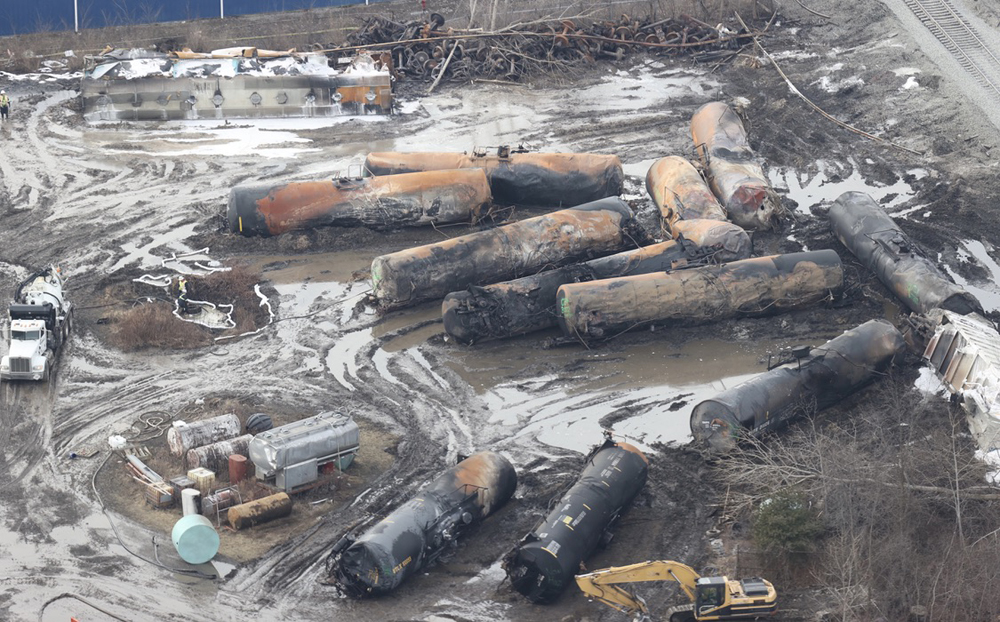
WASHINGTON — The U.S. Department of Transportation will propose a number of new rail safety initiatives on Tuesday in the wake of this month’s fiery derailment of a Norfolk Southern train that was carrying hazardous materials in East Palestine, Ohio.
Trains News Wire has learned that Transportation Secretary Pete Buttigieg on Feb. 21 will call on railroads to immediately take five steps he says will improve safety, including requiring the faster phase-out of older tank cars; providing state emergency response officials with advance notice of hazardous materials shipments through their communities; and deploying new inspection technologies without seeking permission to scale back inspections performed by rail workers.
Railroads also will be urged to join the Federal Railroad Administration’s Confidential Close Call Reporting program, which provides protections to workers who report safety concerns. The Class I railroads also will be asked to provide rail workers with paid sick leave, something that CSX Transportation and Union Pacific have already begun to do with some of the unions representing their workers.
“Profit and expediency must never outweigh the safety of the American people,” Buttigieg says in a statement. “We at USDOT are doing everything in our power to improve rail safety, and we insist that the rail industry do the same — while inviting Congress to work with us to raise the bar.”
Separately, DOT will pursue further rulemaking, to the extent that it can, on electronically controlled pneumatic (ECP) brakes for high-hazard flammable trains, defined as those transporting 20 or more loaded tank cars of a Class 3 flammable liquid in a continuous block, or a single train carrying 35 or more loaded tank cars of a Class 3 flammable liquid throughout the consist. Buttigieg has been critical of Trump-era regulations that he says have tied DOT’s hands on certain rulemaking matters.
DOT will step up inspections on rail routes that carry high-hazard flammable trains and trains that carry a significant amount of hazardous materials. It also will begin an inspection program that focuses on legacy tank cars and the railroads and shippers who have not yet upgraded to safer DOT-117 tank cars.
The agency also will advance its proposed train crew staffing rule, which calls for a minimum of two crewmembers for most railroad operations, and use federal programs under the Bipartisan Infrastructure Law to modernize and improve tracks, eliminate grade crossings, and improve rail safety.
Buttigieg will call on Congress to take five steps to improve rail safety. They include passing legislation that would:
- Allow DOT to increase maximum fines that can be imposed on railroads for violating safety regulations.
- Strengthen rules covering high-hazard flammable trains.
- Modernize braking regulations and “increase the use” of ECP brakes. (ECP braking systems are currently not in use.)
- Speed up phase-in of DOT-117 tank cars. The deadline is currently 2029.
- Increase funding for hazardous materials training for first responders.
DOT is scheduled to announce the safety push at 5 a.m. on Tuesday.
If the raft of new regulations ultimately winds up on the books, it will put the East Palestine derailment in the same category as other disasters that changed the regulatory landscape. They include Chase, Md. (locomotive engineer certification and mandatory drug testing); Chatsworth, Calif. (positive train control); and Lac Megantic, Quebec (stricter hazmat and tank car rules).
Share this article