

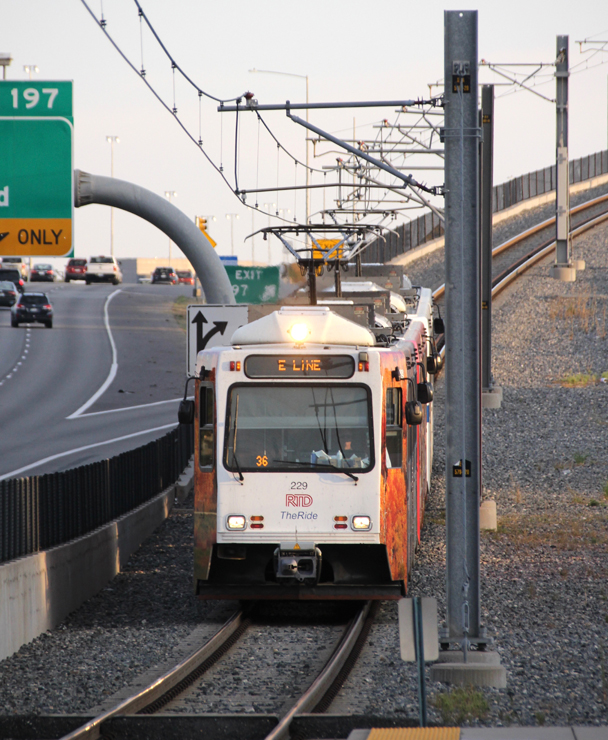
DENVER — The Regional Transportation District will temporarily cut light rail service to one train per hour on some lines as of May 26, the Denver Post reports, saying the reduced frequencies are necessary to address maintenance that has been deferred, but risking abandonment for cars by riders who have that option.
Many of the changes approved late Tuesday at an RTD board meeting are to accommodate a $152 million rebuilding of the light rail system’s downtown loop [see “Major reconstruction project to halt light rail service …,” Trains News Wire, Feb. 29, 2024], but some are permanent service cuts.
The moves approved include:
— Reduced service on the E and H lines, from Denver to its south suburbs, from the current 15-minute frequencies to hourly until Sept. 2.
— Suspension of the L Line, a short route running from the downtown loop to the Five Points area to the northeast, until Sept. 2.
— Rerouting of the D and H lines to Union Station while the downtown loop project is in progress.
— Reduced light rail hours, with most service beginning about 5 a.m. and ending about midnight on weeknights (2 a.m. on Fridays and Saturdays). Currently, service begins at 4 a.m. to 4:30 a.m.; the RTD had proposed ending weeknight service at 10 p.m. and weekend trains at midnight.
— Bus schedule changes on multiple routes.
Board chair Erik Davidson told the Post the moves are about the RTD’s need to “maintain a safe and reliable system in a state of good repair,” but James Flattum of advocacy group Greater Denver Transit told the newspaper, “having a high frequency is the most important thing for making public transit competitive with other modes of transportation. We may be seeing the erosion of habits and routines that were built over decades in just a few months.”
Share this article