BALTIMORE – If you buy a Florida-grown watermelon in the New York City area, there’s a good chance that it rode a CSX Transportation intermodal train from the Sunshine State to the Northeast.
CSX has become the largest hauler of Florida watermelons to the Northeast thanks to a year-old experiment dubbed CSX Greenway, a premium door-to-door trailer-on-flatcar service.
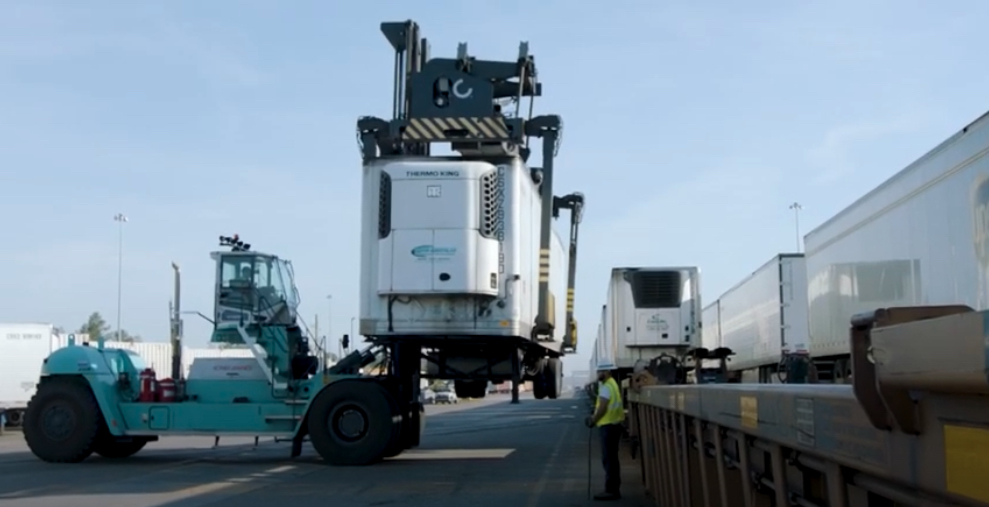
Today CSX is operating a fleet of more than 100 refrigerated trailers that carry produce, frozen food, and agricultural products grown or produced in Florida and southern Georgia. The trailers with CSXZ reporting marks ride trains I031 and I032 between Jacksonville, Fla., and North Bergen, N.J.
“Greenway Combines reliability of trucking with the economic advantages, capacity, and sustainability of rail,” Farrukh Bezar, the railroad’s senior vice president and chief strategy officer, told the North East Association of Rail Shippers last week.
CSX wants to expand the service, and test it in other lanes outside the I-95 corridor, but there’s a lag time for trailer orders due to ongoing supply chain disruptions.

“The plan is to continue to grow the business. The genesis behind it was how do you connect Florida to the consumption markets of the Northeast? For those of you who understand the trucking market, Florida is a nightmare for trucks,” Bezar says.
The state is overwhelmingly a consumption market, so truckers who bring southbound loads to the state rarely find backhaul loads for their return trips north.
CSX aims to haul loads in both directions, with produce northbound and temperature controlled goods or dry consumer goods moving southbound.
The small farmers and growers who use the service are attracted by rail’s environmental advantage over trucks. “They are very concerned and consumed with lowering their carbon footprint,” Bezar says.
The I-95 corridor along the East Coast is an underpenetrated intermodal market, partly because CSX can’t use more efficient double-stack trains due to the clearance restrictions of the Howard Street Tunnel in Baltimore. A clearance project is expected to be completed in late 2024, however, which will allow the railroad to better compete for business.
“We don’t take advantage of the I-95 corridor the way we should and could as a company,” Bezar says. “If you ever ride in your car from Miami up to Boston … you’re sitting in traffic all the time behind trucks. It’s amazing how many trucks are on the highway.”
Share this article