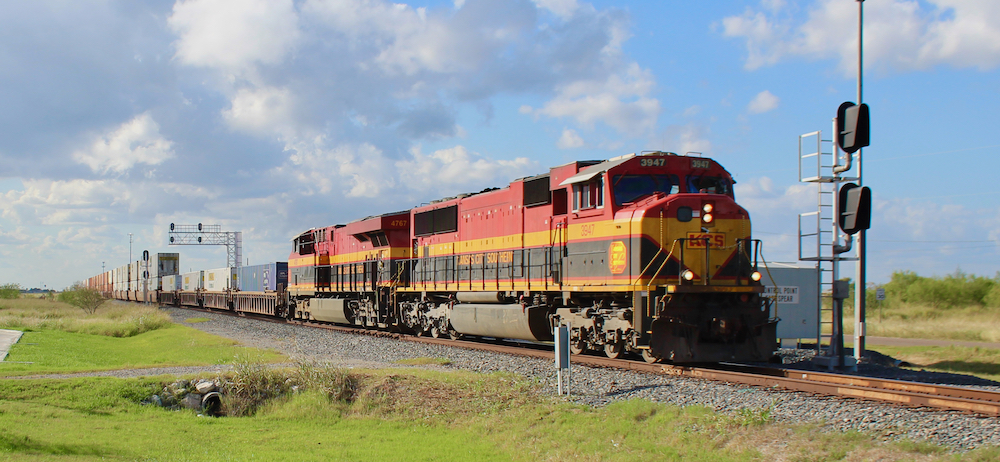
CALGARY, Alberta – CPKC has landed a multi-year contract to handle Schneider National’s intermodal traffic between the U.S. and Mexico.
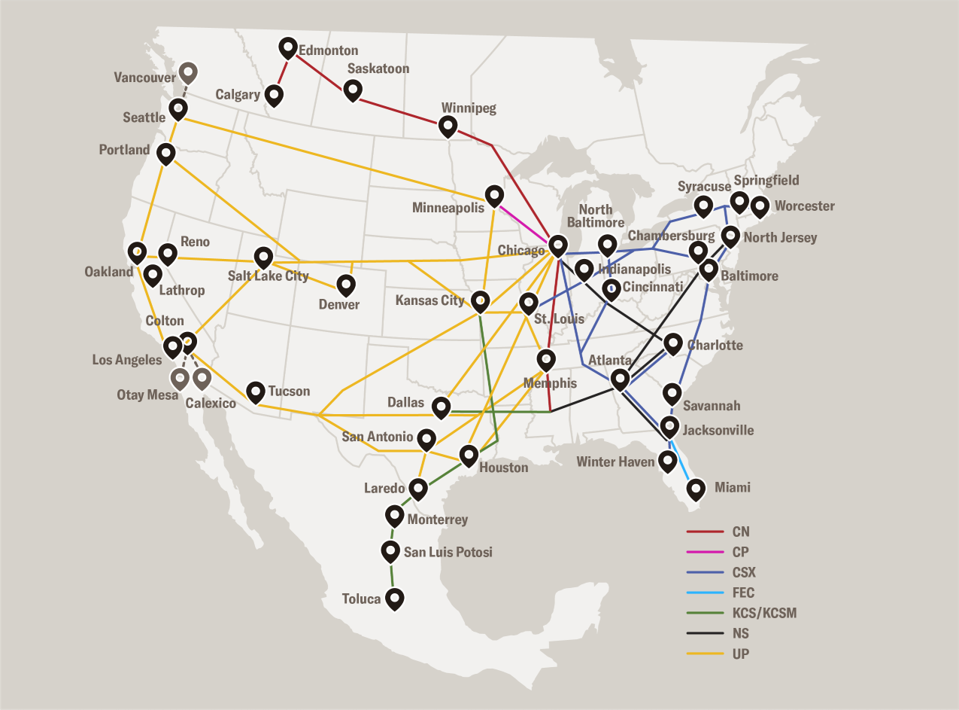
The announcement today – which comes just a week after the Canadian Pacific-Kansas City Southern combination became effective – backs up pre-merger projections that CPKC’s single-line service would enable it to compete in the Chicago-Mexico corridor that’s dominated by Union Pacific and BNSF Railway.
“The CPKC combination creates compelling new transportation solutions for Schneider’s current and future customers looking for more reliability and increased capacity in their supply chains,” CPKC CEO Keith Creel said in a statement. “Our team is eager to deliver truck-competitive services to Schneider on our newly created, cross-border single-line network from Mexico into the United States.”
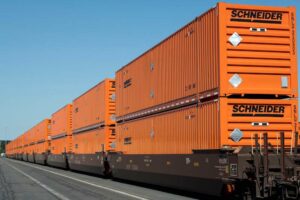
In March, Creel told an investor conference that the first new service CPKC will launch is a cross-border intermodal train linking Chicago and Mexico City. It was expected to begin service in late April or early May.
“It is a natural fit to pair CPKC’s rail operating excellence and Schneider’s superior dray execution to provide unparalleled service,” Schneider CEO Mark Rourke said in a statement. “Our 30-plus years operating in Mexico and broad portfolio of services will bring an intermodal service offering into and out of Mexico that is comparable to the speed and efficiency of shipping over the road, but with the added benefit of sustainability.”
KCS already handled Schneider intermodal traffic on its network. Schneider on Jan. 1 shifted its western intermodal traffic to UP from BNSF. Schneider currently reaches the Laredo, Texas, border crossing via both UP and KCS, according to its current intermodal network map. Schneider relied on CP in the Chicago-Twin Cities lane.
Schneider and CPKC said the first single-line service between the Midwest and Mexico will improve the reliability of cross-border intermodal.
“A single-line move all the way has a lot of attraction because it’s under control of one railroad,” intermodal analyst Larry Gross says, even though the CPKC route is longer and has more curves and grades than UP and BNSF routes. “It matters a whole lot more about how consistent the service is than how fast it is.”
CPKC has said its transit time will be truck-competitive and that it expects to gain nearly 138,000 containers annually that currently move on other railroads in the north-south corridor.
“CPKC will shake things up and force everybody to raise their game,” Gross says. “It’s an opening salvo.”
CPKC’s International Railroad Bridge over the Rio Grande at Laredo offers an alternative to congested highway ports of entry. A second span to expand CPKC’s cross-border capacity is under construction and expected to be completed by the end of 2024.
About 16,000 trucks cross the border at Laredo every day compared to just a few hundred intermodal containers, which CPKC executives have said represents a major growth opportunity.